Tuesday, September 13, 2016

Belgian study finds euthanasia deaths are continually increasing. Researchers fail to look deeper into the data.

Alex Schadenberg
Executive Director - Euthanasia Prevention Coalition


The Journal of the Canadian Medical Association (CMAJ) just published the most recent study concerning Belgian euthanasia data titled: Euthanasia in Belgium: trends in reported cases between 2003 and 2013.

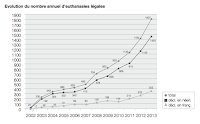
According to the study, researchers examined all reported euthanasia deaths in Belgium from Jan 1, 2003 to Dec 31, 2013 representing 8752 euthanasia deaths. The study found that the number of euthanasia deaths increased yearly from 235 in 2003 to 1807 deaths in 2013. The study concluded:
The practice of euthanasia in Belgium has increased year by year since the introduction of legislation in 2002. An increase in cases often considered as more controversial, such as those involving neuropsychiatric conditions, has also occurred, although such cases remain a small minority. 
One would assume that a "comprehensive" study, such as this one, would uncover new data and information. Sadly this study rehashes the same data by researchers who are known as the "official" Belgian euthanasia researchers.

This study lacks depth in research and analysis.

For instance, there were 1807 reported euthanasia deaths in 2013 in Belgium, and yet the study Recent Trends in Euthanasia and Other End-of-Life Practices in Belgium that was published in The New England Journal of Medicine (NEJM) (March 19, 2015) found that 4.6% of all deaths in the Flanders region of Belgium were by euthanasia and an additional 1.7% were assisted deaths without request.
This study does not examine facts the unreported assisted deaths, that represented almost half of the assisted deaths in 2007 and 2013 in Belgium and the study does not examine the clinical circumstances or the reasons for requesting euthanasia. The study states:
The data provide insight into only those euthanasia cases that were reported. Previous research, conducted in 2007, showed that about half of all euthanasia cases in Belgium were reported to the committee and that unreported cases were generally dealt with less carefully than reported cases. In addition, this study was based on an analysis of secondary data collected as part of the mandatory notification procedure. Details about the patients’ clinical circumstances and the precise nature of the suffering that caused them to seek euthanasia were not recorded in the database.
The study admits that the unreported euthanasia deaths are "generally dealt with less carefully". A study published in the British Medical Journal (BMJ) concerning unreported assisted deaths in Belgium (2007) determined that unreported assisted deaths represented a different demographic group than the reported assisted deaths. The study states:
"However, in a bivariate analysis there was a significant relation between reporting euthanasia and the patient's age, with deaths of patients aged 80 years or older reported significantly less often than deaths of younger patients."
A study published in the CMAJ found that 32% of all assisted deaths in Belgium (2007) were done without explicit request. That study indicates that the assisted deaths without request are rarely reported and were more likely done to:
"patients 80 years or older who were mostly in a coma or had dementia."
The CMAJ study concludes:
"this fits the description of "vulnerable patient groups at risk of life-ending without request."
We need research that uncovers new information, not rehashing the same data.

We did not need another study examining the same basic data concerning the reported euthanasia deaths in Belgium. We need a study that examines the unreported euthanasia deaths and we need a studies that examine the clinical circumstances and the reasons for requesting death by lethal injection. 

We know that people requesting euthanasia are often depressed. We need studies examining these cases. We need to determine when or if euthanasia has become a form of abandonment of people at the most vulnerable time of their life.

We already know that there has been a continuously expanding number of deaths and reasons for euthanasia. We need to know how certain groups, such as people with dementia and other people who are incapable of requesting euthanasia are treated and we need to know if they have become vulnerable in a culture that believes that some lives are not worth living.

For a thorough examination of the data related to the assisted deaths without request and unreported euthanasia deaths in Belgium and the Netherlands purchase the book: Exposing Vulnerable People to Euthanasia and Assisted Suicide written by myself.

Further reading on this topic:

Monday, September 12, 2016

Assisted Suicide: The Musical

Alex Schadenberg
International Chair, Euthanasia Prevention Coalition

Liz Carr in Assisted Suicide: The Musical.
Liz Carr, the incredibly funny British comedian, actress and disability activist, is now also the creator of the production - Assisted Suicide: The Musical, that is playing at the Scotiabank Centre in London England.

Ben Cowles, with Morning Star, a socialist daily newspaper, interviewed Carr on the musical production. Cowles provides context and history related to Liz Carr.
A common assumption among liberals is that only the deeply religious or wildly conservative would oppose such a thing. Not so. 
A prominent campaigner and defender of disabled people’s rights, Carr has worked tirelessly to highlight the struggles her community faces including against the brutal austerity measures the previous coalition government introduced and heedlessly continued by the Tories. 
While society debated the assisted dying Bill last year, Carr tells me she spoke at Marxism conferences, talked to both the Labour and Tory parties, and even, she somewhat embarrassingly admits, wrote to Cameron. “Do you know what that took for me to do that? I prostituted myself because I knew he watched Silent Witness.” She shudders at the memory. “I used myself.”
Carr comments on the timing of the musical, exactly one year after the defeat of the assisted suicide bill in Britain.
“Nobody could have planned that,” Carr says on the cosmic coincidence of the musical being held on the anniversary of the Bill’s defeat. “It feels right, but not in a gloating way. This isn’t a thing where there’s winners and losers.”
Carr shares how she became involved with opposing assisted suicide.
In 2006 she was working on the BBC’s Ouch Podcast, a satirical show which discussed disabled people “in a way that hadn’t been done before.” 
Whenever the BBC needed a spokesperson on disability issues during that time, Carr says the producers would often seek out the Ouch presenters. “When it came to talking about assisted suicide, I got asked to do a few things. So I went from generally being interested in this topic to being invited onto shows like Newsnight.”
The article continues by covering some principles Carr follows in opposing assisted suicide.
You might have noticed that Carr does not use the term assisted dying.  
“I call it assisted suicide because, whatever your reason for wanting to end your own life, it’s called suicide. That’s not judgemental, that’s just what it is. When you call it assisted dying, I think that’s a political move to make it sound more anodyne.” 
Her opposition to assisted suicide is not religious or spiritual or even moralistic. In fact, Carr clarifies, “I am not in principle against supporting people to end their life, but I am in reality. There’s the moral, what we think is a good idea, and then there’s pragmatism.” 
“It maddens me that at a time when the NHS — the beloved, the fallible, the overstretched NHS — is in crisis that we are considering giving them the power to assist some people, not everyone, to end their lives. 
“At the moment it’s a choice between lying on a stretcher in a corridor, being denied the drugs you need to extend your life because the government can’t afford them, or wanting to die at home. But you can’t have that because there’s not palliative care and hospice care isn’t on the whole supported by the state.”
Carr then challenges the concept that assisted suicide is about choice and autonomy:
“If this is about autonomy, then surely handing over the decision of whether a doctor will help you end your life to a government is to lose autonomy, and this is a government we don’t trust. 
“No-one has true autonomy anyway. It’s a laudable value to have as human beings, but it’s linked to wealth and privilege, and as long as we live in a world where people do not have choice over their lives, then don’t talk to me about having choice in death. 
“Until we value ill, older and disabled people as equals; until there are no more hate crimes; until their deaths or murders are no longer portrayed or perceived as mercy killing, and until there’s real equality and validity for those groups of people, then maybe we can have that conversation. But we are not mature enough as a society to let licensed doctors end some people’s lives.”
Not Dead Yet UK demonstration
Carr then comments why people with disabilities oppose assisted suicide:
“One thing stands out to me whenever I see documentaries or news stories on the topic is that they usually show the disabled or ill person looking incredibly vulnerable, usually semi-naked, having something done to them like being bathed, as if they want to show the indignity of that.” 
For Carr it seems as though the media wants able-bodied viewers to put themselves in the disabled person’s shoes and to think: “If I couldn’t wipe my bum, if I couldn’t pee on my own, I’d want to end my life. 
“And that’s the tragedy for me. The press and many of the public will say that assisted suicide is a brave thing to do. 
“And often they show someone in a hoist where you’re suspended and exposed. I think it’s perceived as probably the most dependency-creating and humiliating piece of equipment, far more than a wheelchair, because you’re probably naked and being hoisted either from the bed to the toilet or the shower, so there’s an inevitable intimacy. There’s nothing inevitable about needing a wheelchair or a hoist that means your dependent. It’s the perception we’ve put on it.”
Cowles asks Carr why she decided to produce a musical on assisted suicide:
“Music is used to tell us how to feel about something. So you would watch these documentaries and there would be the saddest music and it was somebody looking out at the world going by. 
“But there’s something about the clapping along at a musical — you see I love a musical; I love being told what to think, weirdly. 
“I struggle with regular theatre because it’s too confusing. But with musicals, I’m guided through and I like that because I know what to feel through the music more than listening to the words. 
“You can be clap, clap, clapping along to almost anything and you don’t realise what you’re clapping along to. I like that because, with assisted suicide, the majority of people are clapping along, thinking this is a great idea but they’re just going along with everybody else rather than thinking for themselves. 
“And then I got really excited about the idea of a chorus song of people on hoists, and then the musical was born.”
The article ends with Carr explaining who she hopes to influence with Assisted Suicide: 
The Musical.
As with anything political, there are people on both ends who feel very strongly about the legalisation of assisted suicide. But it’s the people in the middle, the “people who by default think assisted suicide is surely a good thing to have,” that Carr hopes the play will speak to. “It’s those people to whom I want to say, ‘This is more complicated and more nuanced than I think we’re presented with in the press.’” 
“The problem with disability is social oppression, not disability. The solution to that is not to kill a person; it’s not to give them easy access to end their life. It’s to look at the reasons why that person wants to end their life. And are we doing everything we can? 
“I don’t have all the answers, but I hope the show provokes thought and debate. And as a performer I hope we give them a really good show.” 
Assisted Suicide: The Musical will be shown at the Royal Festival Hall.
You should also read the Liz Carr interview that the Guardian published about - Assisted Suicide: The Musical titled: Legalising assisted dying is dangerous for disabled people. Not Compassionate.
 

Saturday, September 10, 2016

Legalising assisted dying is dangerous for disabled people.

This article was written by Liz Carr and published in the Guardian on September 9, 2016. 

Liz Carr as Clarissa Mullery
Liz Carr is a disability rights leader with Not Dead Yet UK and an actress. She is Clarissa Mullery in the long-running BBC crime thriller series Silent Witness.

By Liz Carr


If I said I wanted to die, the press, celebrities and the public would support my choice, seeing it as rational and understandable. Hell, they would probably set up a go-fund-me campaign to help me make it happen.

Yet when a healthy, non-disabled person wants to kill themself it’s seen as a tragedy, and support and prevention tools are provided. If nothing else convinces me that to legalise assisted suicide is not a safe option for many of us then this does. Suicide is not seen as socially desirable – so why is assisted suicide seen as compassionate when it’s for ill or disabled people?

Marieke Vervoort, the 38-year-old Belgian Paralympian gold medallist, is only the most recent disabled person to announce that she is considering euthanasia, saying her “body is exhausted”. She is not imminently dying. Yet no one seems to be trying to persuade her that life is worthwhile. Would Usain Bolt be met with the same reaction if he announced his decision to end it all after his last Olympics?

Although proponents of assisted suicide legislation say it’s only for those with six months or less to live, they propagandise with cases like that of Daniel James, the 23-year-old man paralysed (but not dying) following a rugby accident, who killed himself at the Swiss clinic Dignitas after he said he did not want to live a “second-class” (that is, disabled) life. Jeffrey Spector, a 54-year-old man also not imminently dying, also killed himself at Dignitas.

The Netherlands, which legalised euthanasia to provide relief for the terminally ill, now regularly provides euthanasia for disabled people who can demonstrate “unbearable suffering”. Canada, the most recent nation to legalise euthanasia and assisted suicide, allows it for “serious and incurable illness, disease or disability”.

Usually, the two sides of the argument are characterised as “religious” (opposed to legalisation) or “secular” (in favour). But it’s not that simple.

NDY September 2015 rally
Frustrated by the lack of opportunity to have the voices of people like me – of disabled people – heard on this issue, I have decided to combine my activism with my career as a performer.

I’ve never seen a piece of art or theatre which expresses opposition to legalising assisted suicide from a disabled person’s perspective – so I decided to try to rectify that. The result is Assisted Suicide: The Musical – a show which premieres this weekend at the Royal Festival Hall, London, and marks the first anniversary of the defeat of the assisted dying bill in parliament.

There were of course religious people there with me and many others outside Westminster, on Friday 11 September 2015. But MPs who glanced out the window would have seen more Not Dead Yet (NDY) T-shirts and banners than religious ones. NDY is made up of disabled people opposed to a change in the law. Every major disabled group in the UK, it should be stressed, is opposed to this legislation.

Suicide is, of course, an individual choice. Disabled people who are determined to take their lives may even find it easier to do so than abled people, given the often precarious nature of their existences. But that does not mean that when a fellow human being – disabled or abled – expresses the wish to die because their life is shit, that we should agree with them. The value of a life is not just in its physicality but in our relationships with those around us.

The bill, had it passed, would have licensed doctors to assist in the deaths of terminally-ill people who had less than six months to live, were mentally competent and requested such assistance. But the direction legislation has taken in other countries shows that the sympathy we disabled people evoke can be used to justify support for us to kill ourselves while non-disabled people are told they have “everything to live for”. How many times has someone come up to me and said how much they admired me just for existing because they could not, in my condition?

There is a fine line between those who are terminally ill and those who are disabled in public perception and the emotional power behind the campaign for assisted suicide is based on misplaced pity. Rather than telling us we have everything to live for – and we do – we are helped to the proverbial cliff edge and offered a push.

People – disabled and not, with many years or only a few months ahead of them – become suicidal for many, many reasons. We know from surveys in Oregon, one of just four states in the US where assisted suicide is legal, that the reasons people choose this option have little to do with pain, although this is always the emphasis of supporters of assisted dying.

In fact, loss of dignity, loss of autonomy, loss of ability to do daily activities, and fear of being a burden are all more important than pain – reasons which are essentially more about the realities of living with a disability in our society – are all more important than pain.

It is worth keeping in mind, too, that, in the context of economic arguments about a health service overly concerned with “waste” of resources, disabled people may be seen as a drain, just like the elderly. We also know from the US that some people have been denied life-extending treatments because they are too costly while the cheaper assisted suicide option has been offered as an alternative. Think this won’t happen here? Medical rationing is the reality of our overstretched NHS.

No one wants us, those we love or even those we don’t to suffer and die in pain. But shouldn’t we try to get end-of-life care right before we throw physician-assisted killing into the mix? Currently hospices and palliative care are only available to the few, and hospices continue to rely on donations for their survival.

Please, don’t wish death upon us because you feel pity for our condition. It is demoralising when disabled people like Vervoort express – understandably – exhaustion with the everyday struggle of existence and discouragement with life and are met with sad, understanding nods. On Saturday, it is world suicide prevention day. Can we be included in suicide prevention efforts, too, please?

• In the UK, the Samaritans can be contacted on 116 123. In the US, the National Suicide Prevention Hotline is 1-800-273-8255. In Australia, the crisis support service Lifeline is on 13 11 14. Hotlines in other countries can be found here.

Thursday, September 8, 2016

Don't Euthanize Me.

Alex Schadenberg
Executive Director - Euthanasia Prevention Coalition


Christine Nagel
(Link to the Global News report on this story.)


A few days ago I received an email from a doctor who sent us a letter from a patient. The email contained a letter this attached picture. The letter said (edited for length):
For years, I warned my children to steer clear of tattoo parlors, and now at 81 years old, I have had to resort to one myself. Bill C-14 makes it legal for us to play God and to make decisions over life and death ourselves. Assisted suicide is promoted as the most dignified way to treat an aging population-humanely, painlessly and without the need for suffering. Financially, it will become the salvation to our overburdened health care systems. 
Our Government and Supreme Court do not of course mention anything about money, but they do warn us that within a few years, seniors will outnumber the rest of the population and will need an army of caregivers to cope with them. That will be costly. Inevitably, euthanasia will become a more "socially acceptable" way to solve this problem than for example Hitler's "Final Solution". 
... So to understand this message clearly, read my shoulder! 
Christine Nagel 
If you don't like tattoo's, the Euthanasia Prevention Coalition will send you a free wallet size - Do Not Kill Me card. Contact EPC (link) and we will send it out.

How many people have died by euthanasia in Canada?

Alex Schadenberg
Executive Director - Euthanasia Prevention Coalition


A recent CBC news report indicates that more than 120 Canadians have died an assisted death since June 2016 when doctors gained the legal right to lethally inject their patients. 

But according to CBC reporter, Catherine Cullen, they could not determine how many euthanasia deaths have actually occurred and there may be no way of knowing.
The actual number of deaths is probably significantly higher because several provinces could not, or would not, provide complete data. Quebec, which was the first province to adopt a law on doctor-assisted death, provided no data whatsoever.
A new documentary confronts the Euthanasia Deception.

According to Cullen there were: 49 assisted deaths in Ontario, 46 assisted deaths in British Columbia, 15 assisted deaths in Alberta, 8 assisted deaths in Manitoba, fewer than five assisted deaths in Saskatchewan but New Brunswick, Nova Scotia and the Yukon Territory refused to respond to CBC while Québec didn't provide data. 

There were no assisted deaths in Newfoundland and Labrador, Nunavut, North West Territory and Prince Edward Island.

How accurate are the numbers in the CBC news report? 

Kingston General Hospital
According to Paul Schliesmann in recent article in the Kingston Whig Standard titled: 'another form of care' states:
Kingston General Hospital has been carrying out assisted death requests since the Supreme Court of Canada struck down the ban on the procedure effective June 6.

However, officials at KGH are not releasing any numbers in order to protect the identities of patients and their families.
 
"We've done a small number of them," confirmed KGH chief of staff Dr. David Zelt.
The article points out that euthanasia is not always done in the hospital. The article states:
"This is not necessarily a hospital treatment," said Zelt. "It can be done in the community and in hospitals as well. People do not have to come to the hospital to do this."
CBC news reported that they were unable to obtain data from Québec but Amy Hasbrouck, the director of the disability rights group Toujours Vivant - Not Dead Yet, reported in July that there were 166 euthanasia deaths in Québec from December, 2015 to June 2016. 

It appears that nobody knows how many people have died by lethally injection since Canada permitted euthanasia and assisted suicide. 

Jerika Bolen: Hard Questions Being Asked

This article was written by William Peace and published on his blog on Sept 7, 2016.

William Peace is a Syracuse University Professor and disability rights leader.

William Peace with students
Jerika Bolen is a 14 year old with SMA type two. She has explicitly stated she wants to die. Last month she had her "last dance" which received a great deal of press. Since her last dance, she has been completely out of the news. No follow up stories have been published in mainstream media outlets. I assume the mainstream press is waiting for Ms. Bolen to die. Her death has been scripted. This makes me shudder. The mainstream press loves this story. Plucky terminally ill child states she has had enough. She is in pain all the time. Her quality of life is unacceptable. She does not want machines to breathe for her. Oh the heart break. This rhetoric sells newspapers, generates high television ratings, and is the wildly effective click bait (paging the mighty.com).

Jerika Bolen
The problem with the above story is that it makes no sense. Many people with the exact same condition as Ms. Bolen lead rich and full lives. Most live well past their teens and many live into middle age. Most do not experience the type of pain Ms. Bolen describes nor do they have over 35 surgeries as has been reported by various news outlets. SMA type two is not necessarily a fatal or terminal condition. Could Ms. Bolen truly be terminal will? Yes, this is a possibility. It is also equally likely she could live many more years if not more decades. The only person that can answer these questions are her physicians and mother. They are not speaking to the press. In this void, some people are asking the hard questions the mainstream press has not thought of much less asked. Carrie Ann Lucas, executive director of Colorado based Disabled Parents Rights, is asking child protection services to investigate. Lucas is not alone. Other organizations have asked the same question: Not Dead Yet (I am on the board of directors), NMD United, and ASAN, Autistic Self Advocacy Network. Many people with SMA type two have discretely and privately sought to contact Ms. Bolen and her family. No wants to intervene in the case as one news outlet maintained. People such as Lucas and many others with a disability are asking a basic question: why has Ms. Bolen been lauded as brave and heroic? Why did 1,000 people from all over the nation show up at the "last dance"? Why do people with a disability that express a desire to die receive overwhelming support? Why do snuff films like Me Before You reinforce the notion that death is preferable to life with a disability?

As I see it, this was a misleading story from start to finish. No human dies in social isolation. Life and the manner in which we die has meaning. For decades, people with a disability that boldly and proudly proclaim a desire to die are lauded. The tracks to death are greased with over flowing support. At no point have I read a mainstream news article that addresses whether a 14 year old has the capacity to make life and death decisions. I have not read any story that asks why child protective services has not investigated the Bolen case. I have not read whether Ms. Bolen has received appropriate psychiatric care or even a psychiatric consultation. I have not read any story that discusses whether a minor has the legal right to die. What I do know is that if a morbidly sick non disabled child expressed a desire to die and had parental support an investigation would be launched instantly. Instead, we have a child with a disability that has expressed a desire to die and has received nothing but support from family, physicians, and the public. This troika of support might be lethal.

Carrie Ann Lucas wrote:
This non-terminally ill child is reportedly going to be placed into hospice sometime in August. While Ms. Bolen maintains optimal respiratory health using a bipap machine with a mask to assist breathing at night, she is able to breathe to sustain life without that device for a very long period of time daily. The only way her breathing will stop is to discontinue any form of breathing support, including her bipap, while administering a sufficient dose of morphine to suppress her breathing – in short euthanasia. If this plan goes forward, it goes beyond the allowed “double effect” of making a hospice patient comfortable even if it may also shorten life. Ms. Bolen is not terminal and being comforted through the dying process, but rather her death could only be induced with medication.
There is so much we do not know about Bolen. In the stampede of support to end Bolen's life all nuance has been lost. She is terminally ill. She is in pain. She wants to die. Life is never that simple. Death is not that simple. Diane Coleman wrote:
as of today, we don’t know whether Jerika and her mother decided to continue with the plan to enter hospice, we don’t know whether the Wisconsin Department of Children and Families decided to intervene and secure better health care for Jerika, and we don’t know whether the hospice provider is willing to deliver enough medication over a sufficient period of time to produce total respiratory failure in a 14-year-old disabled girl who only uses non-invasive breathing support 12 hours a night and is not really terminally ill.
I think it behooves all of us to ask these questions. I think it is the obligation of those directly involved in Bolen's care to answer the very basic questions multiple disability rights organizations are asking. Bolen and her mother chose to make the case very public. They requested financial support and a great deal of money was donated to their "cause". With this publicity comes responsibility. The stakes in this case could not be any higher. We are discussing the life of a minor. Minors have rights and deserve protection. Those protections extend to minors with disabilities like Ms. Bolen.

Wednesday, September 7, 2016

Disability Advocates Push for Better Healthcare rather than death for Jerika Bolen

Originally published by the disability rights group, Not Dead Yet, on September 7, 2016 

Diane Coleman
By Diane Coleman - President of Not Dead Yet.

Many have heard of 14-year-old Jerika Bolen’s plans to die, which received extensive news coverage over the summer. Disability advocates may have wondered why the story didn’t appear in the NDY blog sooner. The short answer is that, behind the scenes, we were trying to push for better health care, especially expert quality pain relief to address the primary reason Jerika stated for wanting to die. We were trying to respond to her comments about her life.

Jerika Bolen
On Sunday, Jerika was scheduled to go into hospice, even though her disability is no where near the “terminal” stages. For twelve hours a day, at night, she uses breathing support, a biPAP, similar to the more common CPAP, with a breathing mask. (I use one about 20 hours a day for a similar neuromuscular condition.) As Carrie Lucas of Disabled Parents Rights wrote in our letter to the Wisconsin Department of Children and Families:

This non-terminally ill child is reportedly going to be placed into hospice sometime in August. While Ms. Bolen maintains optimal respiratory health using a bipap machine with a mask to assist breathing at night, she is able to breathe to sustain life without that device for a very long period of time daily. The only way her breathing will stop is to discontinue any form of breathing support, including her bipap, while administering a sufficient dose of morphine to suppress her breathing – in short euthanasia. If this plan goes forward, it goes beyond the allowed “double effect” of making a hospice patient comfortable even if it may also shorten life. Ms. Bolen is not terminal and being comforted through the dying process, but rather her death could only be induced with medication.
Many of those who joined in our letter are adults with Jerika’s specific diagnosis, SMA Type II, leaders in NMD United. Many of us remember middle school as a difficult time, combining the usual teenage issues with the experience of a highly stigmatized identity in our image conscious society.

And we have big questions about her reported 38 surgeries and high levels of pain, questions about the competence of her doctors. So we urged the state agency to intervene and secure better quality health care and pain relief for Jerika, as well as disability competent mental health counseling.

Based on news coverage of our August 4th letter, Disability groups seek to intervene in teen’s plan to die, the Wisconsin protection and advocacy organization reportedly made the same request.

But as of today, we don’t know whether Jerika and her mother decided to continue with the plan to enter hospice, we don’t know whether the Wisconsin Department of Children and Families decided to intervene and secure better health care for Jerika, and we don’t know whether the hospice provider is willing to deliver enough medication over a sufficient period of time to produce total respiratory failure in a 14-year-old disabled girl who only uses non-invasive breathing support 12 hours a night and is not really terminally ill.

Monday, September 5, 2016

Newsweek promotes infant euthanasia.

This article was published on the National Review corner on September 5, 2016

Wesley Smith
By Wesley Smith

Everything old is new again. 

In the 1920s, through the end of World War II, infanticide of disabled babies was promoted at the highest politically progressive levels. 

Helen Keller of all people, argued that killing disabled children was merely the “weeding of the human garden,” apparently believing that she would be spared because her significant disabilities were not congenital. 

The rank eugenicist and social Darwinist, Margaret Sanger, also deployed the “weeds” metaphor like a cudgel to support infanticide of “human waste.” 

 Infanticide was justified by the German eugenicist doctors, given free reign by Hitler, as a “healing treatment.” 

When I was in my formative years, infanticide was considered pure evil. But with the memories of the Holocaust fading, the intellectual progressives of bioethics are back at their old argument that babies with birth defects can–in some cases, should–be killed 

Although technically illegal, infanticide happens regularly in Netherlands without legal consequence, and a bureaucratic checklist was published that determines which babies can be killed. Showing the direction of the current, the Groningen Protocol (as it is known) was published with all due respect and without criticism, in the New England Journal of Medicine. 

The bioethicists Peter Singer was given perhaps the most prestigious chair in bioethics not in spite of being the world’s foremost promoter of infanticide, but because of it. His argument is that anything that justifies abortion–which in this country is literally, “anything”–justifies infanticide because a fetus and a baby are both human “non-persons.” 

Now in Newsweek, Cornell Law School professor Sherry F. Colb uses the Zika tragedy to promote infanticide. From, “Is Terminating a Late-Term Zika Fetus Euthanasia:” 
As a moral matter, some might want to argue that the lives of infants may be so compromised by defects, as would be the case for many of these babies, that killing them painlessly at birth would be a kindness rather than a harm. 
At this point in time, though, laws in the U.S. do not recognize euthanasia as a legitimate approach to an infant (or an adult) whose life might not be considered worthwhile, due to impairments or pain or some other index of value…. 
Colb promotes late term abortion as a means of getting these babies dead, but really supports such terminations as a form of infanticide-euthanasia. 
But though this might work legally, the issue of euthanasia nonetheless lurks and beckons to us to answer the question: might some lives be better off ended than permitted to continue, given what is in store for them? The woman who terminates at 32 weeks for Zika-caused birth defects may thus have indirectly made a case for euthanasia, while allowing us to pretend that what she has had was just another abortion. 
Unlike her predecessors, Colb doesn’t call these infants “weeds”–although demonstrating her moral mindset, she calls pregnancy a “bodily intrusion”–but she is certainly hearkening back to infanticide as “a healing treatment.” 

The old evil was only hibernating–only instead of spouting hate words, it hides behind a supposed compassion and a call for respecting autonomy. 

But beneath that veneer, the infanticide message is the same today as it was in the 1920s and 30s. We ignore the approaching darkness at our own peril.

Thursday, September 1, 2016

"Right to Die debate" - another propaganda film promoting assisted suicide.

Amy Hasbrouck
By Amy Hasbrouck
Director: Toujours Vivant - Not Dead Yet

HBO’s Vice documentary series presented “Right to Die,” a 27-minute “debate” on assisted suicide.

To call this a debate is ridiculous. Less than two minutes was dedicated to opposition to assisted suicide. The segment implied that the opposition in the U.S. was led by the Catholic church, and didn’t even mention or interview disability rights organizations that oppose assisted suicide. The corresponded did admit that there is “some evidence” of a slippery slope in the Belgium and the Netherlands.

The documentary, narrated by correspondent Vikram Gandhi, is centred around the euthanasia death of Antoinette Westerink, a Dutch woman with a “personality disorder” whose euthanasia is shown during the segment. Ms. Westerink sees herself as preparing to emerge from a chrysalis, and having no regrets about her impending death. However, her adult son and daughter are upset that the psychiatrist who approved her euthanasia did so after only three meetings, and did not consult her family before making the determination.


Order The Euthanasia Deception documentary today.

During the segment, Vikram Gandhi speaks to Christina Symonds, a person who is as yet minimally affected with ALS. As he introduces her, images of “Late stage ALS ‘patients’” are shown; a person in a hoyer lift, and others in hospital beds using external breathing assistance.

Symonds shows her fear of becoming disabled when she says: “The only thing you’ll be able to move in the end are your eyeballs. I don’t want to go through that horror. And I certainly don’t want to put my kids through that.”

Her husband Teddy Symonds adds: “She doesn’t want to sit back and be taken care of and be wiped and be fed. She wants to go ‘I’m done.’ It’s not getting any better. Whatever was gonna work is not working anymore and that’s where I draw the line.’ And if you have that ability, it’s power.”
Ned Delojsi from the California Catholic Conference is quoted twice, for a total of just over a minute (46 seconds then 20 seconds). Though he devotes most of his time speaking about the danger for vulnerable persons, his remarks about faith are used first, to discredit him to the secular audience. Later, Theo Boer raises questions about the dramatic increase in euthanasia in the Netherlands during his 40-second on-screen appearance.

Nelojsi’s interview is followed by a quote from Christy O’Donnell, a person with cancer who uses a wheelchair and states “When they are sitting in this chair with a stage IV diagnosis and a child that they’re leaving or a husband that they love, then they can make their own decision.” Unfortunately the producers did not speak to those disabled people who are “sitting in this chair” yet still oppose assisted suicide.

Howard Glick, another person with a degenerative disease (frontal temporal degeneration) also expresses his fears over becoming disabled. “What do I want to do, waste away in a wheelchair? Not even recognizing my children? Never mind the cost involved.”

As in many similar documentaries, the producers had their minds made up on the issue before they began to explore it, and so neglected to portray the arguments against assisted suicide and euthanasia fairly. They played upon public fears of becoming disabled, using the term “dignity” as the opposite of disability, and implying that the only way to retain control in one’s life was to have assisted death.

In addition, the producers made it clear that usual methods of suicide were unacceptable substitutes for the help of a medical practitioner, nor did they describe what happens when complications arise during assisted suicides and euthanasia. Instead, they promoted the suicide kits marketed by Derek Humphry. The segment also downplayed the objections of doctors who oppose the practice as a violation of the principles of palliative care, lumping them in with the religious community.

This is an excellent piece of propaganda, but not journalism.

Wednesday, August 31, 2016

Brain tissue from Nazi euthanasia victims discovered at German research institute.

Alex Schadenberg
Executive Director - Euthanasia Prevention Coalition

T4 euthanasia victims
The Jewish Times reported that the Max Planck Institute is trying to determine whether Jewish brain tissue was among the brain tissue from the Nazi T4 euthanasia program that was recently discovered at the German research institute.

The article by Raphael Ahran published on August 31 in the Jewish Times states:

Unburied remnants of brains taken from victims of the Nazi regime during World War II were recently discovered in a German research institute, where they had been experimented on until the 1960s. The Max Planck Institute told The Times of Israel on Wednesday that it was not yet clear whether any brain parts from Jews were among those found, and said it was in the midst of a full investigation into the case. 
The gruesome case, reminiscent of the monstrous work of Auschwitz physician Josef Mengele, was widely discussed in the Israeli media Wednesday, after Army Radio reported (Hebrew) that Jews were among the men and women whose brains were used for research purposes during and long after World War II. But a spokesperson for the Max Planck Institute said the identities of the victims were still unknown.

According to the article the brain tissue was used for experiments by German neuroscientist Julius Hallervorden who worked at the institute from 1938 until his death in 1965. The article refers to Hallervorden as an enthusiatic Nazi.

The article explains that 700 brain preparations from euthanasia victims were found in the 1980's. The Max Planck Institute decided to bury the ones that were prepared from 1939 - 1945. In 1990 they erected a memorial to the euthanasia victims. In 2001 the institute stated that they received 100 brain preparations from the Hallervorden estate that came from 35 cases between 1938 - 1967. The article then states that 3 of the 35 cases were known to have been victims of the Nazi T4 euthanasia program.

Max Planck institute's communication chief, Christina Beck told The Times of Israel that:

the process of identifying the victims was ongoing. 
“This project will take a long time because it is to be linked with detailed research into the victims,” 
“Only afterwards will we be able to give say to what extent also Jewish patients were victim of the Nazis’ euthanasia murders.”
History is repeating itself under the slogans of choice and autonomy. Legalizing euthanasia or assisted suicide gives doctors, the right in law, to cause the death of their patients.

Further to the slogans, euthanasia for psychiatric conditions, euthanasia for people with dementia and euthanasia/organ donation have now become accepted in Belgium and the Netherlands.

Assisted Suicide is on the Colorado ballot in November.

A group of disability rights leaders, medical professionals, and other leaders have established Coloradans Against Assisted Suicide (CAAS) to organize a broad and diverse coalition against assisted suicide.


The assisted suicide lobby collected enough signatures in Colorado to get the issue of assisted suicide on the November election ballot.

The Euthanasia Prevention Coalition (EPC) is encourages you to support CAAS by going to their website at: noassistedsuicideco.org and help by spreading the message against assisted suicide. 

CAAS also needs donations to run an effective campaign.

You may have friends in Colorado who are unsure about assisted suicide. Contact them and kindly urge them to vote NO on assisted suicide. You can also urge people to go to the Coloradans Against Assisted Suicide website.

The assisted suicide lobby has been pressuring the Colorado media to use the term "aid in dying" rather than assisted suicide. At least some media have been pushing back.

Colorado politicians reject assisted suicide, now Colorado citizens will need to be convinced to reject assisted suicide.

Killing the mentally ill in the Netherlands

This article was published by Wesley Smith on his blog on August 28.

B
Wesley Smith
y Wesley Smith


The Netherlands considers itself oh, so rational. Its laws around controversial social issues involve the concept of harm reduction.

Harm reduction? Once the country accepted killing as an answer to suffering, it was sure to include the mentally ill.

Now a new study reveals the law’s cruelty. From the Reuters story:

Overall, about a third of the people helped to end their lives were age 70 years or older, 44 percent were between ages 50 and 70 and about a quarter were 30 to 50 years old. Seventy percent were women. 
While fully 55 percent of patients were diagnosed with depression, the others had a number of different conditions, including psychosis, posttraumatic stress disorder or anxiety, neurocognitive issues, pain without any physical cause, eating disorders, prolonged grief and autism.
And now, Netherlands is following Belgium by conjoining euthanasia with organ harvesting, raising the prospect that the mentally ill will come to see their deaths as having greater value than their lives.

Don’t expect this to slow down anything. The only thing that really matters to the Dutch around this issue is transparency.

But what good is transparency when things go from bad, to worse, to evil, and it matters not?

Most people in the Netherlands long ago swallowed the hemlock premise of euthanasia. So I guess we could say about this study and others like it: At this point, what difference does it make?

Monday, August 29, 2016

A New Documentary Confronting the “Euthanasia Deception”


The Euthanasia Deception - Promo from DunnMedia on Vimeo.

Order the Euthanasia Deception documentary. or buy the Euthanasia Deception documentary for $30 for 1 DVD / $100 for 4 DVD's or $200 for 10 DVD's (Link to purchase) or you can download the Euthanasia Deception documentary for purchase or rental (link).

By Richard Weikart
“What is our society becoming? It’s a quality society. Only the best will survive.”
So testifies Belgian Professor Tom Mortier in the powerful new documentary, “The Euthanasia Deception,” that is both thought-provoking and emotionally gripping.

Many interviews therein strip away the sugar-coated rhetoric that is increasingly tempting us to embrace euthanasia and assisted suicide as supposedly compassionate alternatives to agony and suffering. Mortier, however, knows something about the more sordid reality: without his prior knowledge his physically healthy mother was legally killed by a physician because she suffered from depression.

Belgium, which legalized euthanasia almost fifteen years ago, is the focus of much attention in “The Euthanasia Deception,” because it serves as a powerful warning to us. Physicians in Belgium are allowed by law to administer lethal injections to patients, even to children (with parental consent), if they say they are suffering in any way and want to die. They do not have to be suffering any physical pain, nor do they have to be physically sick in any way.

"The Euthanasia Deception” illustrates that though the law supposedly requires the patient’s consent, now that euthanasia has been accepted by Belgian society, some physicians are killing patients with Alzheimer’s or dementia without their consent. Though technically illegal, the government is turning a blind eye to these frequent cases of involuntary euthanasia, thus de facto sanctioning it.

What has brought about this “massive cultural shift” in the past couple of decades that has caused some countries (as well as some states in the United States) to jettison the ideals of the Hippocratic Oath, which forbade physicians from helping people kill themselves?

Tom Mortier's mother.
As Mortier’s quotation suggests, one of the most powerful themes to emerge from “The Euthanasia Deception” is that we no longer consider all people’s lives valuable. We now measure the value of a person’s life by our (elastic) judgement about their “quality of life.” Thus, some human lives are valuable, while others are not.


This comes through poignantly in an interview with “Lionel,” a Belgian man whose twenty-year old daughter is severely disabled. He explains that many people, including strangers on the street, have asked him over the years why he did not euthanize his daughter, whom he loves as dearly as his other children.

Another man, “Mark,” who was diagnosed with multiple sclerosis at age 30, explains that at one point in his life he was very depressed and wanted to die. Now, many years later, he is extremely thankful that assisted suicide was not legal at that time.

Mark Pickup with Kevin Dunn
Mark is delighted to be alive, even though he uses a wheelchair. In the interview he then waxed rather indignant, pointing out that while people with disabilities are being offered assisted suicide, healthy people are offered suicide prevention programs. Apparently we don’t really believe in human equality.


The film dismantles three key deceptive ideas used to promote euthanasia. First, euthanasia proponents try to take the moral high ground by presenting it as a compassionate alternative to pain and suffering. However, as several physicians and palliative care specialists explain, pain is rarely the reason for euthanasia. Rather patients usually request euthanasia because of fear of disability, or because they feel they will be a burden to others.

The really compassionate choice for us as a society is to care for people with disabilities and dying, loving them until the end. Indeed the word compassion derives from root words that mean to suffer along with (someone). Killing is not compassion.

Second, euthanasia advocates claim that euthanasia is an individual right that provides the individual with “autonomy.” As one person being interviewed astutely remarked, euthanasia may end pain for one individual, but it does so by transferring much pain to the next generation.

I was disappointed that no one in the film mentioned another obvious problem with the autonomy argument: suicide brings one’s autonomy to a screeching halt. We should ban assisted suicide for the same reason we ban slavery: because it is the antithesis of personal liberty. We don’t let people choose to become slaves.

Finally, fans of euthanasia insist that safeguards will protect the vulnerable. Belgium is a powerful counterargument, as they have fairly quickly allowed more and more forms of euthanasia for almost any ailments, even purely psychological problems. Worse yet, physicians are admitting that they do not follow the law, but nothing is being done to constrain their unfettered killing.

If you want to understand the perils of the “culture of death” that is gaining ground in our society, you owe it to yourself to watch this video. It not only confronts the false arguments, but it portrays the ways that euthanasia hurts all of us—the victims and the survivors.

“The Euthanasia Deception” is directed by Kevin Dunn and produced by the Euthanasia Prevention Coalition in association with DunnMedia & Entertainment. Information about “The Euthanasia Deception” is available at vulnerablefilm.com.

Editor’s note. Richard Weikart is professor of history at California State University, Stanislaus, and author of “The Death of Humanity: And the Case for Life and Hitler’s Religion.”