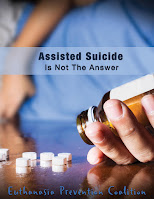
The following article was written by bio-ethicist, Philip Reed, in response to Arthur Caplan's article supporting assisted suicide and was published by Kevinmd.com on March 19, 2024.
Reed begins his article by referring to Caplan's article and then writes:
In Canada, deaths by a physician have increased by
more than 25 percent every year since legalization in 2016 and now make
up over 4 percent of all deaths. Media reports have profiled
physician-assisted death for non-terminally ill Canadians who were
having trouble accessing medical care, housing, and social support.
Caplan understandably wants to avoid this scenario.
The question, however, is how well the safeguards are
really working even in the United States. Are they set up to protect the
U.S. sufficiently against the Canadian scenario?
One safeguard originally built into these laws was that
access to lethal drugs would be limited to state residents. States
understandably did not want to become destinations for suicide tourism.
But Oregon has stopped enforcing this requirement and Vermont passed a
law last year overturning their residency requirement. Other states are
expected to follow suit.
Another alleged safeguard is that people who are mentally
ill or depressed cannot have access to lethal drugs. However, only
Hawaii requires that terminally ill patients be evaluated by a mental
health professional. The other states only require referral when they
suspect depression or another mental disorder might interfere with
decision-making.
In the 25 years of assisted suicide in Oregon,
only 3 percent of patients have been referred for a psychiatric
evaluation. On the one hand, this is surprising, given that by some estimates
1 in 5 Americans have some kind of mental illness. On the other hand,
given that only specialized doctors are willing to prescribe lethal
drugs, patients have to shop for the right doctor. In Oregon, the median
length of the relationship between the patient who receives a lethal
prescription and the doctor who prescribes is down to only five weeks.
One can understand how psychiatric referrals get in the way of this
transaction. But one also wonders whether this sufficiently protects
depressed patients.
Even when a referral is made, the objective is only to determine eligibility for assisted suicide. Only one jurisdiction (the District of Columbia) requires that patients be informed about the option of mental health counselling.
Another safeguard of assisted suicide laws is to have
significant waiting periods between the patient’s initial request and
obtaining the prescription. This helps ensure the request’s authenticity
and that the patient is not choosing rashly. The standard waiting
period, endorsed by Caplan, has been 15 days but things are changing. In
2019 the Governor of Oregon signed a law allowing physicians to bypass
the waiting period in certain cases. In 2021, California shortened its
waiting period from 15 days to 48 hours and subsequently witnessed a
47 percent increase in lethal prescriptions. Hawaii and Washington
shortened their waiting periods in 2023 and Colorado has pending legislation to shorten it. New Mexico, seeing the trend, said, “Why wait?” and started with a 48-hour waiting period.
Are people being pushed to choose an assisted death
prematurely? I suggest that the ways in which some of these choices are
made are subtle and stem from complex psychological and social forces
that are not easily captured by evidence. For example, are we expressing
to terminally ill patients that experiencing the burdens of their
disease does not jeopardize their dignity when we label the alternative
“death with dignity?”
About half
of Oregon patients who use assisted suicide say that they don’t want to
be burdens on their families. Is a choice for death authentic if it is
motivated by the idea of sacrificing a potential life worth living in
order to unburden one’s caregivers?
Also, in my view, it is unfortunate that some states have
incorporated assisted suicide into hospice and palliative care. Hospice
says to terminally ill patients, “We can give you an acceptable quality
of life at the end of life.” The offer of assisted suicide contradicts
this and undermines the mission of hospice.
Medicine in the 21st century is so impressive that we are
genuinely surprised when the doctor tells us that nothing can be done.
But medicine is not a panacea and it cannot treat mortality. The trouble
with assisted suicide laws is that they present death as a neat and
tidy way to solve one’s problems. The alleged safeguards are inadequate,
and as they have gradually eroded, more and more people come to believe
that death can solve their problems too.
Thank you Philip Reed for responding to Caplan.