Showing posts with label Japan. Show all posts

Thursday, August 25, 2016

For disabled people the idea of assisted suicide couldn’t be bigger.

Robyn Hunt
Robyn Hunt responds to David Seymour by explaining why people with disabilities strongly oppose euthanasia and assisted suicide, in her article published on August 24 in The Spinoff. Hunt writes:
I assure David Seymour that assisted suicide is a really big and complicated deal. It is no coincidence that disabled people all over the world oppose it. Our opposition arises from a (largely invisible) dark and troubled history, negative attitudes and behaviours towards disabled people and current human rights abuses. Disabled people see assisted suicide as dangerous because of their already marginalised status. Some disabled people are particularly vulnerable. 
Disabled and other people who oppose assisted suicide are not religious fanatics. Not Dead Yet Aotearoa was founded on disability rights not religious convictions. Assisted suicide supporters attempting to diminish the opposition by ignoring some and making sweeping statements about others is not helpful. 
Part of our unease relates to evidence that lives of disabled people are valued less than those of others. There is a history of euthanasia and eugenics, which have gone hand in hand for disabled people. The most notable, yet largely unknown T4 programme initiated by the Nazi Third Reich was the forerunner to the better known holocaust of Jews, gays, gypsies and others who did not meet the Aryan ideal. Around half a million people with of all kinds of impairments were killed. Some were tortured with “experimentation” before death. The first child to be euthanised was killed at the request of his parents. They were labelled “useless eaters”. Many disabled people today still feel the residual power of that label as they struggle with cuts to services, parsimonious supports and subtle pressures to find work. 
Even today those who murder their disabled family members, often vulnerable children, usually receive lesser sentences than other murderers. Their crimes may be labelled by the media and others as “mercy killings”. 
Disabled people in the past were often discarded by society, “put away” in institutions popularly labelled “bins”, forgotten by society and history and eventually buried in unmarked graves. Today’s mini-institutions still harbour instances of violence and abuse, occasionally gaining media exposure. Disabled people, especially women, feel more vulnerable because they know they are more likely to experience violence and abuse and often feel powerless. Powerlessness and assisted suicide can be a dangerous combination. 
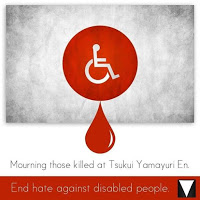
Disability hate crime goes generally unremarked by public notice. While there were widespread and highly visible outpourings of solidarity and grief for victims of recent terror attacks in Nice, Paris and Orlando, there was a resounding public silence after the murders at Kanagawa Kyodokai at Tsukui Yamayuri En, west of Tokyo. Nineteen disabled people were stabbed to death as they slept. The killer was a former employee at the residential/rehabilitation facility for disabled people. In 50 minutes he killed 10 men and nine women and injured 24 others. 
He said afterwards it was better “that disabled people disappear”. He had offered to euthanise multi-disabled people for the state. The names of the victims will never be released because of the stigma and shame for their families. Disabled people everywhere were chilled and fearful in the face of widespread public indifference to the worst mass killing in Japan since World War II. 
Today in New Zealand disabled women can still have their children removed for adoption without their consent. Disabled people, particularly women are still sterilised without their consent, and are subject to invasive treatments such as the growth-attenuation Ashley Treatment, which threaten their bodily integrity. It is still difficult for some disabled people to have accessible information about medical procedures to enable them to make informed choices. Introducing assisted suicide would re-medicalise disabled people’s lives after a long fight to escape the unnecessary medicalisation of disability. 
Another serious human right violation in contravention of New Zealand’s international civil and political rights obligation sees a small group of disabled people incarcerated for years with no redress, despite having committed no crime. They are powerless and forgotten by wider society. 
Disabled people can and do have agency, but physical and other vulnerability and reliance on others for basic daily needs, while not being the “fate worse than death” some people imagine, does present complexities and added risk to daily living. 
Like most people we believe in the alleviation of suffering, such an untrustworthy and loaded word in this context of assisted suicide. One person’s perceived suffering can still be another’s rewarding daily life. Assisted suicide is not the only way to find dignity in death. We support the best palliative care and pain relief. Many disabled people would like to see medical marijuana legalised. Disabled people have committed suicide or attempted it. Yet there is no data collected or suicide prevention programme for disabled people when disability is framed in negative language and the “fate worse than death”. 
Free choice is another plank in the platform of assisted suicide proponents. Yet for many people, not just disabled people, choices are highly constrained, by circumstance, by resources, by subtle, and not so subtle pressure, for example, disabled friends with high support needs have had to fight hard to have externally inserted “Do Not Resuscitate” removed from from their medical records. 
Assisted suicide is therefore not simple, the “easy option” David Seymour would have us believe. Most disabled people remain focused on the goal of a good life, with all its difficulty, before thinking about a good death. There has been no demand for assisted suicide at any of the consultation meetings around the country (five) for the disability strategy that I have attended. 
Many disabled people know only too well the low value society places on disabled lives but they don’t focus on the common view that disability is all about deficit and despair even though there is a healthy level of cynicism about the systems and structures that are supposed to protect us. We know from experience that even with the best will in the world they don’t always work. 
Politicians see assisted suicide as a straightforward issue at their peril.
Robyn Hunt is a joint co-ordinator of Not Dead Yet Aotearoa, a focus for disabled peoples’ voices in NZ against euthanasia and assisted suicide legislation

Wednesday, August 10, 2016

Euthanasia - Disability Hate Crime and the silence.

Alex Schadenberg
Executive Director - Euthanasia Prevention Coalition

The Australian News Weekly magazine published an excellent article by Paul Russell, the Executive Director of Hope Australia and Vice Chair of the Euthanasia Prevention Coalition-International.

Russell, in his commentary, examines the reaction to the disability hate crime that occurred in a care facility in Sagamirihara, Japan where on July 26, 19 people with disabilities were brutally killed and another 26 people with disabilities were injured. This was the largest killing in Japan since the second world war.

Russell is essentially commenting on the media response to the killing in his article that he titles: Euthaansia - Disability hate crime: then the rest is silence.

Russell sets up his article by quoting from a letter from the killer;
In a letter the killer sent to the Japanese Parliament some time before his heinous actions, he wrote:
“I envision a world where a person with multiple disabilities can be euthanised, with an agreement from the guardians, when it is difficult for the person to carry out household and social activities. 
“I believe there is still no answer about the way of life for individuals with multiple disabilities. The disabled can only create misery.”
Bill Peace
Russell quotes several responses by disability leaders to the killing. He first quotes from Syracuse, New York, disability activist and academic Bill Peace wrote on his blog
“This hate crime and mass murder led to a sleepless night for me. What took place could have happened in any nation. It could have taken place in Omaha, Nebraska, Cambridge, England, Paris, France, or Syracuse, NY. As I read story after story I felt a chill go down my spine when I read the following words: ‘He was just an ordinary young fellow.’ 
“I have no doubt he was an ordinary young fellow. That is what makes ableism so frightening. People, typical people, think life with a disability is worse than death. I plan to go out to lunch with my son. We will likely stop at a cross walk and wait for a light to turn. A biped will likely stand near me. That biped might be thinking, ‘Shit, if I were paralysed I would prefer to be dead. That guy should be dead. He sucks up too much health-care dollars.’ 
“This is what scares me. The silence. How many silently wish we people with a disability did not exist. My concerns are shared by many who have a disability and more generally any person with an atypical body.”
In another Blog comment Peace states:
“The hate crime in Japan graphically and horrifically demonstrates that people with a disability are prone to being the victims of violence. That violence includes murder. How many more people need to die before ableism is acknowledged as a global problem. 
“The violence I refer to takes many forms. Hollywood knows that films that kill disabled characters for their own merciful end of life resonate well with audiences. 
“Police in the United States have killed a host of people with a disability. Parents who murder their disabled children are given light sentences for their crimes.
Dave Hinsburger
Russell also quotes from Canadian blogger and disability activist Dave Hingsburger:
“The discussion of and public endorsement of the concept of mercy killing of people with disabilities had taken root in this man with alarming ferocity. No doubt he will be spoken of as someone who has mental health issues, and maybe he does. But when you read what he says, what he says isn’t far from what most people have come to believe. 
“His statement to the police upon turning himself in that ‘it’s better that disabled people disappear’ isn’t a deranged rant by someone out of control, it’s a calm statement of fact that echoes the sentiment of many in society. 
“People with disabilities know this sentiment, we hear it, we experience it and we have come to fear what it will do. Our lives are devalued, our needs are seen as special and therefore burdensome, our rights are declared to be gifts rather than guarantees.”
Russell is asking the question that the disability community has a right to know. Why all the media silence concerning the largest mass killing in Japan since WWII?