Showing posts with label Lord Falconer. Show all posts

Friday, October 18, 2024

Ontario Coroner's euthanasia report: Poor at risk of coercion.

Alex Schadenberg
Executive Director, Euthanasia Prevention Coalition

The Ontario MAiD Death Review report has three parts (Part 3) (Part 2) (Part 1).

Janet Eastman has written an excellent commentary on the report of the Ontario Chief Coroner concerning the experience with euthanasia in Ontario, Canada's largest province. Eastman's article was published in The Telegraph on October 17, 2024

Eastman focuses on the Coroner's report in relation to the upcoming assisted dying debate in the UK. Eastman writes:
Assisted dying is used by patients in Canada because they are poor and lack housing, a major report has found.

The first official report into assisted dying deaths in Ontario, which has been obtained by the Telegraph, found vulnerable people face “potential coercion” or “undue influence” to seek out the practice.

Sixteen experts across medicine, nursing and law identified people whose lives may have been wrongly terminated at the hands of the state, where the action is called Medical Assistance in Dying (MAiD).

It comes after Kim Leadbeater, the Labour MP, introduced her private member’s Bill to legalise the practice for terminally ill patients on Wednesday, saying it “contains robust protections”.
Eastman then explains some of the concerning stories from the Ontario Coroner's report:
In one example identified in the report, a MAiD practitioner drove a 40-year-old addict to his death after his psychiatrist suggested assisted dying as an option.

Using their own car to drive the patient to an external location to die by assisted dying “may have created pressure, and gave rise to a perception of hastening a person towards death”, the report found.

On another occasion, a man in his forties who had been “involuntarily hospitalised” on mental health grounds died by assisted dying after he became convinced he had been injured by the Covid-19 vaccination. A post-mortem later found “no pathological findings”.

Elsewhere in the report, one man who had tried to jump to his death the previous year, who presented with stomach ulcers, narcissistic personality disorder and chronic suicidal ideation, was allowed to die.
Eastman reports that: One of the doctors on the committee warned that “the UK should not assume it will manage this better or avoid potential pitfalls”

Eastman then interview Dr Ramona Coelho who is one of the members of the Coroner's committee and a family medicine practitioner based on London Ontario who said:
“With the legalisation of MAiD, real lives are at stake and the dangers of a slippery slope are very real.”

“When Canada legalised assisted suicide and euthanasia under MAiD in 2016, Canadians believed it was intended to be a rare, last-resort measure, reserved for consenting adults enduring intolerable suffering at the end of life.

“However, lobbying efforts have steadily pushed for broader access and eligibility.”

 Coehlo offers a warning to British legislators:

“British legislators have to consider how easily assisted dying can be expanded, how easily abuses can go undetected.”
Eastman outlines more concerns from the report:
The MAiD Death Review Committee member said: “This worrisome finding suggests that MAiD could be the option of least resistance and be used to end lives when social policies have failed them.”

A 50-year-old depressed woman, dubbed Ms B, was allowed an assisted death because the state could not find housing that “satisfactorily” addressed the symptoms of her multiple chemical sensitivity syndrome (MCSS) in one case.

“As a result of her housing situation and conditions, necessary to address her MCS, Ms B experienced social isolation, which greatly contributed to her suffering and request for MAiD,” it said.

Some committee members “cautioned that a social issue – housing – was at the forefront of this request, not in keeping with a medical condition”. They felt that “MAiD is not a solution for all society and policy failures, furthering social injustices”.

The report also raised concerns about the case of 40-year-old addict with inflammatory bowel disease who died by assisted dying after “a psychiatrist asked him if he was aware of MAiD and presented information on the option”.

Evidence also suggested that Canadian patients could be incentivised to refuse medical treatment and make themselves more ill in order to access the practice.
Dr Coelho emphasized the case of a quadriplegic patient:
Dr Coelho pointed to a case in which a quadriplegic patient was told by one MAiD examiner that the 90-day assessment period prior to his assisted death could be “reduced” if he developed “untreated septicemia”, leading him to refuse treatment.
Eastman interviewed Kim Leadbeater (MP) and Lord Falconer who argued that, if legalized, British assisted suicide legislation will not be extended. But Alex Ruck Keene KC, the leading capacity barrister in the UK disagreed

Alex Ruck Keene KC, the leading capacity barrister, disagreed and said: 
it would be “quite possible to see how the courts would be willing to entertain discrimination-based challenges to the limits she said will be in the legislation because it will not be a question of whether assisted dying should be legal, which the courts have said is for Parliament, but rather to whom it should be available.”
Once legalized, assisted dying legislation will inevitably be extended. If legalized, the debate about whether it's OK to kill ends with a new debate beginning that concerns whether the restrictions are justified and equitable. Further to that, a new debate begins concerning who can kill and for what reasons.

Friday, October 4, 2024

The UK will debate assisted suicide bill this year.

Alex Schadenberg
Executive Director, Euthanasia Prevention Coalition

I am currently in the UK on a speaking tour speaking about Canada's experience with euthanasia (MAiD).

The Care Not Killing Alliance announced on October 3rd that Labour MP Kim Leadbeater said that she will introduce a Private Member’s Bill (she has the first private members bill spot) to instroduce an assisted suicide bill.

The Leadbeater bill has not been released yet. 

There have been several assisted suicide bills debated in the UK over the past few years. The last bill was debated in 2015 which was overwhelmingly defeated in the House of Commons. But sadly times are different after the election of Keir Starmer as Prime Minister.

Starmer, the leader of Britain's Labour Party, is a long-time promoter of assisted suicide. During the election Starmer promised that he would introduce a bill and allow a free-vote on assisted suicide. The July 4 election resulted in the Labour Party winning a massive majority with 411 out of 650 parliamentary seats.

After the election Starmer reiterated his support for assisted suicide and promised a free-vote within the year. BBC news reported:

Sir Keir Starmer has insisted he remains committed to giving MPs a free vote on assisted dying laws at some point.

The prime minister said he would provide parliamentary time for a vote if a backbench MPs proposed changing the law, but stressed the government had other "priorities for the first year or so".

In the House of Lords, Lord Falconer introduced his private members bill in the second spot. Falconer, who has sponsored previous assisted suicide bills, introduced the Assisted Dying for the Terminally Ill Adults bill on Friday July 26.

I reported on October 2 that Scotland's assisted suicide bill is likely to die a natural death. It is possible that Leadbeaters bill will attempt to legalize assisted suicide in all of the UK, including Scotland, Wales and Northern Ireland.

Britain needs to fully examine Canada's experience with euthanasia and reject it. Hopefully the House of Lords will defeat the Falconer assisted suicide bill.

The Euthanasia Prevention Coalition will keep you up-to-date on the British assisted suicide bills. We will continue to work with the Care Not Killing Alliance and other groups in the UK that oppose assisted suicide.

Wednesday, August 7, 2024

Disabled campaigners' warn about Lord Falconer's aim to legalise assisted suicide in the UK

Not Dead Yet UK published the following article on the Falconer assisted suicide bill.

Lord Falconer of Thoroton (Charlie Falconer) introduced a Private Members Bill (there’s an explanation of what they are here) to make it legal to assist people who are terminally ill to die.

As a group of disability rights campaigners, Not Dead Yet UK are deeply concerned about this course of action.

Like many disabled people, we are conscious that attempts to build legalised suicide into healthcare can be profoundly discriminatory – if a non-disabled person wants to die, their doctor does not give them the means to kill themselves.

We want the same care and respect to be given to terminally ill people if they are suicidal.

Rather than legalising the suicides of disabled people, we argue that the only safe way forward is better investment in palliative care and a commitment to improving the things that people often cite when they apply to die in other parts of the world, such as a lack of dignity and feeling like a burden.

Can an assisted suicide law ever be “safe”?

Charlie Falconer told The Guardian

“My bill is designed for people who will die in the near future. I don’t think the state should be helping people who are not terminally ill to take their own lives.”
However, this does not reassure us.

We have seen, again and again, across the world, that laws that begin with relatively strict parameters, such as terminal illness, expand and expand until people with treatable conditions, children, and people who simply can’t afford accessible housing end up being approved to die by assisted suicide.

While Falconer assures us there will be “safeguards”, in reality, these safeguards are virtually impossible to implement effectively. Even the idea that doctors can accurately predict when a person has six months left to live does not reflect reality.

And in a world where there is growing awareness of coercive control, and where we know that many do not receive adequate or appropriate medical care, pain management or social care, we are creating the conditions for people to find themselves agreeing that yes, they should probably die, including to avoid feeling like a burden, when providing them with what they actually need to live could allow them to enjoy and participate in their own life again.

What if good care stopped us from wanting to die? Where are the proposed laws to provide everybody with compassionate and appropriate care instead?

Can Falconer succeed?

Falconer has already failed at changing laws in the area of assisted suicide six times, as detailed here, but he hopes that this iteration of the Assisted Dying for Terminally Ill Adults Bill will be the one that enables assisted suicide for terminally ill people.

Private members’ bills, especially from Lords, are generally thought to be an ineffective way to create a new law. According to Politics Home, “almost all Private Members’ Bills fail. In all sessions of each Parliament between 1997 and 2015 generally only between three per cent and six per cent of bills succeeded”

What could be different this time is that Keir Starmer, the new Prime Minister, seems to be keen on legalising assisted suicide. Earlier this year, he said that if he became prime minister, he would ensure parliamentary time was made available to debate the issue and he would allow a free vote (where politicians vote according to their conscience and personal beliefs, not according to what their political party wants).

Falconer told LBC that he “strongly feels the time for this reform has come”, but presumably he felt the same when he introduced attempts to change the law in 2009, 2013, 2014, 2015, 2019 and 2022 too.

However, with the Prime Minister on side, this time, disabled people could find ourselves under threat in an unprecedented way in this country. Follow Not Dead Yet UK on Twitter / X to stay on top of our campaign to ensure that disabled people are helped to live, not to die.

Monday, July 22, 2024

Britain to debate assisted suicide bill this year

Alex Schadenberg
Executive Director, Euthanasia Prevention Coalition

Keir Starmer, leader of Britain's Labour Party, has been a long-time promoter of assisted suicide. During the election Starmer promised that he would introduce a bill and allow a free-vote on legalizing assisted suicide in the UK. The July 4 election resulted in the Labour Party winning a massive majority with 411 out of 650 parliamentary seats.

After the election Starmer reiterated his support for assisted suicide and promised a free-vote within the year. BBC news reported:
Sir Keir Starmer has insisted he remains committed to giving MPs a free vote on assisted dying laws at some point.

The prime minister said he would provide parliamentary time for a vote if a backbench MPs proposed changing the law, but stressed the government had other "priorities for the first year or so".
Starmer continued:

"As to the timing of it, I haven't made a commitment on that and I don't want to.

"I'm not going back on the commitment I made, it's just we have got to set out priorities for the first year or so, but I will double down on the commitment that we are going to do that, we will allow time for a private member's bill, and there will be a free vote."

After the British election, a "lottery" determines the order for introducing private members bills. In the House of Lords, Lord Falconer received the right to introduce his private members bill second. Falconer, who has sponsored previous assisted suicide bills, will introduce the Assisted Dying for the Terminally Ill Adults bill on Friday July 26.

Britain needs to fully examine Canada's experience with euthanasia and reject it. Hopefully the House of Lords will defeat the Falconer assisted suicide bill.

The Euthanasia Prevention Coalition will keep you up-to-date on the British assisted suicide bills. We will continue to work with the Care Not Killing Alliance and other groups in the UK that oppose assisted suicide. I am scheduled to speak in London England on September 28 and Glasgow Scotland on October 5, 2024.

Saturday, July 15, 2023

Canadian woman with anorexia wants to die by euthanasia

Alex Schadenberg
Executive Director, Euthanasia Prevention Coalition

Anna Mehler Paperny wrote an article for Reuters, published on July 15, examining Canada's March 2024 expansion of euthanasia to include mental illness. Paperny examined the issue based on the story of Lisa Pauli, a 47 year-old woman who lives with anorexia. Pauli, who says that she has struggled with her eating disorder since the age of 8, said:
"Every day is hell," she said. "I'm so tired. I'm done. I've tried everything. I feel like I've lived my life."
Pauli does not currently qualify for MAiD (euthanasia) but in March 2024 Canadians whose sole underlying condition is mental illness, will qualify for euthanasia. Paperny states that Canada will have one of the most expansive euthanasia laws in the world.

Canada's Justice Minister, David Lametti told Paperny that:
"We have gotten where we are through a number of very prudent steps,"
"It's been a slow and careful evolution. And I'm proud of that."
Paperny stated that in 2022 there were 15 Québec euthanasia cases that were outside of the law and there were 19 cases in British Columbia since 2018.*


David Lametti
Lametti believes that Canada's euthanasia law does not go far enough.

Lametti told Paperny that the federal government is considering recommendations from a parliamentary committee to allow euthanasia by advance requests and for "mature minors" - people under 18 deemed capable of making this decision.

When asked about the cases of people with disabilities who are living in poverty, homeless or having difficulty receiving medical treatment Lametti said:
But "you can't get MAID simply because you're having some social challenges or economic challenges. ... Unless they fall into the medical criteria, they can't access."
Lametti ignores the fact that people qualify for MAiD (euthanasia) based on their medical condition (disability) but they are not seeking death because of their disability but because of their social, medical and economic challenges.

Dr Sonu Gaind
Sonu Gaind, the Chief of Psychiatry at Toronto's Sunnybrook Health Sciences Centre told Paperny that:
It can be difficult to determine whether a mental illness is truly irremediable, as the law requires, and to differentiate between pathological suicidality and a rational desire to die,

"We don't even understand the biology of most mental illnesses,"
Michelle Hewitt
Michelle Hewitt, co-chair of the advocacy group Disability Without Poverty told Paperny:
"My biggest fear is that we go to this absolute terminal end and people die but we haven't invested time, money, people in putting the things in place that would mean that people don't want to consider"
Hewitt commented on the euthanasia death of Sean Taggert in 2019.
Sean Tagert, with amyotrophic lateral sclerosis (ALS) or Lou Gehrig's disease who opted for medically assisted death in 2019 after he struggled to get 24-hour care.

"He was very clear on what he wanted - more care hours at home - and when he was told he would have to move to a care facility a distance from his family, particularly his young son, he used MAID,"
Paperny completed the article by asking Charles Falconer, a British Labour peer who supports euthanasia, how Canada's experience with euthanasia is affecting the debate in Britain, where euthanasia is not legal. Falconer stated:
"Canada is being used primarily as an argument against us, not an argument in favour,"

"It does in one sense [represent a slippery slope], doesn't it, because it started off with terminal illness and it's ended up with non-terminal illness and mental illness."
Canada's has experienced a slippery slope when it comes to euthanasia. Lisa Pauli's wish to die by euthanasia does not bring assurance that euthanasia for mental illness is ever warrented. Her story is an illustration of a woman who needs good medical and mental health treatment and support, not death.

It is natural that in her condition she would feel "tired of living" but the answer is not death by lethal drugs, but supportive and intensive treatment that is life giving, not death giving.


* The data does not tell the whole story. Canada has a self-reporting system. The doctor or nurse practitioner who approves the death is also the same doctor or nurse practitioner that can carry-out the death and the same doctor or nurse practitioner required to report the death. Self-reporting systems protect the doctors and nurse practitioners who are willing to participate in euthanasia.

Friday, March 8, 2019

Oregon assisted suicide 2018: new highs (new lows)

This article was published by the Care Not Killing Alliance (UK) on March 4, 2019


Assisted suicide numbers continue to rise in Oregon, with almost two thirds now citing fear of being a burden as a reason for ending their lives, as lawmakers consider widening eligibility

Oregon used to be the blue-eyed boy of the assisted suicide movement in England. Lionised by Lord Falconer and Rob Marris MP, it was said to show how legalised assisted suicide could be regulated and trusted, but the Westminster bills that followed it failed, with MPs rejecting the 2015 Marris Bill 330-118 because of the clear evidence that assisted suicide always becomes what it was not planned to be.

The release of the 21st annual report, for 2018, only adds to
the reasons not to allow euthanasia a toehold in the UK.

Oregon 2018 assisted suicide report. A record number of assisted deaths.
Record high number of deaths

Last year in Oregon, 168 people died after ingesting lethal drugs prescribed by a doctor, ten more than in 2017. To put that into context, Oregon is a state of 4.19m people; if the 168 deaths were extrapolated for a UK-sized population of 66m, the death toll would be more like 2,646. Imagine the London Palladium or Royal Opera House filled to capacity; then have 400 more people sit cross-legged on the stage; then shut off the lights. One of the reasons assisted suicide campaigners like to focus on individual hard cases is that they don't have to address how, once legalised, the practice becomes normalised, and with each passing year more and more people come to believe they too should seek death.


Almost two thirds feared being a burden

Assisted suicide and euthanasia are often presented as resolving a medical issue, but the chief reasons cited are always existential.

Once again last year, the proportion of those seeking assisted suicide not wishing to be a burden on loved ones and caregivers rose, this time to 63.6%. Campaigners might note that this didn't top the list: 95.6% cited being 'less able to engage in activities making life enjoyable' and 95.1% cited 'losing autonomy', but these are inextricably linked with the concept of being a burden and speak to the care and support available to people with terminal and incurable conditions and how those people feel in accepting these, to say nothing also of the support given to carers by employers and local authorities. The very idea of a physician endorsing suicidal intent on the grounds of not wanting to be a burden is obscene.


Some doctors prescribed lethal drugs every 10 or 11 days

Doctor-shopping is a known facet of assisted suicide in practice. Some doctors do not participate due to conscientious objections; others might assess patients who in their opinion do not meet the legal criteria. Some doctors, however, are at ease with the practice of prescribing lethal drugs to patients: the 249 prescriptions written in 2018 were made out by 103 doctors; at least one of these doctors made out 35 on their own; averaged out across the year, they sought to assist a patient's suicide every 10 or 11 days. 'Patient' suggests a meaningful relationship, but prescriptions were made out on the basis of doctor-patient relationships lasting as little as a week.


They could have lived for years

Oregon law stipulates that assisted suicide is available to 'an adult who... has been determined by the attending physician and consulting physician to be suffering from a terminal disease', the latter being defined as 'an incurable and irreversible disease that has been medically confirmed and will, within reasonable medical judgment, produce death within six months.' The flexibility of this definition has been acknowledged openly by health officials, and the statistics once more demonstrate the unreliability of a six month prognosis. Patients lived for up to 730 days between first request and death among those whose assisted suicides fell last year; that's more than two years. The record is 1,009 days - almost three years - and of course there is no knowing how long those patients could have lived even beyond those two or three years. How many of those told they were near the end and who took the cocktail of barbiturates in short order could in fact have lived for many more months or years? We can never know.

Of course, much of this would be academic if the state representatives and senators behind HB 2232 get their way: they wish to redefine terminal illness as 'a disease that will, within reasonable medical judgment, produce or substantially contribute to a patient's death.'

Complications

Last year in Oregon, three of those who died had difficulty ingesting or regurgitated the drugs, with a further four suffering 'other' unspecified complications. There were 168 deaths last year, and for 105, there is no report either way on complications. We do know that there would have been 169 deaths, but one participant 'regained consciousness after ingesting DWDA medications.' For researchers writing in the journal of the Association of Anaesthetists recently, such complications raise 'a concern that some ["assisted dying"] deaths may be inhumane'. So much for "dignity".


"Assisted Dying" - for arthritis and diabetes

The 21st report is the most detailed yet with regard to the underlying illnesses of those who have died. Two people had 'Endocrine/metabolic disease e.g. diabetes', and six people had 'other illnesses'. A footnote regarding the latter says that 'includes deaths due to arthritis, arteritis, sclerosis, stenosis, kidney failure, and musculoskeletal systems disorders'. Note 'due to': 'the Oregon Health Authority, Center for Health Statistics recommends that physicians record the underlying terminal disease as the cause of death and mark the manner of death "natural"' - despite the cause of death in fact being the supply and ingestion of a prescribed overdose of barbiturates.

The Oregon statistics are a patchwork of new highs and new lows; linguistic contortions and administrative deceits. Taken as a whole, they are yet another reminder that the warm and comforting theory of advocates in the UK doesn't stand up to the buffeting of reality where legislators have made the unenviable decision to make death a form of care. The enduring lesson is clear: don't go there.


Friday, August 31, 2018

The case for assisted suicide is inherently flawed.

This article was published by the Economist Magazine on August 28, 2018.

Kevin Yuill is author of the book: Assisted Suicide - The Liberal, Humanist Case Against Legalization.

Professor Kevin Yuill
The case for assisted suicide seems to consist of terrible stories of people dying protracted, painful deaths and prevented by a cruel law from gaining the relief they seek. But this is not always accurate. As the official reports in Oregon and Washington show, pain is not in the top five reasons why people opt for assisted deaths. It is fear that dominates people’s concerns: of loss of autonomy, loss of enjoyment of life’s activities and loss of dignity. I believe these fears are curable, even if the underlying disease that robs people of such functions is not.
Kevin Yuill: Assisted suicide and the false concept of autonomy.
Lord Falconer characterised the existing law as “incoherent and hypocritical”. But that description seems more apposite for many of the arguments for changing the law. There is an Orwellian self-deception in the idea that “assisted dying” is a safe, healthy way of dying compared to “violent” suicide. But the violence inherent in suicide comes not from the method used, but from the extinction of life from a body.

Then there is the unresolvable problem of where to draw the line. The orthodox argument, ably expressed by Lord Falconer, has it that we should draw the line at six months. But this doesn’t add up. If we argue that the relief of suffering is the most important issue, then six months to live is utterly random; people who have more time clearly suffer. As Lord Neuberger, the president of Britain’s Supreme Court between 2012 and 2017, said in relation to Tony Nicklinson, a man with locked-in syndrome who campaigned unsuccessfully for the right to die: “There seems to me to be more justification in assisting people to die if they have the prospect of living many years a life that they regarded as valueless, miserable and often painful, than if they have only a few months to live.”

When should someone be allowed to help someone else to die? The moral essence of the question concerns our attitude towards suicide. Is it okay in some instances, when someone is really suffering? When they have certain horrific diseases? When they are over 70, as a bill proposed by the Dutch government would have it? Or should we approve it whenever someone says they are suffering unbearably?

My case is not against suicide per se. Though most suicides are tragedies, others, such as that of Captain Oates, who sacrificed himself for the good of his comrades on the ill-fated Scott expedition to the South Pole in 1912, are beautiful acts, the epitome of selflessness, duty to one’s fellows and courage.

Our attitude to suicide is necessarily ambivalent. All free, competent adults should be free to make the decision whether or not to live. I disagree with my good friend Peter Saunders when he says “we recognise that personal autonomy is not absolute.” In relation to the decision to commit suicide, it must be (and with assisted suicide, it is not).

Anyone determined enough to do so will likely take their own life, regardless of laws. I am on record as supporting the removal of what I see as the patronising prevention of competent adults getting their hands on deadly drugs. It is the assistance—the complicity of the community in the death of a human being—that is the problem.
Kevin Yuill: Legalizing assisted suicide is dangerous. Just look at Canada.
Kevin Yuill lectures in history at the University of Sunderland, in the UK, and is the author of Assisted Suicide: The Liberal, Humanist Case Against Legalisation

Tuesday, June 23, 2015

Assisted suicide for disabled people – democracy in Britain?

Dr Kevin Fitzpatrick OBE, Director of Hope Ireland, published on the Hope Ireland's blog.
Dr Kevin Fitzpatrick
Professor Raphael Cohen-Almagor’s recent research results[1] are extremely important.

As Baroness Helena Kennedy QC said in a public debate (Southbank, January 28 2012), ‘This is about the kind of society we want to live in’.

Cohen-Almagor’s paper reprises a truth Baroness Jane Campbell, founder of Not Dead Yet UK, has spent years trying to help people understand. We have clear evidence that assisted suicide/euthanasia laws are aimed primarily at disabled people. Lord Falconer has now openly admitted this on the Daily Politics show (BBC 9 June 2015).

Pain, we have repeatedly said, is not the primary reason for asking for assisted suicide. Falconer agrees: ‘…pain…can be dealt with…it is the sense of people losing independence and being reliant on other people…there’s a small number of people who…find that an intolerable position…’ Yes, 61% of people in Washington State US say they want to die because they feel themselves ‘to be a burden on others’.[2] No small number that.

Rob Marris, MP is now determined to bring forward in the House of Commons the Assisted Dying Bill. But this softened language is mere disguise according to page 39 of Lord Falconer’s own ‘commission’ report: ‘assisted dying’ just means ‘Assisted suicide/euthanasia’.[3]

Marris topped the ballot for a Private Member’s Bill. Falconer came twenty-first. Suddenly, Marris had adopted Falconer’s Bill as his own project. I cannot help but wonder how the other nineteen who came out of the hat before Falconer now feel. Is this really democracy in action? So that people may die if they fear the kind of ‘dependence’ millions of us disabled people accommodate every day?

Wednesday, June 10, 2015

Britain to debate assisted suicide bill.

Alex Schadenberg
By Alex Schadenberg
International Chair, Euthanasia Prevention Coalition

The British House of Lords has debated many assisted suicide bills over the past few years. In fact the House of Lords debated the Falconer assisted suicide bill in the past year, a bill that died on the order paper before the election. The House of Commons has not debated an assisted suicide bill in 20 years.

Yesterday backbencher British Labour MP, Rob Marris, was chosen first in the Private Members bill ballot giving Marris the right to introduce Falconer's assisted suicide bill in the House of Commons.

According to the BBC, the Marris assisted suicide bill is scheduled for its first hour of debate on September 11.

Prime Minister Cameron
Prime Minister David Cameron, who has a majority government, opposes assisted suicide. The Express and Star reported that Cameron told his weekly Prime Minister's Question Time that:

“I don’t support the assisted dying proposals. I don’t support euthanasia.” 
...problems with the existing law can be ‘dealt with sensitively’ without ‘bringing in euthanasia’.
Mark Atkinson
The media reported that Mark Atkinson, the interim chief of the disability rights charity - Scope warned that legalizing assisted suicide would put people with disabilities at risk:

"Many disabled people are really worried about the legalisation of assisted suicide. 
“They are concerned that it will lead to them feeling under pressure to end their lives.”
While Agnes Fletcher, Director of Living and Dying Well, added: 
“The bill contains very few explicit safeguards.”
The Care Not Killing Alliance, Not Dead Yet UK, Living and Dying Well coalition and many other groups oppose the assisted suicide bill because it gives physicians, the right in law to cause the death of their patients when their patients are at the most vulnerable time of their lives.

Monday, February 2, 2015

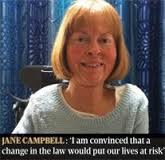
British disability leader speaks out against assisted suicide - "I am convinced that a change in the law would put our lives at risk."

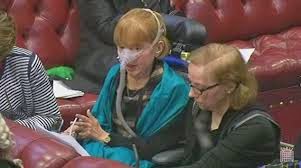
These are the two speeches by Baroness Jane Campbell in the British House of Lords on January 16, 2015 opposing the assisted suicide bill.

Baroness Campbell was Commissioner of the Equality and Human Rights Commission (EHRC) from 2006–2008, Chair of the Disability Committee which lead on the EHRC Disability Programme, former Chair of the Social Care Institute for Excellence (SCIE) and Commissioner of the Disability Rights Commission until October 2006.

Cambell has been featured in several articles on assisted suicide such as: ● Assisted Suicide could lure me to the grave, ● Why I oppose assisted suicide and ● Assisted suicide bill in Britain is fatally flawed.

Baroness Campbell's first speech in the House of Lords - January 16, 2015. 
My Lords, I thank the Minister. I am sorry I have not got a loud voice. I may be a little slow. This is not because I want to hold up the Bill, I just have things to say.


Baroness Jane Campbell
We have been told time and again that disabled people with life-limiting conditions—and I use that term advisedly because we do not recognize the terms “terminal illness” and “months” or “weeks to live”; ... have nothing to fear from the Bill. We are told that it is necessary only to help a few desperate individuals to end their lives when they have weeks or months to live, and that, if enacted, it will not touch anyone who does not want it. 

I do not believe that and, it seems, neither do the authors of the Bill. Why else would they elect to name it the Assisted Dying Bill instead of the assisted suicide Bill? If it is truly concerned only with personal autonomy and choice, surely that should be celebrated and clear.

By avoiding the term “assisted suicide”, the Bill circumvents the framework of measures in place to review, monitor and prevent other forms of suicide. It seeks to exclude deaths under the Bill from the general requirement for a coroner’s inquest to be conducted where suicide is considered a possible cause of death. It contains a provision for publication of annual statistics of “assisted deaths” separate from the established arrangements for collecting and publishing statistics on deaths by suicide. It provides for a death under the Bill to be recorded by the registrar as an “assisted death”.

I have a question for the Minister. This Government, like their predecessors, have a major cross-departmental suicide prevention strategy. It seeks,
“a reduction in the suicide rate in the general population in England”,
and defines suicide as,
“a deliberate act that intentionally ends one’s life”.
In the light of this definition, will the Minister inform us whether, if the Bill were to become law, he anticipates a rise in the suicide rate, and would he expect the suicide prevention strategy to contain measures to reduce the numbers in this group intentionally ending their own lives?

We all, in this House and outside, understand the word “suicide”. It centres on the individual. The act of suicide is the responsibility of the person who commits it, and no other. It is impossible to commit suicide without first consenting to do so. The same does not apply to the word “dying”.

Assisted dying is practised in Belgium, the Netherlands and elsewhere. Whatever the initial intentions were, decisions to end life in those places are now not taken only by the individual. It is not an autonomous act. The slippery slope is oiled by the vague euphemism of “assisted dying”. Disabled people are rightly frightened that the Bill, as currently named, puts them at risk. ... “Assisted suicide” makes it clear that only the individual may instigate and control the process leading to an early, state-sanctioned death. I urge noble Lords to support this argument.

Baroness Campbell's second speech in the House of Lords - January 16, 2015. 

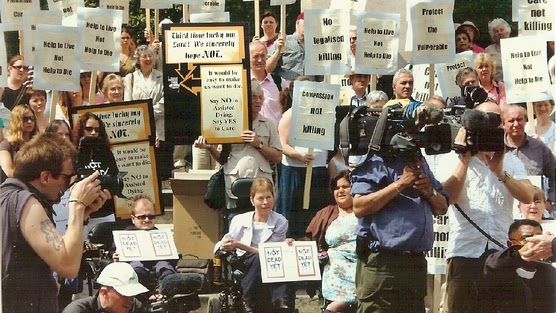
Baroness Campbell speaking to the
Not Dead Yet UK rally in July 2014.
I thank the Minister. My Lords, there are many reasons why I strongly oppose the Bill and why I have spoken against it in the past. But one of the most important reasons why I oppose the Bill is the definition of terminal illness and how many months, weeks or years we have to live. The definition in the Bill gives rise to uncertainty and is therefore terribly open to misinterpretation and abuse. Proponents of the Bill claim that “disabled” and “terminally ill” are distinct from one another. We are told that disabled people can be assured that the Bill is not intended to apply to them.

Tuesday, January 20, 2015

Isn't assisted suicide really suicide?

By Alex Schadenberg
Executive Director - Euthanasia Prevention Coalition

Nick Clegg
Yesterday Nick Clegg, the Deputy Prime Minister in the UK, announced at a mental health conference, the government's intention to reduce suicide to zero by working in cooperation with every part of the National Health Service and other agencies.

According to The Telegraph news, Clegg is modeling this suicide prevention program on the successful program that was implemented in Detroit Michigan. The article stated:

... every suicide is preventable if NHS trusts provide better care for people suffering from depression and other serious illnesses. 
The “zero suicides” target can be met through simple measures, such as keeping in touch with patients who have been discharged from mental health wards and creating a plan so that patients and their friends know whom to contact if they are placing themselves in danger. 
Police and transport agencies will be called on to examine whether safety measures can be put in place in “hot zones” where high numbers of suicides occur, such as shopping centres or bridges. 
The plans have been inspired by a mental health programme in Detroit, US, where a “zero suicide” commitment resulted in no-one in the care of state depression services taking their lives in two years.
The Euthanasia Prevention Coalition and similar organizations encourages the UK government to implement a goal of ending suicide. We recognize that suicide is 100% preventable.

At the same time the British House of Lords continued their debate on Lord Falconer's assisted dying bill, a bill that proposes to legalize assisted suicide in the UK.

Kevin Yuill
In response to the assisted suicide debate, Dr Kevin Yuill asks the question - isn’t assisted dying really suicide? Yuill states in his article:

Yet the campaign against suicide throws up questions about assisted dying, which was debated in the House of Lords last week. Here we find another example of the “massive taboo” that people are scared to talk about. That is: isn’t assisted dying really suicide? How can we wage a war against suicide for some whilst encouraging it as a legitimate choice for others? ... it is difficult to argue that what is being proposed is not essentially suicide. 

Tuesday, January 13, 2015

Psychiatric euthanasia deaths tripled in the Netherlands.

By Alex Schadenberg
Executive Director - Euthanasia Prevention Coalition

This Friday, January 16, the British House of Lords will resume its debate on the assisted dying bill. Today, the Daily Mail published an extensive article on the euthanasia practice in the Netherlands.

The article focuses on the Netherlands euthanasia statistics and recent trends including the fact that psychiatric euthanasia tripled in the Netherlands in 2013. The article states:

The latest official figures also revealed a 15 per cent surge in the number of euthanasia deaths from 4,188 cases in 2012 to 4,829 cases last year. 
The incremental rise is consistent with a 13 per cent increase in 2012, an 18 per cent rise in 2011, 19 per cent in 2010 and 13 per cent in 2009. 
The rise is also likely to confirm the fears of Dutch regulator Theo Boer who told the Daily Mail that he expected to see euthanasia cases smash the 6,000 barrier in 2014. 
Overall, deaths by euthanasia, which officially account for three per cent of all deaths in the Netherlands, have increased by 151 per cent in just seven years.
The statistics also indicate that of the 4829 euthanasia deaths in 2013, about 3600 were people with cancer, 97 were people with dementia and 42 were people with psychiatric issues.

Peter Saunders
Dr Peter Saunders, a founder of the Care Not Killing Alliance, told the Daily Mail that the experience with euthanasia in the Netherlands indicates that euthanasia is impossible to effectively regulate.
‘What we are seeing in the Netherlands is “incremental extension”, the steady intentional escalation of numbers with a gradual widening of the categories of patients to be included.’ 
...there was a similar pattern of increasing numbers of assisted suicide and euthanasia in the US state of Oregon, Switzerland, and Belgium. 
‘The lessons are clear. Once you relax the law on euthanasia or assisted suicide steady extension will follow as night follows day.’
Theo Boer
The article then interviews Professor Theo Boer, who was a member of Euthanasia Review Committee in the Netherlands for 9 years, recently changed his mind and now opposes euthanasia.

Professor Boer, who has reviewed 4,000 cases of euthanasia in his role as a regulator, told Parliament in the summer: ‘Don’t go there.’ 
Once a firm advocate of euthanasia, he said that he now the Dutch were ‘terribly wrong’ to think they could control it.

Writing in the Daily Mail, he said his country has witnessed an ‘explosive increase’ in the numbers of euthanasia deaths since 2007 and that he expected the number of such deaths this year to hit 6,000. 
He was also gravely concerned at the extension of killing to new classes of people, including the demented and the depressed. ‘Some slopes truly are slippery,’ he said.
The article then examing the experience with euthanasia in Belgium.
Doctors in neighbouring Belgium, which this year legalised euthanasia for children, are now killing an average of five people every day by euthanasia, according to latest figures, with a 27 per cent surge in the number of euthanasia deaths in the last year alone. 
In one of the most shocking cases, a Brussels man last week described how he arranged the double euthanasia of his octogenarian parents who wanted to die because they were afraid of loneliness.
The article concludes by explaining that the Netherlands have now interpreted the term "unbearable suffering" to apply to mental anguish. The article states:
It has also emerged that a Dutch woman in her 80s was killed by her doctors just because she did not want to live in a care home. 
The case is the first to be referred to Dutch prosecutors by regulators since euthanasia was legalised in Holland 12 years ago.
The British House of Lords needs to listen to the experience of Professor Boer and reject the assisted dying bill.

Links to more information:

Help Not Dead Yet UK defeat the assisted suicide bill.


Join the Not Dead Yet UK thunderclap to unleash tweets, facebook and social media messages in opposition to the assisted suicide bill at the same time on Friday January 16, the day when the House of Lords will be yet again discussing and amending the assisted dying bill.

Not Dead Yet UK has been using thunderclap for the past year and it has enabled them to win the social media battle. The assisted suicide lobby has caught onto this and have copied them. Instead of physically protesting on Friday, Not Dead Yet UK are having a virtual protest which includes writing to peers and signing up to their Thunderclap. Please use your networks to ensure we have a virtual presence opposing the assisted suicide bill on Friday?

Link to thunderclap: https://www.thunderclap.it/projects/21181-opposing-an-assisted-dying-law

The Not Dead Yet UK Thunderclap just went online so only a few have signed up but that will soon change with your help. 


The Thunderclap is set to go off  just before the Lords debate begins in London England at 9.30 am (GMT) on Friday 16th January.

That is the same as 4:30 am (Toronto/EST) or 5:30 pm (Sydney Australia)

Many thanks for your continued help in this campaign.

Liz Carr – Not Dead Yet UK

Sunday, January 11, 2015

Assisted dying would turn doctor's into executioners.

A majority of Britons may support the Bill, but that's also true of the death penalty

I was going through past articles from and I came across this article that was originally published in the Independent on July 18, 2014. Alex Schadenberg

Kevin Yuill
By Kevin Yuill


Clayton Lockett’s death by lethal injection earlier this year in Oklahoma brought a storm of criticism of Oklahoma’s death penalty procedures. Lockett mumbled, writhed, blinked his eyes and licked his lips throughout the procedure and took over 30 minutes to die. The Los Angeles Times observed: “The Oklahoma case is sure to be cited as strong evidence that state prison authorities cannot be trusted to capably administer lethal injections.”

But today the House of Lords is debating whether to invest British doctors with the same powers as the Oklahoma state prison authorities. Doctors will effectively become executioners if Lord Falconer’s Bill becomes law.

Why do liberals who, like me, think that capital punishment is unacceptable in a civilized society rush to support Falconer’s Bill? Beyond simply the method of dispatching people, there are many other similarities. If the premeditated killing of a human being by the state, even for the best possible reasons, is wrong, assisted dying is wrong.

Of course, there are important differences between assisted dying and capital punishment. But the similarities bear scrutiny in relation to today’s debate.