Wednesday, December 17, 2014

The Bentley "spoon feeding" case has been appealed to the BC Court of Appeal.

By Alex Schadenberg
Executive Director - Euthanasia Prevention Coalition


On February 3, 2014; the Euthanasia Prevention Coalition (EPC) was elated when Justice Greyall of the BC Supreme Court decided that Normal Feeding is basic personal care and not medical treatment in the Bentley case. 

The Bentley family has appealed the decision to the BC Court of Appeal arguing that Justice Greyall erred in his decision. They are arguing that normal feeding by spoon and cup is a form of medical treatment and Mrs Bentley's is being fed against her prior wishes which they define as "assault and battery."

The Bentley case concerns a woman living at the Maplewood Care Facility in Abbotsford BC. Mrs Bentley is living with dementia. She is being fed normally by spoon and drinks from a cup. Her family claims that she would not have wanted to live this way. The family wants normal feeding to be discontinued and that Mrs Bentley be allowed to die from dehydration.

In August 2013, the family of Mrs Bentley launched a lawsuit against Fraser Health and the BC government ordering that feeding by spoon and cup be discontinued. The Bentley family defined normal feeding as medical treatment. They claimed that feeding was being imposed on Mrs Bentley against her prior wishes and that it constituted a form of "assault and battery."


Mrs Bentley is not being fed by a feeding tube and she is not being forced fed.

It is interesting that, in August 2013, the Bentley family claimed that Mrs Bentley was living with "end stage" dementia and yet in December 2014 she continues to be fed normally.

EPC intervened in the Bentley case. We argued that normal feeding by spoon and cup is not medical treatment but rather constitutes normal care and a basic necessary of life.

The EPC is once again seeking to intervene in the Bentley case. The EPC intervention, among other arguments, will prove that normal feeding is recognized internationally as basic care and not medical treatment.

If normal feeding is redefined as medical treatment, then people with dementia will be at risk of family members deciding to stop feeding or hydrating them, even when they are still eating normally. 
EPC believes that people should have the right to be fed normally. 

Assisted Suicide poll - shows that Canadians are divided on the issues.

By Alex Schadenberg
Executive Director - Euthanasia Prevention Coalition

The Angus Reid Institute completed an assisted suicide poll  in late November that shows that Canadians are divided and conflicted on the issues, and that a negative experience with palliative care directly effects the opinion of people on the issues.

In its description of the survey results, the Angus Reid Institute states:

Canadians express moderate to strong support for changes in legislation that would allow physicians to help patients who want to commit suicide, but the specific circumstances that might justify this course of action suggest deep divisions in public opinion. 
Canadians’ views on doctor-assisted suicide vary significantly based on the perceptions of recent experiences with loved ones receiving end-of-life care. 
Those reporting a negative experience with palliative and hospice based care are significantly more likely to support physician-assisted suicide.
... In the middle is the largest group of Canadians who are open to the arguments in favour of a new overall approach in law, but who remain highly uneasy about specifics.

Tuesday, December 16, 2014

New Jersey Senate may vote on assisted suicide bill.

By Alex Schadenberg
International Chair - Euthanasia Prevention Coalition

Sign the petition urging New Jersey Governor Chris Christie to veto the assisted suicide bill.

The New Jersey assisted suicide bill narrowly passed, in 2014 (4 - 3) in the Senate Health Services and Senior Citizens Committee after hearing testimony on the bill.

Contact the New Jersey Senators and tell them to reject assisted suicide Bill 382 because it is not safe.

Assisted Suicide Bill 382 may go to a vote in the New Jersey Senate in January 2016. If the Senate passes the bill, Governer Chris Christie will need to veto the bill.

Sign the petition urging New Jersey Governor Chris Christie to veto the assisted suicide bill.

NJ.com published a good article concerning the Senate committee hearing. The article stated:
The Senate Health, Human Services and Senior Citizens Committee voted 4-3 to let the “Aid in Dying” bill proceed to the full 40-member Senate, but did so in a way that registered committee members concern and uncertainty by approving it "without recommendation." 
Sens. Jim Whelan (D-Atlantic), Robert Gordon (D-Bergen) and Chairman Joseph Vitale (D-Middlesex) voted yes to allow to the bill to move forward, but agreed they would have voted no had it come up for a vote in the full Senate today. 
"I'm not sure there are enough safeguards in place" to prevent the law from being abused, Vitale said
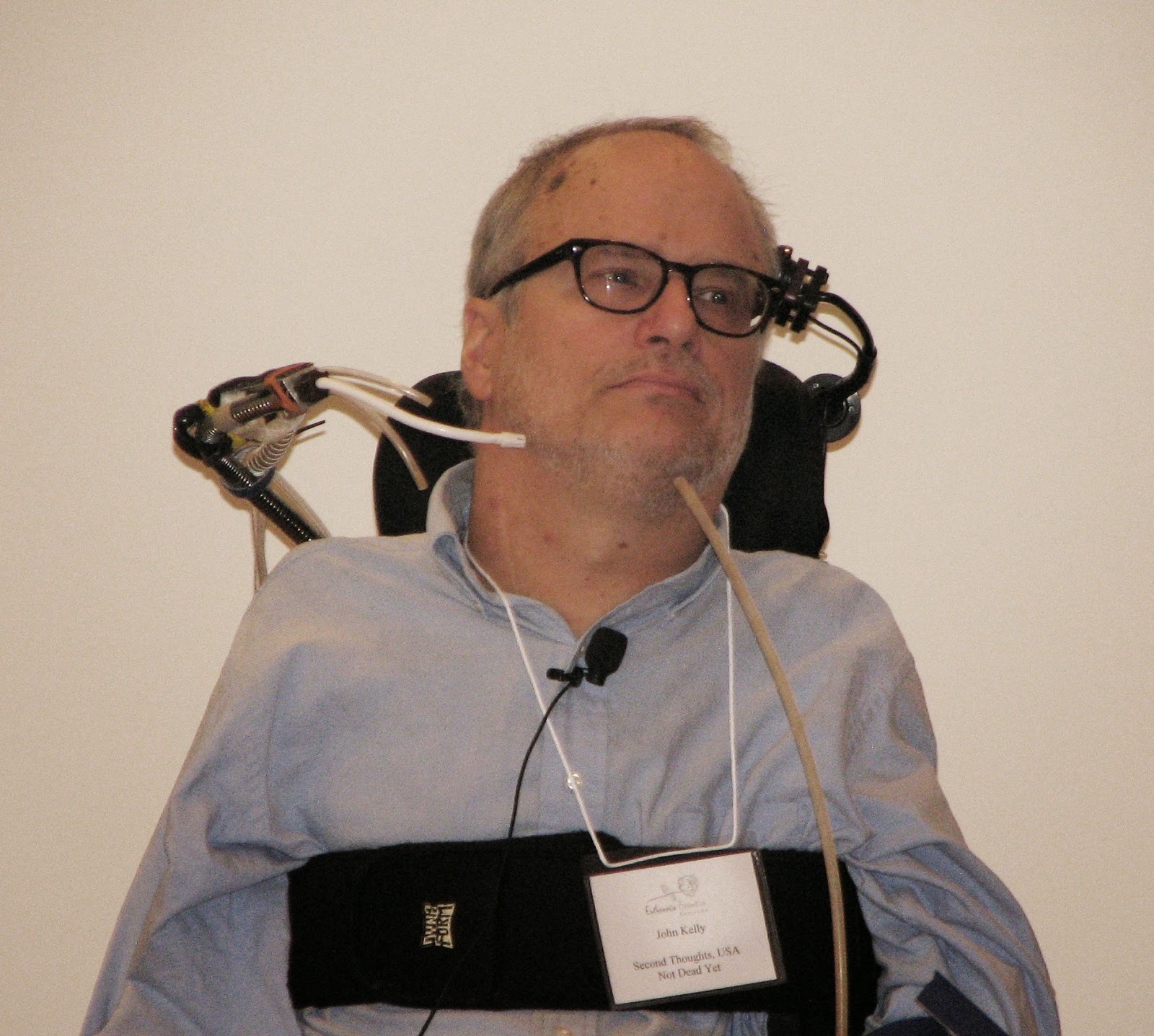
John Kelly from Not Dead Yet.
The Senate committee held a hearing with only two speakers from each side of the bill. The disability rights community were left out of that hearing. The second hearing occurred after the outcry of disability rights leaders who demanded that their voice be heard. The NJ.com article stated:
The bill has drawn the ire of many people with physical and developmental disabilities and their advocates. Curtis Edmonds, a managing attorney at Disability Rights New Jersey, a federally-funded legal advocacy organization, warned that such a law would define "what is perceived as an acceptable quality of life... and death as an obligation rather than autonomy."
Contact the New Jersey Senators and tell them to reject assisted suicide Bill 382 because it is not safe.

Monday, December 15, 2014

Former British Psychiatrist admits to assisting 7 suicides.

By Alex Schadenberg
International Chair - Euthanasia Prevention Coalition

Alex Schadenberg
The British Daily Mail  has reported that Colin Brewer, a former psychiatrist who lost his right to practise medicine in 2006, has admitted to assisting 7 suicide deaths at the Dignitas suicide clinic in Switzerland in the past two years. Brewer also admitted that only one of the people was terminally ill.

The Daily Mail reported that Brewer made these revelations in his book. The article stated:
Among the seven people were Marjorie, a former businesswoman in her nineties, who lived in severe pain that could not be diagnosed or treated. 
A man in his sixties called Eddie, a retired professional, was going blind and wanted to die before he lost his sight.

Then there was Henry, in his eighties and with early Alzheimer’s, and Charlotte, a WI chairman with Alzheimer’s, who wanted to die before she had to leave her home.
The article then focused on Jacques, a retired academic:
... Jacques, a retired academic in his seventies who suffered arthritis, heart disease and high blood pressure, Dr Brewer said: ‘It sounds no worse than in most people of his age. But he dreaded the possibility of a sudden deterioration … that would deprive him of the mental capacity to decide on the manner of his death.’

Organ donation after assisted suicide in Switzerland.

By Alex Schadenberg
Executive Director/International chair - Euthanasia Prevention Coalition

For the past few years doctors in Belgium have linked organ donation to euthanasia. Recently the Dutch Minister of Public Health, Edith Schippers proposed guidelines for euthanasia/organ donation.

Yesterday, Swissinfo.ch published an interview with ethicist, David Shaw, concerning organ donation / assisted suicide. Shaw specialises in the ethics of organ donation and transplantation in the Institute for Biomedical Ethics at the University of Basel. He is also a member of Britain’s Donation Ethics Committee, which advises the Department of Health on organ policy.

In the interview, Shaw questions why Switzerland doesn't have a national donor registry. Shaw believes that donor cards alone aren't enough. He comments on assisted suicide:
... I'm not saying that we should be killing people to take their organs. But Switzerland is one of the few countries in the world where several hundred people use assisted suicide every year. This is a situation where you have people who want to die, you know when they're going to die, and many of them are probably registered organ donors. So it's also more respectful to the people to let them do this final kind of parting gift to humanity.

Labour Party drops euthanasia bill (New Zealand)

Monday, December 15, 2014


Euthanasia-Free NZ congratulates Labour leader Andrew Little and MP Iain Lees-Galloway for resisting sponsorship of the ex-Maryan Street voluntary euthanasia bill.

The End-of-Life Choice Bill proposes legal assisted suicide and euthanasia for anyone over 18 who has either a terminal condition which could end their life in 12 months, or an irreversible physical or mental medical condition that the person feels makes their life unbearable. It would effectively legalise euthanasia for anyone with a chronic physical or mental illness, disability, ageing-related condition or any condition for which a person refuses further treatment.

Renée Joubert
Public support for voluntary euthanasia is overestimated and based on unscientific online polls that ask an uninformed public to respond to leading questions couched in euphemisms”, says Renée Joubert, executive officer of Euthanasia-Free NZ.
 
“Hence, many people confuse “assisted dying” (a euphemism) with switching off life support, withdrawing or refusing treatment and ‘do-not-resuscitate’ orders. However, euthanasia actually involves a doctor administering lethal drugs by injection in a way similar to overseas executions. Assisted suicide involves a person swallowing lethal drugs prescribed by their doctor.”

Saturday, December 13, 2014

France is establishing rules for terminal sedation.

By Alex Schadenberg
International Chair - Euthanasia Prevention Coalition

June 24, 2014 protest against euthanasia.
The President of France, 
François Hollande since the election in May 2012, has stated on several occasions his intention to legalize euthanasia. 

Hollande has faced strong opposition to legalizing euthanasia

Instead of legalizing euthanasia, Hollande has announced that his government will introduce a bill to legislate rules for terminal sedation and to update (Leonetti law) the rules related to the withholding and withdrawal of medical treatment.

According to media reports, the Hollande called for: 
"the right to deep, continuous sedation until death" if the patient asks for it, and if their condition threatens life in the short term. If a patient isn’t able to decide alone, then the doctor, after a necessary consultation, would end treatment by switching off their life support. 
The new legislation may also allow patients to express their wishes regarding how they want to die, and oblige doctors to follow these instructions when patients are no longer able to express their will. 
The group soulager mais pas tuer responded to the proposed legislation with caution. They fear that the wording of the bill will allow covert euthanasia. They stated:
Sedation terminal, taking the risk of accelerating exceptionally occurrence of death may be legitimate. However, sedation whose intention and result quickly cause death is euthanasia. Playing with words is to introduce a serious risk of confusion insecure patients who will doubt the real intention of those who care for them.
Groups opposing euthanasia and assisted suicide and supporting a social solidarity have become well organized over the past few years.

Links to more information:

Rethink Euthanasia

This letter was published on December 13 in the Saskatoon Star Phoenix.

By Dr Linda Baker


In his column Where's the line in legalizing euthanasia? (Dec 9) Andrew Coyne makes a factual, dispassionate presentation on the situation in place in Quebec currently and is being considered federally. These are the same arguments against allowing euthanasia being raised by the Canadian Society of Palliative Physicians, the Euthanasia Prevention Coalition of Canada, and the Christian Medical and Dental Society of Canada, among others.

Unfortunately, some of these organizations are mistakenly viewed as "Christian fundamentalists" with an agenda to impose their values on others. I hope Coyne's objective summary will speak sense to citizens and government before we misguidedly go down a path that we as a country will regret. Witness what is happening in Belgium, the Netherlands and Switzerland. Canadians need to realize that pain usually can be well controlled, and that physicians are seeking to improve palliative care. During the course of any illness, patients have the right to decline recommended treatment they feel is burdensome or futile.

I urge all readers to find Coyne's column and read it if you missed it, and consider the implications. Better yet, pass it on to your friends and family and discuss it.

Thursday, December 11, 2014

Bill S-225 isn’t good

This article was published on December 11, 2014 on the Living with Dignity blog.

Bill S-225 was recently introduced in the Senate of Canada. This bill aims to legalize euthanasia and assisted suicide. It would do this by amending sections 14 and 251 of the Criminal Code of Canada. We oppose the legalization of euthanasia and physician assisted suicide because they are not needed. Efforts should go towards improving proper access to pain and symptom management to everyone who needs it. Efforts should also go towards improving suicide prevention and appropriate access to services for people with disabilities.

It is important that we all speak to our Senators to ask them to vote NO and reject Bill S-225.

Senate Bill S-225 is based on MP Stephen Fletcher's own bills in the House of Commons (C-581 and C-582). While neither C-581 nor C-582 is likely to be reach First reading in the House, Bill S-225 will be debated in the Senate early in 2015. The language on the bill is open to interpretation and opens the door for abuse. Safeguards don't protect people from abuse of euthanasia or physician assisted laws, but this bill is particularly bad news.

It would be easy, although erroneous, to think the so-called safeguards in the bill are solid. A closer look and analysis show significant problems.


Some of significant problems with Bill S-225

Wednesday, December 10, 2014

Wales National Assembly rejects assisted suicide.

By Alex Schadenberg
International Chair - Euthanasia Prevention Coalition

Dr Kevin Fitzpatrick speaking
at the European parliament.
Congratulations to Dr. Kevin Fitzpatrick and Not Dead Yet - UK for their part in defeating the assisted suicide vote today.


A vote on whether to propose a bill to legalize assisted suicide was defeated in the Wales National Assembly today by a vote of 21 to 12.

Dr Fitzpatrick, who has lived most of his professional life in Wales, communicated with members of the National Assembly.

Dr Fitzpatrick is the Director of EPC - International and the spokesperson for the disability rights group, Not Dead Yet - UK.

Tuesday, December 9, 2014

Contrary to media reports: an Israel court did not permit euthanasia for the first time.

By Alex Schadenberg
Executive Director - Euthanasia Prevention Coalition.
Alex Schadenberg

The language of the euthanasia debate continues to confuse people and much of the media. Recent opinion polls that ask: If you were suffering and terminally ill, should you be able to ask for a death with dignity have received a strong YES response. But what does the question actually mean?

In a similar way, the Israel media falsely reported that - for the first time in Israel, the court permitted euthanasia for a terminal patient. The article states:
The Tel Aviv District Court gave the verdict after the Attorney General reached an unprecedented decision to allow the patient to be disconnected from the life support machine he was connected to, according to the Israeli daily. 
The verdict was carried out and the patient died after the machine was switched off. The unique case was released for publication after a request from Ha'aretz.
Euthanasia causes death.
In the past, the withdrawal of medical treatment was falsely referred to as passive euthanasia. The withdrawal of medical treatment does not constitute euthanasia but rather it allows a natural death.

There is a clear distinction between euthanasia, which is the direct and intentional cause of death, and withdrawing treatment, which allows death to occur naturally. No one actually caused the death of this person in Israel, the person died of her medical condition.

Andrew Coyne: Assisted Suicide, What begins in compassion seems to end in eugenics.

This article was written by Andrew Coyne and published in the National Post on December 9, 2014.

Andrew Coyne
By Andrew Coyne - National Post Columnist

The case for assisted suicide and euthanasia, at least as it has been presented, is that we may freely dispense with certain moral distinctions, once considered of some importance — between killing yourself and having someone else kill you; between refraining from prolonging life and deliberately ending it — while continuing to insist on any number of others.

The issue is thus invariably cast as if the practice would be reserved for adults of sound mind, in the final stages of a terminal illness, suffering unbearable physical pain, freely consenting to have done to them what they would surely choose to do themselves were they not so disabled. In its most complete form, the patient must not only consent, but actually initiate the process in some way (hence “assisted” suicide, versus euthanasia, where someone else does the deed). At all events we are assured the task would be performed by a licensed physician, no doubt with a sterilized needle.

So it is that a cause advanced in the name of a limitless individual freedom (self-annihilation, it is said, being the ultimate assertion of personal autonomy) defends itself with reference to how acutely limited that freedom would actually be. Advocates, impatient with such arbitrary distinctions as that between suicide and assisted suicide — of what use is the right to kill oneself, they ask, if you are physically incapable of carrying it out? — are nevertheless at pains to preserve the distinction between terminal illness and mere depression, between adults and children, between the mentally competent and incompetent, between personally consenting and having someone else consent on your behalf.

But it cannot be. By erasing the one distinction, they eviscerate the rest. For the right asserted in this case is not merely a negative right, in the old-fashioned sense of the right to be left alone, but a positive right, a claim on others, entitling one to their assistance. It is not a civil liberty, such as the right to vote, implying a degree of competency or at least free will such that it might justifiably be restricted to adults, but a more fundamental sort of right, like the right not to be tortured, that does not hinge upon agency in the rights-holders, but inheres in them simply as human beings (or even animals).

Monday, December 8, 2014

A critique of Canadian Senate Bill S - 225 - An Act to Amend the Criminal Code (physician-assisted death)

By Alex Schadenberg, 
Executive Director - Euthanasia Prevention Coalition

Alex Schadenberg
Senate Bill S - 225 is designed to legalize euthanasia and assisted suicide by amending Section 14 and Section 251 of the Criminal Code of Canada.

The Euthanasia Prevention Coalition (EPC) opposes the legalization of euthanasia and assisted suicide for several reasons including the fact that legalizing physician-assisted death gives physicians, in law, the ultimate power to cause or assist the death of their patients. When abused, the result is the death of a vulnerable Canadian.

EPC supports measures to improve: disability rights, pain and symptom management and suicide prevention.

The bill was originally written by Stephen Fletcher MP for his own potential death, and thus it is written for a person who is not terminally ill, who requires a wide application for euthanasia and assisted suicide.
  • The bill specifically allows euthanasia and assisted suicide for people with disabilities. 
  • The bill is not limited to terminal illness. 
  • The bill allows euthanasia or assisted suicide for "psychological suffering," which is not defined.
  • The bill requires physicians to self report the death after it has occurred. This assumes that physicians will self-report abuse of the law and it does not provide protection for the patient. 
Bill S-225 is particularly concerning because it specifically focuses on intentionally causing the death of people with disabilities who already lack equality and acceptance within Canadian culture.

Our concerns related to the conditions in Bill S-225 are:


Section 3(a) be eighteen years of age or more;

  • This is only a temporary “safeguard.” It will be considered a form of discrimination to deny assisted death to someone because of their age if the person claims to be physically or psychologically suffering. 
Section 3(c) have been diagnosed by a physician as having an illness, a disease or a disability, including a disability arising from traumatic injury,
Section 3(c)(i) that causes the person physical or psychological suffering that is intolerable to that person and that cannot be alleviated by any medical treatment acceptable to that person,
  • This section provides uncontrollable access to euthanasia and assisted suicide. Physical or psychological suffering that is intolerable to that person and cannot be alleviated by any medical treatment acceptable to that person is completely subjective. This section offers no objective reasons for a physician to say no to a lethal injection.
  • The term psychological suffering was interpreted in the Netherlands to enable a 63-year-old healthy man who had worked all of his life, who never married, to die by euthanasia because he was retiring, depressed and lonely.
  • The term psychological suffering was interpreted in Belgium to enable a healthy 70-year-old woman to die by euthanasia because she became very depressed after a long-term relationship ended.
  • Psychological suffering is not defined and no “safeguard” can protect people from the abuse that may occur and from the expansion of the law that will occur, as is the case in the Netherlands and Belgium.
Section 3(c)(ii) that results in the person being in a state of weakened capacities with no chance of improvement;
  • This section is so wide that you can drive a hearse through it. What does it mean to be in a state of weakened capacities with no chance of improvement? Many people with disabilities and other frail people fulfill this criteria.
Section 3(d) be of sound mind and capable of fully understanding the information provided to him or her under subsection (6)
  • a study from the Journal Clinical Oncology (September 20, 2005) found that people in the Netherlands experiencing feelings of depression were 4.1 times more likely to request euthanasia. The study found that depression is a primary risk factor for requests for euthanasia.
Section 3(e) be acting voluntarily, free from coercion or undue influence.
  • Elder abuse and the abuse of other vulnerable persons are growing problems that are under-reported. You cannot assume that all assisted deaths will be voluntary and free from coercion or undue influence.
  • A study published in the CMAJ (June 2010) found that people who died by an assisted death without request tended to be over the age of 80, in a hospital and incompetent to make decisions for themselves. The study stated:

“Our finding that the use of life-ending drugs without explicit patient request occurred predominantly in hospital and among patients 80 years or older who were mostly in a coma or had dementia fits the description of “vulnerable” patient groups at risk of life-ending without request.”
Section 13 An assisting physician must, not later than 30 days after the death of a person to whom the physician has provided assistance with dying, submit to the Minister of Health, for the purpose of data collection and analysis, a report in the form prescribed by the regulations that includes the following information:
  • The reporting system requires the doctor who does the act to report the death after the person has died. This does not represent a “safeguard” for vulnerable persons. Since the person has already died when the report is submitted, if an abuse of the law occurred, it is too late to protect the person.
Doctors will not self report abuse. The information gathered by the reporting system will only have statistical value.
  • You cannot assume that every assisted death will be reported. The Lancet (September 8, 2012) reported that 23% of all assisted deaths in the Netherlands (2010) were not reported. The BMJ (October 5, 2010) reported that 47% of the assisted deaths in the Flanders region of Belgium (June - November 2007) were not reported.
This bill gives physicians the power, in law, to directly and intentionally cause the death of their patients. People need support and protection, not lethal injections. People with disabilities seek equality in living not more ways to die.

This bill is written with language that can be interpreted widely. We do not live in a utopian society, a place where elder abuse does not exist, coercion is unheard of, and people with disabilities do not experience discrimination. 

Whether or not you support euthanasia or assisted suicide, this bill is deadly. 
Please vote no and reject Bill S - 225.

Links to more articles on this topic:

Wales to debate assisted suicide, Kevin Fitzpatrick responds.

Written by Dr Kevin Fitzpatrick, OBE, to two members of the Welch assembly. 
Dr Fitzpatrick is the Director of EPC - International and the spokesperson for the disability rights group, Not Dead Yet - UK.
Kevin Fitzpatrick speaking at
the European Parliament

I understand that in just two days time, the Welsh Assembly will debate whether there is support for wider legislation permitting assisted suicide/euthanasia (AS/E). I am writing to you most urgently to ask you to consider how such legislation affects all citizens, but especially disabled people.

There are deep and serious questions when someone says ‘I wish to die’. For example, amongst many factors, the thought can seduce someone in a vulnerable moment. Disabled people know this seduction as well as any.

So our difficulty here is not focused on individual vulnerability - but on the consequences of introducing a law, ‘permitting’ the intervention of any third party into end-of-life decisions. Such laws have the most awful, fatal outcomes for disabled and other vulnerable people. Overwhelming evidence from other jurisdictions, including and particularly Oregon in the context of the proposed legislation, makes that clear

Disabled people are most at risk from this legislation - largely due to discrimination solely on the grounds of disability
Anyone faced with such an end-of-life decision can be ‘vulnerable’. AS/E laws, implemented by practitioners or not, have terminal consequences for vulnerable disabled people.

Friday, December 5, 2014

Nancy Elliott writes to New Jersey Senators concerning assisted suicide.

Dear Senator __________

Nancy Elliott
My name is Nancy Elliott and I am a Team Leader with Euthanasia Prevention Coalition, International. I am a former three term New Hampshire State Representative. I served on the Judiciary Committee, which is where I was first exposed to Assisted Suicide Legislation.

Early this spring our Democrat led House soundly rejected HB1325, a similar bill to yours by a vote of 219 to 66. Many expected this bill to pass, but Legislators, some who thought they were for this bill, became uncomfortable as they were educated in the kinds of harm this legislation could cause.

Many of you have been led to believe that it is imperative that you pass this legislation to help people like the young woman from Oregon who recently took her own life. Her situation was sad, but as legislators, you know that to make laws for a small select few is bad law. While this might help someone face a bleak future, it will hurt many more. We must look at the big picture.

In New Hampshire legislators were particularly concerned with the aspect of Elder Abuse. I am sure you have heard much on this, but the fact is that our bill and A2270 doesn't require a witness at the death. Once the person requests Assisted Suicide, they have put everyone on notice, if anything happens to me, don't ask any questions. If the person is given the lethal dose against their will, who would know. There is no witness at the death. This is a prescription for Elder Abuse especially if the person has money. This troubled our Legislators.

Euthanasia of newborns with disabilities and infanticide.

By Alex Schadenberg
Executive Director - Euthanasia Prevention Coalition

Udo Schuklenk, who was the chair of the one-sided Royal Society of Canada: End of Life Decision Making panel, is now proselytizing his philosophy (or Peter Singer's philosophy) promoting euthanasia of newborns and infanticide. Schuklenk uses quality-of-life arguments to support his eugenic philosophy to encourage the killing of newborns with disabilities.

In an article published in The Journal of Thoracie and Cardiovascular Surgery, titled: Physicians can justifiably euthanize certain severely impaired neonates, Schuklenk argues that some lives are not worth living and that parents should have the right to decide to end the lives of newborns with disabilities. Schuklenk states:
A quality-of-life ethic requires us to focus on a neonate's current and future quality of life as relevant decision-making criteria. We would ask questions such as: Does this baby have capacity for development to an extent that will allow him or her to have a life and not merely be alive? If we reach the conclusion that it would not, we would have reason to conclude that his life is not worth living.
Schuklenk argues that based on a Quality-of-Life Ethic euthanasia of newborns or infanticide is a moral option and in some cases it should be demanded. Schuklenk states:
A quality-of-life proponent could just as well argue that respect for human dignity demands that the infant's life be terminated on compassionate grounds.

Thursday, December 4, 2014

Canadian Senate to debate dangerous euthanasia bill

By Alex Schadenberg
Executive Director, Euthanasia Prevention Coalition


A critique of Canadian Senate Bill S - 225.


Senator Nancy Ruth and Senator Larry Campbell introduced Senate Private Bill S 225, a bill that legalizes euthanasia by lethal injection and assisted suicide by lethal prescription. This bill is based on the private members bills that were introduced by Stephen Fletcher MP earlier this year.

The Euthanasia Prevention Coalition (EPC) welcomes an open debate based on the facts.

Canada has debated euthanasia and assisted suicide on many occasions with the most recent vote in parliament (April 2010) where bill C-384 was defeated by a vote of 228 to 59.


The language of Senate Bill S 225 is intentionally permissive. The bill is designed to protect physicians who act by lethally injecting or assisting the suicide of their patients. It is not designed to protect the patients. 
  • The bill specifically allows euthanasia and assisted suicide for people with disabilities. 
  • The bill allows euthanasia or assisted suicide for "psychological suffering." Psychological suffering is not defined. 
  • The bill is not limited to terminal illness.
  • The bill requires the physician to self report the death after it has already occurred. This assumes that physicians will self-report abuse of the law. Since the patient is dead, when the act is reported, therefore no actual protection exists for the patient.
People with disabilities generally oppose euthanasia and assisted suicide. The Council of Canadians with Disabilities (CCD) intervened at the Supreme Court of Canada case concerning euthanasia and assisted suicide. In its media release CCD spokesperson, Catherine Frazee stated:
In jurisdictions where assisted suicide/euthanasia is legal the leading reasons given for dying are not pain related, but rather “losing dignity and autonomy” and “becoming burdensome for family and friends”. 
To endorse these as valid reasons to die can only reinforce and entrench fear of disability and prejudice about the value of disabled people’s lives
Since bill S 225 does not define "psychological suffering" we must consider how this term has been applied in the Netherlands where euthanasia for psychological suffering already occurs. For instance:
Professor Theo Boer, a 9 year member of a Regional Euthanasia Review Committee in the Netherlands, changed his mind and now opposes euthanasia. In a recent article, Boer stated:
I used to be a supporter of legislation. But now, with twelve years of experience, I take a different view.  
At the very least, wait for an honest and intellectually satisfying analysis of the reasons behind the explosive increase in the numbers. Is it because the law should have had better safeguards? Or is it because the mere existence of such a law is an invitation to see assisted suicide and euthanasia as a normality instead of a last resort? Before those questions are answered, don’t go there. Once the genie is out of the bottle, it is not likely to ever go back in again.
EPC welcomes an open debate on euthanasia and assisted suicide, so long as it is an open debate. Ignoring the facts will be at Canada's peril. 

Links to further information.

Liz Carr: Silent Witness, the Right to Die and the perceived value of people with disabilities

This article is part of the interview by Hannah Dunleavy with disability leader, actress and comedian, Liz Carr, that was published in Standard Issue Magazine on December 3, 2014. 
Liz Carr currently stars in the BBC TV show Silent Witness.

Liz Carr: Not So Silent Witness comments on assisted suicide:

... With Lord Falconer's Assisted Dying Bill at the committee stage, we can’t not talk about this vision of the Right to Die.

“It puts too much power in hands of the medical profession. I’m not religious, I’m not anti-choice. And it’s not that I’m not compassionate, I hope.

“What concerns me are doctors are already a very closed shop. You will find doctors that will help you and doctors who won’t, and that’s happening now. But it will be much harder to challenge.

“Currently, where people have had assistance to end their life, it often will go through the court, so it’s there for people to see what’s going on. And I feel better with those safeguards.

“I fear we’ve so devalued certain groups of people – ill people, disabled people, older people – that I don’t think it’s in their best interests to enshrine in law the right of doctors to kill certain people.

“I think it will begin with terminally ill people and then that definition will widen. It’s not like I think people will be taking granny to the chambers. It’s much more subtle. It’s almost like constructive dismissal where so many things are happening to you – your benefits have been cut, you’re in pain, you’re ill but the home help can’t come anymore. Or your family are tired from looking after you and you don’t want to see them suffer. There are so many reasons that all come together. For some people, if we put in the right supports, would they still want to die?

Liz Carr as Clarissa Mullery in Silent Witness
"The phrase dying with dignity has been synonymous with the people who support this legislation. I don’t want people to die in pain or without dignity, I think people can have that with decent healthcare and medical care, where we plough money into palliative care.

“Hospices aren’t government funded they’re privately funded and we need to look at that and giving people the choice to die how they want. And if there’s still a group of people who aren’t happy, then we ask ‘are we in a position to provide for that?’”

Monday, December 1, 2014

Euthanasia & Assisted Suicide: 20 most read blog articles.


2. Euthanasia is out-of-control in the Netherlands – September 25, 2012.


3. Declaration of Hope – January 17, 2013.

4. Belgian twins euthanized out of fear of blindness – January 14, 2013.

5. Petition: Stop euthanasia Bill 52 in Quebec – May 24, 2014

6. Nitschke continues to promote Nembutal sales over the internet – June 22, 2010.

7. 5 reasons why people devalue the elderly – May 25, 2010.

8. Depressed Belgian woman dies by Euthanasia – February 6, 2013.

9. Dutch ethicist changed his mind - Assisted Suicide: Dont Go There - July 16, 2014.

10. Trisomy 18 is not a Death Sentence. The story of Lilliana Dennis – May 29, 2012.


11. Québec's euthanasia Bill 52 is lethal - December 12, 2013.

12. Dr Phil show: Woman wants to euthanize her adult children with disabilities – April 16, 2012.


13. Botched sex-change operation victim euthanized in Belgium – October 1, 2013.

14. Hassan Rasouli to be transferred from Sunnybrook hospital - January 6, 2014.

15. Belgium study finds that nearly half of all euthanasia deaths are not reported – December 4, 2010.

16. Mild stroke led to mother’s forced death by dehydration – September 27, 2011.

17. Elder abuse caught on video, incident is not isolated - May 22, 2013.

18. Oregon 2012 Assisted Suicide report - January 24, 2013.

19. Oregon suicide rate soars after legalizing assisted suicide - September 12, 2010.


20. Belgian woman with Anorexia Nervosa dies by euthanasia – February 10, 2013.


Other important articles:

Assisted suicide 'a stepping stone'

This article was published on December 1 in New Zealand by Stuff media.

By Renee Joubert

I know first-hand how painful it is to watch a loved one deteriorate and die.

However, I feel frustrated by the emphasis the current assisted suicide debate puts on the terminally ill.

Rhetoric about how the terminally ill need assisted dying is only a way to manipulate our emotions and soften up society for the real agenda: legal assisted suicide for everyone. The pro-euthanasia lobby wants suicide to be regarded as normal, acceptable and rational. Their only objection is that "suicide is violent" - not that it's to be prevented and discouraged in principle. In fact, it should be facilitated for anyone who "wants to die".

Recently euthanasia advocate Philip Nitschke appealed his medical deregistration in response to his involvement in the suicide of a 45-year old depressed but healthy man. Nitschke's lawyer said in his opening address, the case was about "the dangerous idea [of] whether a person who is contemplating rational suicide ought to be required by a medical doctor not to do so".

He implied that if a person had a good reason to want to die, a doctor should not intervene.

Dutch doctors to approve organ donation euthanasia

This article was published on December 1 by Mercatornet on their Careful blog.

By Michael Cook

Doctors in the Netherlands are working on a scheme to increase the number of life-saving organs available for transplant – by harvesting them from people who want to be euthanased.

Erasmus Medical Centre in Rotterdam and the University Hospital of Maastricht have already written national guidelines which are being studied by the Dutch Transplant Foundation.

If the procedures are approved, they would be binding on hospitals and doctors throughout the country.

Spurring on this study is the feeling among transplant surgeons that healthy organs are sometimes wasted when patients are euthanased. In the words of a medical ethics expert with the Royal Dutch Medical Association (KNMG), Gert van Dijk, “An estimated 5 to 10% of people who are euthanased could be considered for organ donation. Five percent does not seem like much, but this still means 250 to 500 potential organ donors every year.” He believes that Dutch doctors could even double the number of organs available for life-saving procedures.

Commercial Assisted Suicide Industry

This article was published on National Review Online on November 30, 2014.


By Wesley Smith

Wesley Smith
Human logic goes where our first principles and fundamental premises take it.

Assisted suicide’s core premise is that being killed to stop suffering is a fundamental human right. In other words, terminal illness may sometimes be potically expedient entry point to euthanasialand, but it isn’t the point of legalization.

And now, in the journal Bioethics, bioethicist Roland Kipke argues that if assisted suicide is a right of autonomy, we should permit entrepreneurs to go into the business of making people painlessly dead, what he calls “commercially-assisted suicide” (CAS). From, “Why Not Commercial Assistance for Suicide?”:

‘CAS’ means that persons who wish to commit suicide are supported in a businesslike fashion, for remuneration. In the majority of cases, the core of this support might consist in providing a lethal dose of a drug to enable the person to kill herself. Furthermore, the assistance can consist of counselling, accompanying the suicidal person during the dying process, and further services connected with the suicide. 
‘Businesslike’ means that the suicide assistants intend to provide their service on a continuing basis and to earn (a part of) their livelihood from it. CAS, as it is understood here, is, therefore, not a one-off act and it is not (only) done as a favour…However, as it is understood here, CAS is only provided by non-physicians.
This isn’t a new idea.