Monday, January 14, 2013

Belgian twins euthanized out of fear becoming blind.

To preface my blog article about the recent articles concerning the practice of euthanasia in Belgium, one needs to acknowledge that the Quebec government is considering legalizing Belgian style euthanasia through the back-door

If Quebec legalizes euthanasia, will it result in similar abuses?

The Daily Mail newspaper in the UK published an article today that that was written by James Rush and Damien Gayle and titled: Deaf twins who discovered that they were going blind are euthanized in Belgium hospital

On December 14, 2012, identical twin brothers who were born deaf died by euthanasia at the Belgium University Hospital in Jette, even though they were not sick, they were not yet blind, and they had lived a productive life together. They died by lethal injection. The article states:
Euthanasia is legal under Belgian law if those making the decision can make their wishes clear and are suffering unbearable pain, according to a doctor's judgement. ...
But this case was unusual as neither twin was suffering extreme physical pain or was terminally ill. 
Marc & Eddy Verbessem
The Examiner.com reported that the identical  twin brothers, Marc & Eddy Verbessem, took two years to find a hospital that was willing to approve their lethal injection. The article stated:
"After enlisting the support of their local doctor, it took the twins almost two years to find a medical institution to administer a lethal injection after being turned down by their local hospital."
The National Post reported that the parents and brother of Marc & Eddy tried to convince them not to die by euthanasia. The article quoted their older brother Dirk, to have stated:
The twins had spent their entire lives together, sharing a flat while both working as cobblers and could communicate only with special sign language understood by each other and their immediate family. 
“They lived together, did their own cooking and cleaning. You could eat off the floor. Blindness would have made them completely dependent. They did not want to be in an institution,” said Mr Verbessem. 
“I sometimes think, if they had their own wives and children, perhaps they would have had something to live for.” 
“I tried to talk them out of it even at the last moment,” said their brother. “Together with my parents, I said goodbye.
A Reuters news article explained how the Belgian law allowed the brothers to die by euthanasia, even though they weren't sick or dying. The article stated:
A patient must be an adult, capable of making a judgment, and the wish to die must be voluntary, overwhelming and repeated. The patient must also be suffering persistent and unbearable mental or physical pain beyond medical help.

In addition, the condition must be serious and incurable, and have been brought on by illness or injury.

“Unbearable suffering can be mental as well as physical,” the hospital spokesman said. “The brothers were inseparable. They lived together and had the same job.” He said the brothers died on Dec. 14 and that their family supported their wishes.
Therefore a person who is physically healthy but experiencing mental suffering qualifies for death by lethal injection.

An article in the Daily Mail reported that the 45 year old twins died by euthanasia only days before the ruling socialist government announced plans to expand the Belgian euthanasia law to include children with disabilities and people with dementia or Alzheimer's. The article stated:
Just days after the twins were killed Belgium's ruling Socialists tabled a legal amendment which would allow the euthanasia of children and Alzheimer's sufferers.
Alex Schadenberg responded to the Belgian socialist party announcement of plans to extend euthanasia by writing this article.

These men were not suffering, they were not sick but they were deemed to be "better off dead."

The problem with giving doctors the right to euthanize their patients is that it creates new social and personal pressure for people who could be supported by non-lethal means.

What is occurring in Belgium is the logical extension of legalizing euthanasia. If it is acceptable to kill one group of people in society by euthanasia then it will soon become acceptable to kill other groups of people in society by euthanasia.

The National Federation of the Blind in the US condemned the euthanasia of these men.
To learn more about the practice of euthanasia in Belgium, it is helpful to read the article by Peter Saunders, the campaign director for the Care NOT Killing Alliance in the UK analyses experience of euthanasia in Belgium over the past 10 years.

You should also read the article by American bioethicist, Wesley Smith, entitled: Belgium euthanasia: Off the Moral Cliff.

Alex Schadenberg wrote an article in 2011 concerning the euthanasia trends in Belgium that was titled: Euthanasia is out-of-control in Belgium.

The Daily Mail article concludes by stating that in 2011 there were 1133 reported cases of euthanasia in Belium.


It is important to note that a Belgium studies indicates that up to 47% of all euthanasia deaths go unreported.

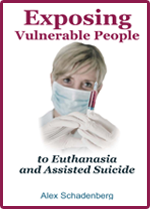
The book, Exposing Vulnerable People to Euthanasia and Assisted Suicide by Alex Schadenberg uncovers the data proving that unreported euthanasia deaths and the abuse of the euthanasia laws in jurisdictions where it is legal, such as euthanasia deaths without request, not only occurs but represents a threat to vulnerable patients.

Order the book: Exposing Vulnerable People to Euthanasia and Assisted Suicide. Link.

Educating people on assisted suicide changes minds

The following article was published by OneNewsNow after an interview with Alex Schadenberg, the International Chair of the Euthanasia Prevention Coalition.

Charlie Butts  (OneNewsNow.com)
Saturday, January 12, 2013
.
A group is questioning the results of a new poll that claim 55 percent of Americans support assisted suicide.

Alex Schadenberg of the Euthanasia Prevention Coalition (EPC) says the National Public Radio survey does not explain whether the respondents truly support it, or if they are expressing personal concerns of experiencing an uncomfortable death. He contends it is a matter of educating the public -- and once that is done, he says, the majority opposes assisted suicide.


For example, polls in Massachusetts last year showed voters favoring the legalization of doctor-assisted suicide before the education campaign began.
"On November 6, the people of Massachusetts defeated the assisted suicide plebiscite by 51 percent to 49 percent, saying that they were not going to support assisted suicide," Schadenberg notes. 
"Now what's important about this is that Massachusetts was chosen by the assisted suicide lobby groups as the state to run this plebiscite in because it was the most likely state to pass such a thing."
Meanwhile, he tells OneNewsNow there are serious problems with end-of-life care, specifically when it comes to dealing with pain.
"When we have the technology and the proper medications in place to keep you comfortable -- that they are not being used is a problem. But the answer to this problem is not killing people," he remarks. "It's providing proper care for people."
The EPC spokesman further warns that assisted suicide provides the vehicle for a second party to cause one's death, which creates a multitude of difficulties. The primary instances of these difficulties have surfaced in Europe, where assisted suicide has long been a practice and has now evolved into allowing people who suffer from depression, for example, to make the decision to end their own lives.

Belgium is even considering permitting young people to qualify for lethal drugs if they do not want to live or are suffering from a disability.

Link to the article: Do Americans want to legalize assisted suicide? that is written by Alex Schadenberg.

Friday, January 11, 2013

Irish court says NO to assisted suicide.

A three judge panel Irish divisional court unanimously upheld the assisted suicide law by rejecting a challenge to the Irish assisted suicide act.

Marie Fleming, who lives with MS and is married to Tom Curran, a leader of Exit International, a euthanasia lobby group, challenged the Irish assisted suicide law claiming that the assisted suicide law is unconstitutional based on the Constitution and the European Convention of Human Rights. The case was heard last month.

This decision is particularly important for Canada because the Fleming case was based on the Carter case in British Columbia. The Carter case is going to the BC Court of Appeal in March 2013.

According to the Irish Independent the Irish court unanimously upheld the assisted suicide law in a 100 page document. The Divisional Court:
rejected Ms Fleming's claims under the Constitution and the European Convention of Human Rights. 
The court said that it was impossible to liberalise the law on assisted suicide and at the same time protect vulnerable persons such as the aged, the disabled, the poor, the unwanted and others including those who were financially compromised who may be vulnerable to assisted suicide.
The Irish Independent stated:
In her landmark action, Ms Fleming claimed that the strict ban on assisted suicide was unconstitutional and in breach of the European. 
Convention on Human Rights (ECHR) as, she claimed, it violates her rights to dignity, privacy and autonomy.
According to the Irish Independent, the Crown opposed to the arguments by Fleming based on:
Lawyers for the State opposed the action during a six day hearing. 
The State said that although suicide had been decriminalised, there was no constitutional right to commit suicide. 
The State said it was entitled, as a matter of social policy, to maintain the ban.
The Irish Times explained the Fleming decision in this way:
While finding her personal autonomy and equality rights were engaged by the ban, the court found no disproportionate interference with those rights. 
This case was “entirely different” from one where a competent adult refused medical treatment, even if such refusal led to death, because assisted suicide involved the taking of “active” steps by a third party to bring about the death of another. 
If the court could “tailor-make” a solution to suit Ms Fleming’s needs “alone” without any possible implications for third parties or society at large, there might be “a great deal” to be said for her article 40.3.2 case, but the court could not be so satisfied. 
The court had heard ample evidence to support the view any relaxation of the ban would be impossible to tailor to individual cases and also inimical to the public interest in protecting the most vulnerable. Evidence from other countries where assisted suicide was legal showed abuse risks were “all too real”.
The decision of the Irish court was very important. The three judge panel heard very similar evidence as the Canadian court in the Carter case and decided to uphold the current law. 
The Fleming case will likely be appealed to the Irish Supreme Court.


Thursday, January 10, 2013

Quick facts about Assisted Suicide

The following article was originally published by Montanans Against Assisted Suicide website.

Margaret Dore
By Margaret Dore, Esq.*


For a print version, click here.

1. Assisted Suicide

Assisted suicide means that someone provides the means and/or information for another person to commit suicide. When a physician is involved, the practice is physician-assisted suicide.[1]

2. The Oregon and Washington Laws

In Oregon, physician-assisted suicide was legalized in 1997 via a ballot measure.[2] In Washington State, a similar law was passed via another ballot measure in 2008 and went into effect in 2009.[3] No such law has made it through the scrutiny of a legislature despite more than 100 attempts.[4]

Jeanette Hall
3. Patients are Not Necessarily Dying


The Oregon and Washington laws are restricted to patients predicted to have less than six months to live.[5] Such persons are not necessarily dying. Doctors can be wrong.[6] Moreover, treatment can lead to recovery. Consider Jeanette Hall, who was diagnosed with cancer and given six months to a year to live.[7] She was adamant that she would "do" Oregon’s law, but her doctor, Ken Stevens, convinced her to be treated instead.[8] She is still alive 12 years later.[9]

4. A Recipe for Elder Abuse

The Washington and Oregon laws are a recipe for elder abuse. The most obvious reason is due to a lack of oversight when the lethal dose is administered.[10] For example, there are no witnesses required at the death; the death is allowed occur in private.[11] With this situation, the opportunity is created for an heir, or some other person who will benefit from the patient’s death, to administer the lethal dose to the patient without his consent. Even if he struggled, who would know?

Barbara Wagner
5. Empowering the Healthcare System


In Oregon, patients desiring treatment under the Oregon Health Plan have been offered assisted suicide instead.

The most well known cases involve Barbara Wagner and Randy Stroup.[12] Each wanted treatment.[13] The Plan denied their requests and steered them to suicide by offering to pay for their suicides.[14] Neither Wagner nor Stroup saw this scenario as a celebration of their "choice." Wagner said: "I'm not ready to die."[15] Stroup said: "This is my life they’re playing with."[16]

Wagner and Stroup were steered to suicide. Moreover, it was the Oregon Health Plan, a government entity, doing the steering.[17]

6. Suicide Contagion

Oregon's suicide rate, which excludes suicides under its physician-assisted suicide law, has been "increasing significantly" since 2000.[18]

Just three years prior, Oregon legalized physician-assisted suicide. This increased suicide rate is consistent with a suicide contagion. In other words, legalizing one type of suicide encouraged other suicides. Montana already has one of the highest suicide rates in the nation.[19]

7. A "Wedge" Issue

In Washington State, where assisted suicide was legalized four years ago, there is already a discussion to expand its law to direct euthanasia for non-terminal people.[20] Indeed, last month, there was a column describing reader suggestions for euthanasia for people unable to afford care, which would be on an involuntary basis for people who want to live.[21]

* Margaret Dore is an attorney in Washington State where assisted suicide is legal. She is also President of Choice is an Illusion, a nonprofit corporation opposed to assisted suicide. For more information, see www.margaretdore.com and www.choiceillusion.org

-----------------

[1] Compare: American Medical Association, Code of Medical Ethics, Opinion 2.211, available at: http://www.ama-assn.org/ama/pub/physician-resources/medical-ethics/code-medical-ethics/opinion2211.page

[2] The Oregon and Washington laws are similar. For a short article about Washington’s law, see Margaret K. Dore, "'Death with Dignity': What Do We Advise Our Clients?," King County Bar Association, Bar Bulletin, May 2009, available at: https://www.kcba.org/newsevents/barbulletin/BView.aspx?Month=05&Year=2009&AID=article5.htm

[3] Id.

[4] http://epcdocuments.files.wordpress.com/2011/10/attempts_to_legalize_001.pdf

[5] See ORS 127.800 s.1.01(12) and RCW 70.245.010(13).

[6] See e.g., Nina Shapiro, "Terminal Uncertainty: Washington’s new "Death With Dignity" law allows doctors to help people commit suicide­once they’ve determined that the patient has only six months to live. But what if they’re wrong?," 01/14/09, available at: http://www.seattleweekly.com/2009-01-14/news/terminal-uncertainty

[7] See Jeanette Hall, Letter to the editor, "She pushed for legal right to die, and - thankfully - was rebuffed, Boston Globe, October 4, 2011 ("I am so happy to be alive!), available at: http://www.boston.com/bostonglobe/editorial_opinion/letters/articles/2011/10/04/she_pushed_for_legal_right_to_die_and___thankfully___was_rebuffed/ Kenneth Stevens MD, Letter to the Editor, "Oregon mistake costs lives," The Advocate, the official publication of the Idaho State Bar, Sept. 2010, (scroll down to last letter at: www.margaretdore.com/info/Stevens.pdf).

[8] Id.

[9] Per her telephone call today.

[10] The Oregon and Washington Acts can be viewed in their entirety here and here.

[11] Id.

[12] See Susan Donaldson James, "Death Drugs Cause Uproar in Oregon," ABC News, August 6, 2008, at: http://abcnews.go.com/Health/story?id=5517492&page=1; "Letter noting assisted suicide raises questions," KATU TV, July 30, 2008, at: http://www.katu.com/news/specialreports/26119539.html; and Ken Stevens, MD, Letter to Editor, "Oregon mistake costs lives," The Advocate, the official publication of the Idaho State Bar, September 2011, to view, scroll down to bottom of second page here: http://www.margaretdore.com/info/September_Letters.pdf

[13] Id.

[14] Id.

[15] KATU TV at note 12

[16] ABC News at note 12

[17] See also Affidavit of Ken Stevens MD (Leblanc v. Canada), with attachments, available at: http://maasdocuments.files.wordpress.com/2012/09/signed-stevens-aff-9-18-12.pdf

[18] See "Suicides in Oregon: Trends and Risk Factors," Oregon Department of Human Services, Public Health Division, September 2010, page 6, ("Deaths relating to the death with Dignity Act (physician-assisted suicides) are not classified as suicides by Oregon law and therefore excluded from this report"), available at: http://epcdocuments.files.wordpress.com/2011/10/or_suicide_report_001.pdf

See also Oregon Health Authority, News Release, "Rising suicide rate in Oregon reaches higher than national average," September 9, 2010, ("suicide rates have been increasing significantly since 2000") available at: http://www.oregon.gov/DHS/news/2010news/2010-0909a.pdf [19] Cindy Uken, "State of Dispair: High-Country Crisis, Montana’s suicide rate leads the nation," Billings Gazetter, November 25, 2012, http://billingsgazette.com/news/state-and-regional/montana/montana-s-suicide-rate-leads-the-nation/article_b7b6f110-3e5c-5425-b7f6-792cc666008d.html?print=true&cid=print

[20] See Brian Faller, "Perhaps it's time to expand Washington's Death with Dignity Act, The Olympian, November 16, 2011, available at: http://www.theolympian.com/2011/11/16/1878667/perhaps-its-time-to-expand-washingtons.html

[21] See Jerry Large, "Planning for old age at a premium," The Seattle Times, March 8, 2012 at: http://seattletimes.nwsource.com/text/2017693023.html ("After Monday's column, some readers were unsympathetic, a few suggested that if you couldn't save enough money to see you through your old age, you shouldn't expect society to bail you out. At least a couple mentioned euthanasia as a solution.")

Wednesday, January 9, 2013

"Kill Me" Living Will Coming to Australia?

On January 5 I published an article written by Paul Russell, the leader and founder of HOPE Australia concerning a proposed euthanasia bill that is potentially being sponsored by South Australian MP Steph Key. The article was entitled: Euthanasia by "Living Will."

Yesterday I wrote an article about another euthanasia bill that is being proposed by South Australian MP Bob Such. The article is entitled: South Australian MP Bob Such to introduce euthanasia bill, again.

South Australia has faced a barrage of bills to legalize euthanasia over the past few years. A similar bill sponsored by Bob Such was defeated by a vote of 22 to 20 in June 2012.

 The following article was written by American Bioethicist Wesley Smith on the euthanasia bill that South Australian State MP Steph Key is proposing. Wesley published this article on his blog on January 4 under the title: "Kill Me" Living Will Coming to Australia? The article follows.


By Wesley Smith - Human Exceptionalism blog, January 4, 2013.

Wesley Smith
The euthanasia movement rarely tells the full truth about its objectives. Activists pretend that their goal is only to legalize “voluntary” terminations, or in the USA, to restrict killing to the already dying whose suffering–a very elastic term in euthanasia advocacy–cannot otherwise be controlled.

But once a society accepts the premise that killing is an acceptable answer to human suffering, eventually concepts such as “voluntary” and “only for the terminally ill,” fall by the wayside. Look at the Netherlands, where 45% of neonatologists (according to a Lancet study) have committed infanticide and doctors engage in non voluntary euthanasia–euphemistically called “termination without request”–without fear of any significant legal or professional consequence. 

Now, a bill soon to be introduced in the South Australia Parliament–where euthanasia is always bubbling on the legislative stove–would permit people to be killed by doctors based on via instructions made, catch the irony, in a “living will.” From AdelaideAdvertiser story:
State Labor backbencher Steph Key is working on new voluntary euthanasia legislation and will meet with interest groups at the end of this month. While she stressed she was still finalising her plans, Ms Key said she would prefer the option of voluntary euthanasia outlined in a living will, as is done in Belgium, to other models in places like Switzerland or Oregon in the US that require the patient to carry out or administer euthanasia themselves. 
A living will allows a person to take control of end-of-life medical decisions by indicating if they would prefer or refuse treatment for future illnesses. Under Ms Key’s preferred model, a person would be able to state in a will that if they find themselves in “a situation where their life is intolerable in a medical sense then . . . they would like to follow through with the option of voluntary euthanasia. That doesn’t mean that you have to follow through with that necessarily or you can’t change your mind,” Ms Key said. However, she said the decision should be made before a person became too sick.
This is really insidious. Many people think they would rather die than experience a significant disability or cognitive impairment.  But when their worst fear take place, they may not feel that way at all.  But under this proposal, their no longer existing younger incarnation would be able to order their current self killed–and practically speaking, it wouldn’t really matter whether the to-be-killed person still wanted to die or not, especially if he or she couldn’t communicate well. And it would certainly open the door to putting grandma out of our or society’s financial misery.

People are so worried about becoming unloved burdens or being ill thought of if they experience a serious incapacity. Proposals like this tell them they are right.


Tuesday, January 8, 2013

South Australian MP, Bob Such, to introduce euthanasia bill, again.

South Australian Parliament
South Australian Independent MP, Bob Such, will once again attempt to legalize euthanasia in South Australia. A similar bill sponsored by Bob Such was defeated by a vote of 22 to 20 in June 2012. Such told the Adelaide Advertiser that "he would re-jig the laws and try again."

South Australia has had gone through a constant series of attempts to legalize assisted suicide. On January 5, South Australian MP Steph Key also stated her intention of introducing a bill to legalize euthanasia by "Living Will." 

Fortunately, South Australia is also where Paul Russell the founder and leader of HOPE Australia lives. Russell is working with a Coalition, including people with disabilities, legislators and doctors, who oppose the legalization of euthanasia and Assisted Suicide.


Paul Russell, Alex Schadenberg,
Leesa Vhalos, & Dr. Britton
Adelaide Australia, June 2012.
It appears that the euthanasia lobby intends to win by wearing Paul Russell out. HOPE Australia is busy opposing the legalization of euthanasia and assisted suicide throughout Australia.

The article in the Adelaide Advertiser stated that the Bob Such euthanasia bill would establish a panel of 8 people to oversee the euthanasia law in South Australia. It is interesting that the euthanasia lobby continues to promote these ineffective and toothless committees that are established to examine the euthanasia deaths, after the person has died. It is ridiculous that the euthanasia lobby insists that after-the-death reporting can actually protect a vulnerable person from having euthanasia imposed upon them.

The Advertiser article that was written by Lauren Novak also stated that the "Cause of death would not be listed as suicide or homicide." In other words, the Coroner will be ordered to lie on the death certificate.

It is interesting that Novak concludes the article in the Advertiser by stating:
"Canadian anti-euthanasia expert Alex Schadenberg visited Adelaide to brief MPs before the vote about the risks of abuse or misuse of euthanasia. 
He said international statistics showed there were cases where euthanasia was performed without the consent of the patient. 
The medical profession should be improving palliative care, he said."
In June 2012 I met with Novak for one hour and gave her information about the recent studies in Belgium and the Netherlands that prove that significant abuse is occurring. To this day, Novak has yet to publish her interview with me, even though she continually reports on euthanasia and assisted suicide.

To learn more about the practice of euthanasia in Belgium and the Netherlands order the recent book by Alex Schadenberg: Exposing Vulnerable People to Euthanasia and Assisted Suicide

Paul Russell is a great leader and he is the Vice Chair of the Euthanasia Prevention Coalition International.

Monday, January 7, 2013

South Australia: Euthanasia by "Living Will"

The following article was written by Paul Russell, the founder and leader of HOPE Australia, a group that opposes euthanasia and assisted suicide. The article was published on the HOPE Australia blog under the title: "Living" Wills to be used to Die? 

Paul Russell is responding to an article in the Adelaide Advertiser. The Advertiser interviewed Steph Key, a member of the South Australian legislature who plans to introduce a bill, again, to legalize euthanasia in South Australia.

When I was in South Australia last June, I had the opportunity of presenting information about the research on the euthanasia law in Belgium before a group of members of the South Australian legislature that included Steph Key. Last year Key attempted to legalize euthanasia through the back-door, under the guise of palliative care and now Key is promoting euthanasia by "Living Will."

For more information the Belgium euthanasia law, read my book: Exposing Vulnerable People to Euthanasia and Assisted Suicide.


Paul Russell
Paul Rusell, HOPE Australia, January 5, 2012

South Australian MP and euthanasia advocate Steph Key MP announced today that she wants to be able to create 'options' in Living Wills for people to be able to choose death.

'Living Wills'- once used to describe what are now known more accurately as 'Advance Care Directives', are instruments where a person can make a determination, in advance, of what type of care they want and/ or reject at the end-of-life. The use of the word 'Living' in this context simply modifies the normal understanding of a Last Will and Testament. Key's use, however, seems to be a deliberate and macabre play between living and dying.

Advance Care Directives can be useful instruments. They can also be problematic in situations where the request is poorly worded or does not account for unforeseen circumstances. Regardless, they were never intended to be used for the person to direct that they be killed.

South Australian Parliament
Key is confused here. The article in the Adelaide Advertiser today records Key as saying that the Oregon laws allow a patient to carry out euthanasia themselves. She later defines her 'preferred model' as creating an option for euthanasia. One cannot carry out euthanasia for oneself - it is either suicide, pure and simple, or suicide with the assistance of another - assisted suicide. If it is euthanasia, then another person, normally a medical practitioner, takes the direct action to kill.

These comments come at a time when the South Australian Upper House will soon begin to debate a government bill that seeks to reform the entire notion and application of Advance Care Directives. Contrary to the article's assertion and in spite of the claims in that bill, it does allow for euthanasia and assisted suicide in some circumstances. It may be that Key's announcement is more about deflecting attention from the current bill's agenda than it is about setting up her own regimen.

Given the problematic nature of advance care directives as mentioned earlier, it is impossible to conceive or construct a 'death wish' statement that could not be misinterpreted. This would provide opportunities for abuse when a relative or other person who stood to benefit from the estate of the person, pushed for their deliberate demise.

Nor is it difficult to accept the possibility that the drafting of an advance care directive could be done under duress. This is a recipe for Elder Abuse.

Key mentions Belgium as providing a model for her thinking. Yet studies on the Belgium statistics from the Flanders Region make clear that opportunities for abuse abound. In 2010 in that region, 32% of euthanasia deaths occurred without consent or request and a staggering 47% of cases were not even reported.

The Advertiser article closes with a statement from a local euthanasia activist who claims that there's been a 'paradigm shift' in the thinking of young people towards support for euthanasia. Just like the assertions in the Advance Care Directives Bill - just because someone says it is so doesn't make it so.

Assisted Suicide should not be the answer


The following letter was written by pharmacist, Abigail Robbins in Washington State and published in the Gateline on January 2, 2013 under the title: Assisted Suicide should not be the answer: Pharmacist-assisted suicide should be illegal in Washington state.

Pharmacist-assisted suicide should be illegal in Washington state.

By Abigail H. Robbins; Gig Harbor Washington State - January 2, 2013

The euthanasia drug has shown the medical industry has stopped trying to save patients from life-threatening diseases. The American Medical Association code of conduct says, “Patients should not be abandoned once it is determined that cure is impossible.”

Seventy-one people died from the drug. And fewer people take it for pain than for the fact they have stopped being able to do the things they enjoy doing.

Less than 25 percent of the patients who take the pills take them for pain, and more than 50 percent take it for loss of autonomy.

Many patients take the pill because they will be a nuisance to their families. In fact, 88 percent who get the pills do so because they think they will burden their loved ones.

Supporters of assisted suicide believe if people are going to die, they should be able to do so peacefully instead of dying painfully.

In order to get the drug, patients must be terminal with at least six months left to live.

However, if you do take the drug, you may not die. About 20 percent of those who take it don’t perish.

Read more here: http://www.thenewstribune.com/2013/01/02/2420932/assisted-suicide-should-not-be.html#storylink=cpy

Friday, January 4, 2013

Terri Schiavo's brother petitions court to intervene in Guardianship Case.


The following article was received during the holidays. The Euthanasia Prevention Coalition is very interested in this case. We do not believe that withholding hydration and nutrition from a person who is not otherwise dying, is in the best interests of that person.

Schiavo's Brother Petitions Court to Intevene in Guardianship Case

Philadelphia, Pa., December 27, 2012

Bobby Schindler
Attorney Christopher Johnson has filed with the Supreme Court of the State of New York, asking the court to allow Mr. Bobby Schindler, brother of Terri Schiavo to serve as Guardian for Mr. Gary Harvey.

In 2006, Mr. Harvey, a Chemung County resident, was involved in a home accident, which left him with a profound brain injury. His spouse, Mrs. Sara Harvey, sought guardianship only to be denied by the Chemung County Supreme Court who ultimately appointed the Chemung County Department of Social Services as Mr. Harvey's guardian. Since that time, Mrs. Harvey has been in a prolonged court battle with Chemung County officials and the New York State Court System.

Indeed, it was in May of 2009 when the ethics committee from the hospital where Mr. Harvey was residing recommended the removal of his nutrition and hydration tube, and also issued a "do-not-resuscitate order" (DNR).

Fortunately, the court denied that request. However, inexplicably, the DNR stayed in place and Mr. Harvey remains under the control of Chemung County, despite the fact that the county tried to end his life.

"I have raised the question many times, 'How can Chemung County, Guardian of Mr. Harvey, be acting in his best interest when they, in fact, tried to kill him?' From all indications, it appears that Mr. Harvey has been warehoused and denied the opportunity to receive the care and rehabilitative services that would benefit his condition," stated Bobby Schindler.

It is the hope that with this filing, the court will recognize that Mr. Harvey deserves the chance to receive aggressive therapy and rehabilitation. Certainly from Mr. Schindler's experience with brain injured persons, he would afford Mr. Harvey the help he needs in the hopes to significantly improve his quality of life.

Bobby Schindler is the brother of Terri Schiavo and is the Executive Director of the Terri Schiavo Life & Hope Network, established in 2005 to protect the rights of the medically vulnerable. For more information, please visit www.lifeandhope.com

Thursday, January 3, 2013

Obituary - Dr. André Bourque, President: Vivre dans la Dignité


It is with great sadness that we advise you of the passing of Dr. André Bourque, president and co-founder of the (Vivre dans la Dignité) Living With Dignity network. Dr. Bourque was Chief of the Department of General Medicine at CHUM for many years and associate professor at the University of Montreal.

Living with Dignity had the immense privilege of benefiting from Dr.Bourque's tireless work and wonderful example from the founding of the network in 2010. He was known and respected for his profound humanity and his ability to rally others to our common cause. 

In the words of Dr. Patrick Vinay, palliative care specialist and vice-president of Living with Dignity: "Dr. Bourque was a man of action, a man of great thoughtfulness, who was at the forefront of the defending the rights of the sick and the most vulnerable and ensuring they received care appropriate to their condition at all times." 

Our deepest condolences go out to Dr Bourque's family.


Prayers and condolences will be offered at the Centre funeral Côte-des-Neiges,
4525 chemin de la Côte-des-Neiges,
Friday, January 4, 2013, from 7pm to 9pm.

The funeral will be held at the Cathédrale Marie-Reine-du-Monde
Saturday, 5 January 2013, at 10:30 am


C'est avec grande tristesse que nous vous apprenons le décès du Dr André Bourque, président et cofondateur du réseau Vivre dans la Dignité. Il était aussi Chef du département de médecine générale du CHUM depuis de nombreuses années et professeur agrégé à l'Université de Montréal. 

Vivre dans la Dignité a eu l’immense privilège de compter sur l'engagement inconditionnel et exemplaire du Dr Bourque au sein de son réseau depuis sa fondation en 2010. Il était respecté et connu pour ses grandes qualités humaines et pour sa capacité à rassembler les personnes autour de projets communs.

"Le Dr Bourque était un homme d'action et de pensée et très actif dans la défense des droits des malades et de la pérennité des soins appropriés en tout temps", affirme le Dr Patrick Vinay, médecin en soins palliatifs et vice-président de Vivre dans la Dignité.

Nos pensées vont à son épouse et à sa famille, à qui nous offrons nos plus sincères condoléances.

Il sera exposé au Centre funéraire Côte-des-Neiges,
4525 chemin de la Côte-des-Neiges, 
le vendredi 4 janvier 2013, de 19h à 21h.

Les funérailles auront lieu à la Cathédrale Marie-Reine-du-Monde
le samedi 5 janvier 2013, à 10h30.

Tuesday, January 1, 2013

Assisted suicide in Washington and Oregon: A recipe for elder abuse and cloaked in secrecy

The following article was written by Seattle lawyer, Margaret Dore and published on December 31 on the Missoulian website under the title: Oregon, Washington assisted suicide laws include no protections for patients. Margaret Dore indicated that she had titled the article: Assisted suicide in Washington and Oregon: A recipe for elder abuse and cloaked in secrecy.
Margaret Dore

By Margaret Dore, Esq.

I disagree with Susan Hancock’s description of how the Washington and Oregon assisted suicide laws work.  (Dec. 20, guest column)  I disagree that assisted suicide cannot be forced upon an unwilling person.

The Oregon and Washington assisted suicide acts have a formal application process. The acts allow an heir, who will benefit from the patient’s death, to actively participate in this process.

Once the lethal dose is issued by the pharmacy, there is no oversight. For example, there is no witness required at the death. Without disinterested witnesses, the opportunity is created for an heir, or for another person who will benefit from the patient’s death, to administer the lethal dose to the patient without his consent. One method would be by injection when the patient is sleeping. The drugs used in Oregon and Washington are water soluble and therefore injectable. If the patient woke up and struggled, who would know?

The Washington and Oregon acts require the state health departments to collect statistical information for the purpose of annual reports. According to these reports, users of assisted-suicide are overwhelmingly white and generally well-educated. Many have private insurance. Most are age 65 and older. Typically persons with these attributes are seniors with money, which would be the middle class and above, a group disproportionately at risk of financial abuse and exploitation.

The forms used to collect the statistical information do not ask about abuse. Moreover, not even law enforcement is allowed to access information about a particular case. Alicia Parkman a mortality research analyst at the Center for Health Statistics, Oregon Health Authority, wrote me: 
“We have been contacted by law enforcement and legal representatives in the past, but have not provided identifying information of any type.“
Assisted suicide in Washington and Oregon is a recipe for elder abuse and cloaked in secrecy. Don’t make our mistake.

Supporting documentation below.

Margaret Dore, Esq. Seattle, Washington

[1] See, for example, Margaret Dore, "'Death with Dignity': What Do We Advise Our Clients?," King County Bar Association, Bar Bulletin, May 2009 (describing Washington's application process and other aspects of Washington's law), at:  https://www.kcba.org/newsevents/barbulletin/BView.aspx?Month=05&Year=2009&AID=article5.htm

[2] The drugs used, Secobarbital and Pentobarbital (Nembutal), are set forth in the Oregon and Washington annual reports. See, e.g., Table 1 to Oregon's most recent report listing these drugs, page 2, at:  http://public.health.oregon.gov/ProviderPartnerResources/EvaluationResearch/DeathwithDignityAct/Documents/year14-tbl-1.pdf

[3] Secobarbital and Pentobarbital are  water and alcohol soluable, such that they can be injected without consent, for example, to a sleeping individual. See "Secobarbital Sodium Capsules, Drugs.Com, at:  http://www.drugs.com/pro/seconal-sodium.html or http://www.drugs.com/pro/nembutal.html

[4] See the most current official report from Washington State, "Washington State Department of Health 2011 Death with Dignity Act Report, Executive Summary ("Of the 94 participants in 2011 who died, . . . 94% were white, non-Hispanic . . .75 percent had at least some college education"), available at: http://www.doh.wa.gov/portals/1/Documents/5300/DWDA2011.pdf. See also the most current official report from Oregon, also for 2011 ("most [users] were white (95.6%) [and] well-educated (48.5% had at least a baccalaureate degree) . . .", available at:  http://public.health.oregon.gov/ProviderPartnerResources/EvaluationResearch/DeathwithDignityAct/Documents/year14.pdf

[5] See Washington's report, table 2 (46% had private insurance only, or a combination of private and Medicaid/Medicare). See Oregon's report ("patients who had private insurance (50.8%) was lower in 2011 than in previous years (68.0%). . .")

[6] See Washington's report, Table 2 (74% were aged 65 or older). See Oregon's report, page 2 ("Of the 71 DWDA deaths during 2011, most (69.0%) were aged 65 years or older; the median age was 70 years").

[7] Educated persons are generally financially better off than non-educated persons; persons with private insurance often have current or past employment; seniors generally are relatively well off. See "Broken Trust: Elders, Family, and Finances, a Study on Elder Financial Abuse Prevention, by the MetLife Mature Market Institute, the National Committee for the Prevention of Elder Abuse, and the Center for Gerontology at Virginia Polytechnic Institute, March 2009, Executive Summary, page 4 ("Elders' vulnerabilities and larger net worth make them a prime target for financial abuse").  Available at:  http://www.metlife.com/assets/cao/mmi/publications/studies/mmi-study-broken-trust-elders-family-finances.pdf

[8] The Met Life Study of Elder Financial Abuse, "Crimes of Occasion, Desperation, and Predation Against America's Elders," June 2011, page 2, key findings ("The annual financial loss by victims of elder financial abuse is estimated to be at least $2.9 billion dollars, a 12% increase from the $2.6 billion estimated in 2008").  Available at:  http://www.metlife.com/assets/cao/mmi/publications/studies/2011/mmi-elder-financial-abuse.pdf

[9] The reporting forms focus on "ingestion" of the lethal dose and whether the patient "took" or "consumed" the lethal dose, none of which necessarily require a voluntary or consensual act. Oregon's reporting forms can be accessed here: http://public.health.oregon.gov/ProviderPartnerResources/EvaluationResearch/DeathwithDignityAct/Documents/mdintdat.pdf

[10] Ms Parkman's e-mail to me can be viewed here: http://choiceisanillusion.files.wordpress.com/2012/10/alicia-a-parkman-no-law-enforcement-access.pdf