Thursday, March 12, 2015

Australian Medical Association expels Nitschke

This article was published on the HOPE Australia website on March 12, 2015.

Paul Russell
By Paul Russell, Director of HOPE Australia.


Never far from the news it seems the ABC Alice Springs reports today that the Northern Territory Branch of the Australian Medical Association has expelled Philip Nitschke from its ranks.

This news comes immediately after the death of Nitschke's legal council last week. Peter Nugent QC was, according to reports, suffering from stage four cancer but was not understood to be near death. Nitschke told Fairfax Media that Nugent “had options in place” for ending his own life. He also said that Nugent's death was 'perplexing' and 'a great loss'.

Nugent had been acting pro bono for Nitschke in the matter of the suspension of Nitschke's medical licence in July last year after questions were raisied about whether or not he (Nitschke) should have referred a suicidal Perth man for counselling when he had approached Nitschke via email and in person.

The suspension was heard in the Northern Territory Health Professional Review Tribunal in November last year. The suspension, upheld at that juncture, continues pending the hearing of a dozen complaints to the Australian Health Professionals Regulation Agency about the activities of Exit and Philip Nitschke (including one complaint from this writer).

Nitschke has lodged an appeal to the original suspension and that hearing is listed for the Supreme Court in Darwin in early April.

Responding to this latest move by the AMA to expel Nitschke as a member, head of the NT Branch of the AMA, Dr Robert Parker told the ABC that the decision related to both the Nigel Brayley case (mentioned above) and the AMA's own code of ethics.

"It wasn't just the AHPRA [Australian Health Practitioner Regulation Agency] issues, it was also the AMA issues," he said. 
"The AMA expects very high standards from its members and my understanding is that the council, in reviewing Dr Nitschke felt that he hadn't...actually achieved those very high standards."
Dr Parker added that advocacy of 'rational suicide' does not comply with the AMA's code of ethics.

Nitschke tweeted: 
"The AMA "high standards" means any Supreme Court decision is irrelevant - more medical arrogance on euthanasia issue".
He also told the ABC that: 
"The fact that the NT AMA comes along now and says [they're] not even going to wait for the court to have a look at it...is just evidence of how small minded they are."
This has been a long time coming for those who have watched with concern the growth and development of the Exit organisation and its seemingly ever increasing reach in suicide advocacy.

The saga will continue.

Wednesday, March 11, 2015

27% increase in assisted suicide at Swiss suicide clinic in 2014.

By Alex Schadenberg
International Chair - Euthanasia Prevention Coalition


The Exit suicide clinic in Switzerland reported that there were 583 assisted suicide deaths in 2014, a 27% increase from the 459 deaths in 2013.

Exit claimed that the spike in numbers was due to a greater media interest in euthanasia, an ageing population and a rise in cases of dementia.


Last May, Exit extended assisted suicide to elderly healthy people who are living with physical or psychological pain. This decision would have led to an increase in deaths.

In February 2014, Oriella Cazzanello, an 85 year-old healthy woman died at a Swiss suicide clinic. The letter she sent her family stated that she was unhappy about how she looked.

Pietro D'Amico
In April 2013, Pietro D’Amico, a 62-year-old magistrate from Calabria in southern Italy, died by assisted suicide at a suicide clinic in Basel Switzerland 
after receiving a wrong diagnosis.

A 2014 Swiss study found that people who died at Swiss suicide clinics had no underlying illness in 16% of the cases.

It appears that euthanasia and assisted suicide are becoming normalized in countries where it is legal. Recent statistics indicate that euthanasia increased by 27% in 2013 in Belgium and 15% in 2013 in the Netherlands, while assisted suicide increased by 44% in 2014 in Oregon and 43% in 2013 in Washington State.

Euthanasia and assisted suicide appear to be socially contagious.

Former Super Bowl Champion, O.J. Brigance, who lives with ALS opposes assisted suicide.

By Alex Schadenberg
Executive Director - Euthanasia Prevention Coalition

O. J. Brigance
The Daily Signal reported that former Super Bowl champion, O.J. Brigance, testified against assisted suicide at the Maryland Senate Judiciary Committee hearings on Tuesday March 10.

Brigance, who was a Super Bowl champ with the Baltimore Ravens in 2000, has been living with ALS for 8 years. 


Link to the testimony.

Brigance urged the committee to reject the assisted suicide bill because it would "devalue lives." Brigance said that he has enjoyed some of the most meaningful years of his life since being diagnosed. He said:
"The thought that there would be a legal avenue for an individual to take his or her own life in a moment of despair, robbing family, friends and society of their presence and contribution to society deeply saddens me and is a tragedy,"
He also said:  
“Since being diagnosed, I have done a greater good for society in eight years, than in my 37 years on earth.”
Maryland is expected to vote on the assisted suicide bill in the next few weeks.

Governor Larry Hogan, during the last election, said that he would veto an assisted suicide bill.

Tuesday, March 10, 2015

The Carter Decision: Not Safe for Doctors

By Alex Schadenberg,
Executive Director - Euthanasia Prevention Coalition


The Carter decision has been heralded as legalizing “physician-assisted death,” more commonly known as assisted suicide or euthanasia. A closer reading of the decision reveals, however, that these practices are not “legalized” in the sense that they are safe for doctors to do. This will be the case until the expiration of a 12 month suspension and the passage of regulations by Parliament of a regulatory scheme to create safe harbors for practice.

Carter merely provides that the Criminal Code provisions prohibiting physician-assisted death are of no force or effect when three factors are satisfied: patient competency; clear consent; and a “grievous and irremediable medical condition.” (Decision, ¶147). Physicians are not always right regarding such factors.

Consider, the Victorio Noval case, in California, where a hospital reportedly performed a “terminal extubation,” thus causing Noval’s death. After the fact, the hospital learned that his daughters had lied about his condition for the purpose of a quick inheritance and that consent had been required by Noval’s son, which had not been obtained. The hospital and other parties have now been sued. Hospital staff are reportedly refusing to testify in order to avoid incriminating themselves on criminal charges.

If, by contrast, Noval had died under a regulatory scheme such as Washington’s death with dignity act, there would have been no basis for liability as long as the act was used. See: Washington State’s death certificate instructions, requiring that a death be treated as “Natural” as long as the act was “used.”

Without the imposition of a similar regulatory scheme by Parliament, no doctor who assists a suicide, can be assured of his or her safety to do so. Even after the 12 month suspension period, doctors are at risk of homicide charges because, like the hospital in  Mr. Noval’s case, they learn after the fact that they were wrong.

View the Carter decision.

Assisted suicide defense to "cover up" alleged murder.

Alex Schadenberg
By Alex Schadenberg
Executive Director - Euthanasia Prevention Coalition

A Brockville nurse who has been accused of killing her terminally ill husband could have been "covered up" if assisted suicide was legal.

The trial of Nancy Lane in the alleged murder of her husband Art Lane began yesterday in Ottawa. Nancy, a nurse and a former member of the Brockville town council, allegedly intentionally overdosed her husband, after returning from the Dominican Republic, where she was visiting her alleged lover. She is accused of killing her husband in order to collect his life insurance.

Art Lane
The Ottawa Sun reported Crown prosecutor Robert Morrison as stating:

By 2008 she had taken a lover half her age in the Dominican Republic. 
She was besotted with him, writing to one friend on the eve of a visit that "in a few days I will be in heaven." 
A forensic accountant will testify that the Lane finances had reached "complete desperation" in 2009 and "financial armageddon" in the months before Art Lane's death, 
Art Lane had a $200,000 life insurance plan and she was the sole beneficiary. What's more, if he went into the light she would be able to collect on his pension. 
On Oct. 6, 2009 she returned from the Dominican. Art Lane picked her up in Montreal.
Two days later his son looked in and found him frail and failing, drinking water from a backyard pool. 
Art Lane had grown unresponsive. He was drenched in sweat and barely breathing. 
She didn't call 911. She did laundry, 
When she was done, she returned upstairs and found her husband dead. She grabbed a stethoscope to make sure and still didn't call 911. 
She then burned pill bottles,  
Lane said her dead husband was a palliative care patient, whose death was expected. 
But after she learned an autopsy would take place she claimed it was suicide. 
Toxicologists would find traces of drugs in his system that could have reduced his heart rate and blood pressure. 
The pills were water soluble too, making it easy for her -- a Brockville mental hospital nurse -- to slip them into his water, the court heard.
According to the Ottawa Citizen, Lane's son acted as an undercover agent to collect evidence for the police. The Ottawa Citizen also reported that Nancy Lane's defence is to plead guilty to the lesser charge of assisted suicide. The Ottawa Citizen reported that:
Lane has presented her husband’s death as a mercy killing. 
that he was depressed and suicidal and that his wife assisted his suicide with a bunch of pills.
In Oregon, where assisted suicide is legal, this alleged murder would, more easily, be "covered up" as an assisted suicide. In Oregon, there is no oversight once the lethal dose is obtained. 

If assisted suicide were legal, Nancy Lane's claim that this was an assisted suicide, would likely result in minor charges, at worst, for not fulfilling the rules of the law.

Monday, March 9, 2015

What about assisted suicide's impact on those left behind?

The following article was published in the Montreal Gazette on March 9, 2015.


By Derek Miedema:

“No man is an island” said John Donne. We are not only radical individuals. Our lives and our deaths have profound consequences for those we love and those who love us. How we die is not solely our domain, but touches families, friends and our communities.

The makeshift roadside memorials and ghost bikes chained to light posts on busy city corners remind us that how one leaves the world lingers long after the last breath. Suffering does not end at death — not for those left behind.

When the Supreme Court of Canada struck down the prohibition on euthanasia and assisted suicide in the name of personal autonomy, it did not address the suffering of grieving families. In fact, the court’s decision last month introduced further tensions within families with a suffering loved one.

Assisted suicide adds a whole new dimension to the dying process for families and friends of the seriously ill. Choosing whether or not to kill yourself could never be described as simple. Take this example from Washington State: Attorney Margaret Dore recounts the story of a client in the state of Washington where assisted suicide has been legal since 2009. The client found herself caught in a family feud over whether or not her ailing father should take a prescribed lethal dose to kill himself. The adult daughter was distraught and the family divided. Worse still, her father lived his final months caught in the middle, unsure whether he should kill himself or not.

In situations like this, the dying family member can feel like a burden on his loved ones. The sad reality is this: The option of assisted suicide transforms the feeling of being a burden into consideration of a duty to die.

Sometimes, that duty to die can be imposed by someone outside the family, leaving individuals and family members to defend their right to life.

Last year, my own twin brother, severely handicapped from birth, was admitted to his local hospital with pneumonia. A family member stayed by his side, but during a few hours that he was alone, a purple bracelet appeared on his arm. Since the medical staff wouldn’t volunteer what it meant, my mother inquired about it, and was told it indicated a “do not resuscitate” order. My severely handicapped brother can’t speak and eats through g-tube. His doctors, without input from our family, labelled him better off dead than suffering from pneumonia. The possibility that my brother could be left to die in a hospital terrifies my family. It complicates caring for and protecting him.

Saturday, March 7, 2015

Assisted Suicide and the Patient - Physician Relationship.

This article was published on the Repeal Act 39 website.


Dr Robert Emmons
By Dr Robert S Emmons

I am a psychiatrist with twenty-five years of experience in private practice. I hold the rank of Part-Time Clinical Associate Professor in the Department of Psychiatry, University of Vermont College of Medicine, where for many years, I taught the practice of ethics and psychoanalytic psychotherapy to residents and medical students. I am a past chair of the Ethics Committee of the Vermont District Branch of the American Psychiatric Association.
I am not here to tell my neighbors how to live or end their lives, nor am I here to tell my colleagues how to practice. Rather, I am here to inform you about the clinical problems that are created as the State of Vermont gets involved.
The Code of Ethics of the American Medical Association prohibits physician involvement in prescribing or advising on lethal prescriptions or any other form of patient suicide: “Physician-assisted suicide is fundamentally incompatible with the physician’s role as healer.” I do not belong to the AMA, but I do subscribe to this principle of ethics. My code of ethics does not compel me to interfere in any way with the choices of others about how their lives may end; my code of ethics applies only to my own actions as a physician. I am not here to tell my neighbors how to live or end their lives, nor am I here to tell my colleagues how to practice. Rather, I am here to inform you about the clinical problems that are created as the State of Vermont gets involved simultaneously in the patient-physician relationship in two key areas: end of life care and the rationing of medical care.

Under Act 39, patients in Vermont can have access to lethal prescriptions, as long as they and their doctors follow a complicated protocol prescribed and legally enforced by the state. The protocol contains artificial timelines and clinically superfluous documentation requirements that are much less about patient welfare and much more about conferring legitimacy on a process that is banned by the profession. The end of life, with all its complexity and subtlety, is one place where a one size fits all approach is especially contraindicated. By spelling out such a detailed protocol, the state takes ownership of the process away from patients and their doctors. When patients and doctors get preoccupied with following externally imposed rules, they lose track of their own reasoning processes and clinical intuitions, the quality of clinical decision-making suffers, and we have less confidence that patient values are truly being served.
When patients and doctors get preoccupied with following externally imposed rules, they lose track of their own reasoning processes.

Friday, March 6, 2015

Questions remain as debate begins on assisted suicide.

This article was published by Advocate Daily on March 4, 2015.

Hugh Scher
As Parliament considers the implications of the landmark Supreme Court decision striking down the ban on assisted suicide, it must consider implementing the “notwithstanding clause” if it intends to protect vulnerable Canadians, says Toronto human rights and constitutional lawyer Hugh Scher.

The high court weighed in on the controversial topic in its much-anticipated ruling Feb. 6, which addressed a constitutional challenge to Canada’s assisted suicide law heard Oct. 15, 2014. It struck down the ban on providing a doctor-assisted suicide to mentally competent people experiencing an "irremediable'' condition, illness or disability and who are experiencing subjectively intolerable physical or psychological suffering.

The SCC gave Parliament one year to change the law so the present ban on assisted suicide remains in place.

The case began with a lawsuit filed by the British Columbia Civil Liberties Association in 2011, seeking to allow assisted suicide and euthanasia under certain circumstances.

The Euthanasia Prevention Coalition, represented by Scher, intervened in the case throughout, in Carter v. Canada (Attorney General), 2015 SCC 5; Carter v. Canada (Attorney General) 2013 BCCA 435 (CanLII); and Carter v. Canada (Attorney General), 2012 BCSC 886 (CanLII).

While the Supreme Court matter has concluded, Canadians are now faced with a new chapter full of questions and concerns related to the incoming law, says Scher.
“Given that the Supreme Court appears to be opening up the idea of euthanasia and assisted suicide, the question remains as to whether or not any level of safeguards can be implemented to prevent abuses,” Scher tells AdvocateDaily.com. 
“Many groups are urging the federal government to implement the notwithstanding clause, which enables the government to override a court ruling – including a Supreme Court ruling – under the Charter of Rights and Freedoms in circumstances where Parliament is of the view that the court ruling effectively undermines a substantive policy objective that is considered of paramount concern to Parliament.  
“I can see no more significant concern for Parliament than the preservation and protection of life and protection against abuse of the vulnerable,” Scher says.
The Supreme Court weighed in on the matter in its previous 5-4 decision in Rodriguez v. British Columbia (Attorney General), [1993] 3 SCR 519, 1993 CanLII 75 (SCC), where the court found a British Columbia woman with ALS could not have a doctor assist her to commit suicide. The majority ruled the prohibition on doctor-assisted suicide didn't violate Rodriguez's rights under the Canadian Charter of Rights and Freedoms, or that any such infringements were justified as there was no halfway measure that could meet Parliament’s legitimate objective to protect the vulnerable and promote life.
“If Parliament is to act and impose restrictions, limitations and so-called safeguards to attempt to protect Canadians and prevent abuses, then it must be afforded a level of sovereignty and independence to do its own investigation and to implement measures that it believes are essential to meet that objective,” says Scher. 
“The suggestion is made by many that the Supreme Court ruling sets down a set of criteria that will ultimately be the end with respect to the circumstances of euthanasia or assisted suicide in Canada. The reality is that it’s hard to imagine under our constitutional model how those limits could be maintained without being extended,” he says. 
“The basis for the limits themselves are founded upon a perception of disability asrepresenting an undignified and devalued way of life. Each of the criteria set down by the court are based upon different elements of disability, whether it be the existence of an irremediable medical condition or disability, the existence of physical and psychological suffering which is often associated with certain disabilities, and even the question around competence and capacity to consent, which involves an assessment of the level of intellectual capacity, reasoning and voluntariness – all of which are assessed based onvarious degrees of ability or disability.”
Referring to A.C. v. Manitoba (Director of Child and Family Services), 2009 SCC 30, [2009] 2 S.C.R. 181, Scher says the criteria set out by the Supreme Court will almost certainly be challenged moving forward.

In A.C., says Scher, the Supreme Court extended the ability for minors to consent to or refuse medical treatment, even where that decision would result in the death of the minor.

“Given that decision, it is difficult – indeed, almost impossible – to understand how the same inevitable result would not occur with regard to euthanasia or assisted suicide.”
The same concern arises, says Scher, with regard to the application of these criteria relating to people with dementia, Alzheimer's, or other conditions involving significant mental health concerns.
“There will be a significant push to allow people, by advance directive, to effectively permit euthanasia or assisted suicide to be implemented without care or concern for any of the safeguards that either the court or the government may attempt to implement,” he says. 
“This would be completely contrary to the ruling of the court, which requires an assessment of capacity, consent and voluntariness at the time of the act. However, it appears that inevitably, this fundamental rule and safeguard will become eroded as the push continues to allow greater and greater personal autonomy. This creates a significant and inevitable risk to all Canadians.”
Further, “one might question the likely inability of any manner of safeguard to protect Canadians from potential abuse once euthanasia is legalized, and whether it is even worth the endeavour to attempt to spend the next year canvassing all so-called safeguards that ultimately are likely to fall by the wayside as the scope of people to whom euthanasia and assisted suicide is offered becomes wider and wider,” says Scher. Indeed, it appears evident that the need for safeguards is largely being pursued as a means to immunize and protect doctors from prosecution, rather than to protect vulnerable people.

Such challenges, says Scher, have “lead some to believe that the most philosophically consistent position is to maintain an outright ban of euthanasia and assisted suicide, recognizing the inability to regulate these practices by way of any manner of so-called safeguards without seeing the inevitable expansion to a wider and wider group of Canadians.

“Others have suggested perhaps the better alternative is to do away with any manner oflimitation and simply maintain a right to die for all Canadians, regardless of their circumstances. This would effectively treat all Canadians equally without differentiating based upon factors such as age or level of disability.”
The ideas reflect the most extreme positions on the issue, says Scher, but others including Scher feel that no middle ground exists.
“It will fall to Parliament to take hold of its Parliamentary sovereignty to create a complete ban on these practices by invoking the notwithstanding clause in the event that the government is to remain true to its core principles of the protection of the vulnerable and the preservation of life,” says Scher.
“In the event that the government is to attempt to seek out some middle ground catalogue of safeguards, this will inevitably require a commitment to universal palliative care as a basic human right across the country, a requirement for psychological assessment of capacity and voluntariness, and clear and accessible judicial oversight to determine whether the criteria put in place are actually being met and followed by those doctors charged with the responsibility to carry out the practice of killing patients.”
It will also be imperative, says Scher, 
“for Parliament to ensure that the conscience rights of doctors are respected across the country by not compelling physicians to engage in practices of euthanasia or referrals for euthanasia that they fundamentally believe to be contrary to their Hippocratic Oath, basic professional obligations and potentially their own religious beliefs.”
A failure to recognize and respect the rights of doctors to freely exercise their own conscience would create an imbalance relative to competing constitutional rights, says Scher.
“Such a process would create a hierarchy of constitutional rights that is disrespectful of our constitutional tradition and the requirement to balance competing values within our constitutional order,” says Scher.
As Canadians move forward in a post-Carter world, Scher says heated debates around assisted suicide aren’t likely to wane across the country.

The Euthanasia Prevention Coalition, represented by Scher, recently intervened in another high-profile case involving end-of-life care.

In Bentley v. Maplewood Seniors Care Society, 2014 BCSC 165 (CanLII), the family of an 83-year-old woman with advanced Alzheimer’s disease sought an order requesting that she no longer be given nourishment or liquids by staff members at The Maplewood Seniors Care Society, where the woman resides.

The family stated it was their mother’s wish while she was mentally capable that she not be fed in her current condition, but the B.C. court sided with the care centre, ruling the woman is capable of making the decision to accept oral nutrition and hydration. The Supreme Court agreed, and the case was recently heard at the B.C. Court of Appeal, which upheld the lower court ruling and highlighted the serious concern about caregivers starving patients to death:

“I recognize the terribly difficult situation in which Mrs. Bentley’s family find themselves and I appreciate the disappointment they must feel in being unable to comply with what they believe to have been her wishes and what they believe still to be her wishes,” wrote Justice Mary Newbury. 
“It is a grave thing, however, to ask or instruct caregivers to stand by and watch a patient starve to death. It should come as no surprise that a court of law will be assiduous in seeking to ascertain and give effect to the wishes of the patient in the ‘here and now’, even in the face of prior directives, whether clear or not," says the decision.
Another recent case saw a Winnipeg man charged with criminal negligence causing death and failing to provide the necessaries of life after the death of his 89-year-old mother. The man, who is accused of leaving his fallen, elderly mother on the floor of her home where she then died, says she did not want to continue her life.

“We’re already seeing examples of what the next stage may look like as we consider cases where families move towards starving and dehydrating family members as an assertion of their claims to autonomy and choice,” says Scher. “I certainly hope our society has not devolved to the point where harmful acts of neglect that deprive others of the basic necessities of life can be considered proper or ethical care or medical treatment of Canadians.”

Assisted suicide would be fraught with problems and abuses

This Op-Ed was published in the Connecticut Mirror on March 6, 2015.

By Stephen Mendelsohn, leader of the disability rights group Second Thoughts Connecticut.

The Public Health Committee of the Connecticut General Assembly has twice rejected doctor-prescribed suicide legislation after hearing testimony about the dangers it posed to seniors and people with disabilities. Some 140 attempts to legalize assisted suicide in other states have also been rejected.

Led by a vocal disability community, opposition to assisted suicide cannot be reduced to soundbites. Death is far too important for six-word slogans like “My Life. My Death. My Choice.” Instead, let us examine the real issues—the mistakes, coercion, and abuse that are inevitable and which cannot be fixed.

No assisted suicide bill proposed to date requires witnesses at the time of death. Bills do, however, allow the witnesses to the suicide request to be an heir and a close friend of that heir. There is no way to know whether the individual took the life-ending drugs voluntarily or was pressured. Existing laws have no investigative authority. Moreover, doctors are required to falsify death certificates, stating as the cause of death the underlying illness rather than the lethal prescription.


The case of Tami Sawyer and Thomas Middleton is instructive. Middleton had ALS and moved into Sawyer’s home, where he died a month later under Oregon’s assisted suicide law. Two days after the death, Sawyer sold Middleton's house and deposited the proceeds into her account. Sawyer pleaded guilty to fraud and money laundering in a pyramid scheme. A second case involving Middleton’s estate was dropped only because she was already serving jail time. We will never know whether this was merely fraud or murder for profit.

So when proponents claim that there have been no abuses in Oregon, let us remember Thomas Middleton. Let us remember Barbara Wagner and Randy Stroup, denied chemotherapy by Oregon Medicaid, which offered to pay instead for their assisted suicides.

Let us remember Kate Cheney, age 85 and with dementia. Although a psychiatrist concluded that she had dementia and was being pressured by her daughter, she died after taking the suicide prescription. Let us remember Michael Freeland, with a history of depression and suicide attempts, who was prescribed lethal drugs. Let us remember Patrick Matheny, Cynthia Barrett, David Prueitt, and Wendy Melcher. These are just the cases we know about; what about those that have gone unreported?

When proponents deny evidence of suicide contagion, let us remember that since its legalization of assisted suicide, Oregon’s suicide rate has climbed much faster than the national average. According to the Centers for Disease Control, for people age 35-64 from 1999 through 2010, the increase was 49 percent for Oregon versus 28percent nationally.

Let us remember that for mercilessly bullied autistic and LGBT teenagers, physician-assisted suicide sends the dangerous message that “my death” is “my choice.”

Let us honor Connecticut’s progressive tradition against discrimination by ensuring equal access to noncoercive suicide prevention services for old, ill, and disabled people, rather than offering suicide assistance.

And when proponents claim that this law is only for people who are mentally competent and have less than six months to live, let us remember all who outlived their terminal prognosis—often by years, even decades. Senator Ted Kennedy, Valerie Harper, Jeanette Hall, John Norton, and Rahamim Melamed-Cohen are better-known examples.

Let us remember the statements by leading proponents calling for expansion after this initial law is passed. When Compassion and Choices president Barbara Coombs Lee came to Hartford last October, she declared her support for assisted suicide for people with dementia and cognitive disabilities unable to consent. CT News Junkie quoted her saying, “It is an issue for another day but is no less compelling.” Dr. Marcia Angell, leading proponent of Massachusetts assisted suicide ballot question, recently wrote that she now favors euthanasia as well as assisted suicide.

Finally, let us remember our social interconnectedness. Rev. Dr. Martin Luther King, Jr. wrote, “We are caught in an inescapable web of mutuality, tied in a single garment of destiny. Whatever affects one directly, affects all indirectly.”

People with disabilities understand interdependence in our daily lives. We value everyone as having inherent dignity which is not lost by needing assistance with bodily functions like eating, dressing, or toileting. Our opposition to assisted suicide is based on basic civil rights.

Stephen Mendelsohn is one of the leaders of Second Thoughts Connecticut, a disability advocacy organization opposed to the legalization of assisted suicide.

Thursday, March 5, 2015

Book Review: Do You Call This A Life? Blurred Boundaries in the Netherlands' Right-to-Die Laws.

Purchase the book or DVD: Do You Call This A Life? Blurred Boundaries in the Netherlands' Right-to-Die Laws for: $20 for the book or $10 for the DVD of van Loenen's talk in Ottawa or (book and the DVD for $25) includes postage from the Euthanasia Prevention Coalition (EPC) by calling: 1-877-439-3348 or email: info@epcc.ca
Do You Call this a Life? Blurred Boundaries in the Netherlands’ Right-to-Die Laws. By Gerbert van Loenen.
Book Review by Paul Russell;
the director of HOPE Australia and the Vice Chair of EPC-International

“What do you want to do when you leave school?” A casual conversation starter I think I’ve probably had with each of my children at some point – even repeatedly. It had an additional context when I raised it with Joseph recently in a quiet moment. 

Joseph, in his fourteen years had had probably more prospective careers than most of us could think of; ranging from a long period when he was convinced he would be a priest to only recently wanting to ‘go into business’ operating a pizzeria out of our kitchen (Mum had other ideas!).

Sometimes this kind of exchange is simply banter; a time filler exploring the thoughts and ideas of a child with ever-expanding horizons as the world opens up before him or her.

“A firefighter, Dad!” “But Joseph, the fire brigade probably won’t accept someone with Down syndrome, mate. It just won’t happen.”

Okay! I know! That sounds like a harsh response, but it’s not. Joseph and I have great conversations about all sorts of things. Anne and I are also as firmly committed to providing him with the very best educational and emotional platform we can. But we’ve done that for all our children, so that’s hardly surprising, even if fleshing that out requires somewhat a different approach from the others.

The question of disability is a consistent theme throughout Gerbert van Loenen’s book: Do You Call this a Life? Blurred Boundaries in the Netherlands’ Right-to-Die Laws. Ostensibly chronicling and analysing the history and progression of the Dutch affair with euthanasia, van Loenen’s crisp prose refers constantly to the changing and challenging of concepts in Dutch academia and politics in relation to the worth of human life. In summary: once human life is valued only in subjective terms of relative merit or worth, there is an inexorable extension of application, in terms of euthanasia laws, from a limited cohort to almost anyone.

Wednesday, March 4, 2015

Paul Russell: A statement we should all fear.

The article was published on the HOPE Australia website on March 4, 2015.

By Paul Russell 
The director of HOPE Australia and Vice Chair - EPC International

The theory and the practice of euthanasia simply don’t match and the rhetoric and reality are miles apart.

Dutch activist Dr Rob Jonquiere, head of the world body pressing for euthanasia, is in New Zealand peddling euthanasia up and down the country.

He has said some outrageous things, some of which I tackle below. But the most outrageous statement, one that we should all fear, he gave recently to the New Zealand media:
"Sometimes the only way to terminate the suffering is to take away the life."
‘What’s so outrageous about that?’ you may ask. Well, perhaps those who are used to hearing pro-euthanasia peddlers talking about people dying in pain might not notice immediately. But Jonquiere is not talking about pain, he’s talking about suffering. There’s a significant difference; one that should ring alarm bells.

Tuesday, March 3, 2015

Great News: Appeal dismissed in BC normal feeding case.

Hugh Scher
This article was published by Advocate Daily on March 3, 2015.

By Hugh Scher, EPC Legal Counsel

The British Columbia Court of Appeal has dismissed a request from the family of an 83-year-old woman that their mother no longer be given nourishment or liquids by staff members at the nursing home where she resides, says Toronto health and human rights lawyer Hugh Scher.

In Bentley v. Maplewood Seniors Care Society 2015 BCCA 91, Justice Mary Newbury agreed with a lower court judge, ruling that the woman, who has advanced Alzheimer’s disease, is exercising her consent when she opens her mouth to accept food and water, despite her family’s position that it was her wish while she was mentally capable that she not be fed in her current condition.

The Euthanasia Prevention Coalition (EPC) and EPC – BC, represented by Scher and Geoff Cowper QC, were intervenors in the case at trial and on appeal.
“I recognize the terribly difficult situation in which Mrs. Bentley’s family find themselves and I appreciate the disappointment they must feel in being unable to comply with what they believe to have been her wishes and what they believe still to be her wishes,” writes Newbury. 
“It is a grave thing, however, to ask or instruct caregivers to stand by and watch a patient starve to death. It should come as no surprise that a court of law will be assiduous in seeking to ascertain and give effect to the wishes of the patient in the ‘here and now’, even in the face of prior directives, whether clear or not," says the decision.
The coalition also advanced its position at the Supreme Court of British Columbia, which previously ruled that oral nutrition should not be considered health care or medical treatment, but rather seen as basic personal care and support. The court found the woman is capable of making the decision to accept oral nutrition and hydration and is “providing her consent through her behaviour when she accepts nourishment and liquids.”

The Supreme Court ruled spoon-feeding is “a form of personal care, not health care,” and “withdrawing oral nutrition and hydration for an adult that is not capable of making that decision would constitute neglect within the meaning of the Adult Guardianship Act.”

The woman had prepared advance directive documents, but the Supreme Court considered them invalid due to lack of clarity and contradictions in the wishes.

The case is one of several examples of end-of-life care issues stirring up heated debates across Canada, says Scher, who appeared at the Supreme Court of Canada on behalf of the  coalition in Carter v. Canada (Attorney General), 2015 SCC 5 in the fall.

Links to more information about the Bentley case:

For more information contact:
Hugh Scher, EPC legal counsel (Toronto): 416-816-6115 or hugh@sdlaw.ca

Oregon debating bill to expand assisted suicide.

By Alex Schadenberg
International Chair - Euthanasia Prevention Coalition


An Oregon, assisted suicide Bill HB 3337 is being debated in the State House to expand the assisted suicide law.

Currently people in Oregon are eligible to die by assisted suicide if they are defined as terminally ill. The assisted suicide act states:
“Terminal disease” means an incurable and irreversible disease that has been medically confirmed and will, within reasonable medical judgment, [produce] result in death within [six months].
Bill HB 3337 will expand the definition to 12 months.


Jeannette Hall lives in Oregon and was diagnosed as terminally ill with a 6 - 12 month prognosis in 2000. She asked for assisted suicide but is alive today because her physician didn't abandon her by prescribing a lethal dose, but rather provided medical treatment. Hall is happy to be alive today.

The 2014 Oregon assisted suicide report indicates a 44% increase in assisted suicide deaths and a 48% increase in the number of lethal prescriptions. In 2014, at least one person who died by assisted suicide obtained the lethal dose in 2012, (439 days before death) even though the law requires the person to be within 6 months of death.

In 2014, Assisted suicide's in Oregon increased in numbers, conditions and demographics.

  • 105 assisted suicide deaths in 2014 up from 73 in 2013. (44% increase).
  • 155 prescriptions for suicide in 2014 up from 105 in 2013. (48% increase).
In previous years almost 80% of the assisted deaths, were cancer related. In 2014, 68% had cancer with "other illnesses" increasing to 8.6% (9 deaths). Other illnesses included diabetes.

Oregon did not previously attempt to expand the assisted suicide law because the assisted suicide lobby was trying to first expand the number of states that permit assisted suicide.

In Oregon, the doctor who prescribes suicide self-reports the assisted suicide death after the person has died. Since doctors do not self-report abuse of the law and since the doctor is rarely at the death, therefore we have no idea if the assisted suicide death was voluntary and we have no idea if the person who died was mentally competent, depressed or coerced.

The lack of oversight reveals concerns that elders, who are being abused, people with depression or incompetent may be dying by assisted suicide.

Disability advocate: Supreme court is wrong on assisted suicide.

This letter was published in the Hamilton Spectator on March 3, 2015.

By Steven Passmore

As a person living with a disability, I am deeply concerned with the Supreme Court of Canada ruling, which struck down Canada's laws protecting me from assisted suicide. As a non-elected body, the Supreme Court has made a bad decision which will negatively affect all 35 million Canadians.

We are a nation that prides itself on democracy. In April, 2010, Parliament defeated an assisted suicide bill by a vote of 228 to 59. That was a pretty strong consensus. Nine Supreme Court Justices should not be able to overrule 308 members of parliament (MPs).

In Canada, does democracy still rule?

The Supreme Court of Canada has overstepped its mandate; the justices should have upheld the law and not struck down our current law. I would urge Parliament to use the notwithstanding clause to overrule the Supreme Court of Canada's decision on the basis of democracy.

Steven Passmore, Hamilton, Advocate for Persons with Disabilities and Board Member of Euthanasia Prevention Coalition

The case of a BC woman who is being fed normally, to be decided today.

By Alex Schadenberg
Executive Director - Euthanasia Prevention Coalition

The Euthanasia Prevention Coalition (EPC) hopes that the BC Court of Appeal will dismiss the case of a BC woman, who is living with dementia and being fed normally. Mrs. Bentley is not being fed by a feeding tube, she is being fed orally and continues to swallow normally. 

On February 3, 2014; Justice Greyall of the BC Supreme Court decided that Normal Feeding is basic personal care and not medical treatment in the Bentley case. The court recognized that there is an obligation to provide basic personal care, whereas medical treatment is optional.

EPC intervened in this case because we agree that normal feeding by spoon and cup to be basic normal care. Mrs. Bentley willing eats and swallows normally. The decision by Justice Greyall was correct. EPC also recognizes that people who require assisted feeding will be negatively affected if Greyall's decision is overturned.

The Bentley family argued that Justice Greyall erred in his decision. They stated that normal feeding by spoon and cup is a form of medical treatment and Mrs Bentley's is being fed against her prior wishes which they define as "assault and battery."

The family wants normal feeding to be discontinued. Mrs Bentley would die from dehydration.

In August 2013, the family of Mrs Bentley launched a lawsuit against Fraser Health and the BC government ordering that feeding by spoon and cup be discontinued. The Bentley family defined normal feeding as medical treatment.

It is interesting that, in August 2013, the Bentley family claimed that Mrs Bentley was living with "end stage" dementia and yet in December 2014 she continues to be fed normally.

For more information contact:
Hugh Scher, EPC legal counsel (Toronto): 416-816-6115 or hugh@sdlaw.ca
Dr Will Johnston, Chair EPC - BC (Vancouver): 604-220-2042 or willjohnston@shaw.ca
Alex Schadenberg, EPC Executive Director (London): 519-851-1434 or info@epcc.ca

Monday, March 2, 2015

Ontario Physicians want conscience rights protected.

By Alex Schadenberg
Executive Director - Euthanasia Prevention Coalition

The College of Physicians and Surgeons of Ontario (CPSO) on February 20 ended their consultation on the issue of conscience rights for physicians.

The CPSO has been suggesting that physicians will not be required to assist the death of their patients but that they will be required to refer their patients to a physician who will assist the death.

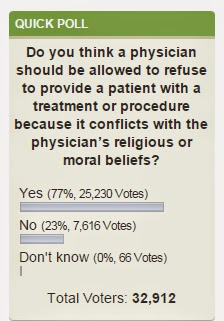
The CPSO had an online poll asking: Do you think a physician should be allowed to refuse to provide a patient with a treatment or procedure because it conflicts with the physician's religious or moral beliefs? 

The CPSO published the results of the online poll. Out of 32,912 respondents, 25,230 (77%) agreed that the conscience rights of physician should be protected.

Physicians are demanding that their conscience rights continue to be protected by the CPSO. These physicians consider assisted death to be not part of health care.

Physicians should not be required to lethal inject, assist the suicide, or refer a patient a physician or an agency for the purpose of causing or assisting death.


Connecticut should reject assisted suicide bill again

The following column was written by Paul Choiniere and published on March 1, 2015 in The Day. 

By Paul Choiniere

You have to give the group Compassion & Choices high marks for persistence. Despite little progress, for the third straight legislative session they are back in Connecticut, asking the General Assembly to pass a law that would allow doctors to prescribe medications that terminally ill patients could use to commit suicide.

I know the group doesn't like that ugly word and you won't find it in any of Compassion & Choices press releases or guest commentaries. Instead there are references to "aid in dying," "death with dignity" and "end-of-life choices."

But what they are talking about is the state sanctioning suicide: "The act of taking one's own life voluntarily and intentionally."

The assisted suicide bills did not get to the floor for a vote in 2013 or 2014, but as I wrote a year ago, the group sees Connecticut as a progressive state that can eventually be persuaded to see the issue as a matter of individual choice - the choice in the organization's words to "have the best death possible."

It is an issue that generates strong and emotional opinions on both sides. Compassion & Choices garnered much media attention last year, and certainly won some converts, with the moving story of 29-year-old Californian Brittany Maynard, who utilized the Oregon law to take her life before her brain cancer became severely debilitating.

This is a movement more imposed on Connecticut than generated from the grassroots. C&C has also launched campaigns in New Jersey, Massachusetts, Colorado and California. Vermont and Washington, as well as Oregon, already allow doctor-assisted suicide in cases of terminal illness.

As proposed in Connecticut, a person with a few months to live, and who is becoming increasingly incapacitated and dependent on others and wants to avoid suffering, can obtain medication to commit suicide at a time of his or her choosing. In the parlance of the movement, they can choose to "die with dignity."

I remain convinced such a law is not needed and would take society down a troubling ethical path.

What message does it send to and about severely disabled people to contend it is undignified to need the assistance of others? When government gives the OK through law that expediting death can be the best option, it can apply subtle pressure on the dying - who may worry they are a financial and emotional burden on family - to "just get it over with."

Sunday, March 1, 2015

Maggie Karner: Assisted Suicide Would Undermine My Cancer Battle

Maggie Karner, who is living with the same medical condition as Brittany Maynard had, wrote an article that was published in the Hartford Courant titled: Suicide Option Would Undermine My Cancer Battle. Karner, who lives in Bristol Connecticut opposes assisted suicide and the assisted suicide bill that is being debated in the Connecticut legislature.
Maggie Karner in Hawaii in 2009
  

Karner first comments on assisted suicide and her medical condition:
I have been diagnosed with a terminal brain cancer — a glioblastoma. Because of my diagnosis, I would likely be eligible for the state's help to commit suicide under a bill before the General Assembly — and that is terrifying. 
Like many Connecticut residents, I have wondered whether I would want my doctor to offer suicide as a treatment for deadly cancer. The out-of-state proponents of the bill regarding physician-assisted suicide suggest having the ability to end your life legally is comforting. But I can tell you from personal experience that it is nearly as troubling as the cancer itself. 
You see, I get strength and comfort from the knowledge that nobody is going to give up on me — medically, psychologically or holistically. Right now, I have the firm support of the state and my fellow citizens in my desire to live — no matter the cost or burden. If that were to change, the tiny knowledge that I might be straining my family, friends, doctors or community resources unnecessarily would be a heavy burden. The constant "option" for suicide would wear at my resolve and I fear, become an unspoken "duty" for me and others.
Maggie then comments on the Oregon assisted suicide law:
In Oregon, where assisted suicide is legal, the top reasons people give for wanting a deadly prescription are fear of losing autonomy (91.5 percent), fear of being less able to engage in activities (88.7 percent) and fear of loss of dignity (79.3 percent). These are not good enough reasons to upend the medical axiom of "first, do no harm."
Karner then comments on the Connecticut situation:
In 2014, Connecticut legislators enacted a pilot program regarding medical orders at the end of life. These forms, given to medical and hospital personnel, declare in advance the level of intervention a person wants when receiving emergency or end of life care. To build on these efforts and provide laws that will actually help the most people, our legislators should increase awareness and access to hospice and palliative care, double funding for home health care and their aides (more jobs!) and require mandatory training for doctors on pain management techniques. 
These measures would help many more hundreds and thousands of Connecticut people rather than undercutting the care and security of people like me who are fighting for their lives.
Karner concludes her article by arguing for compassionate care and not assisted suicide.