Monday, February 9, 2015

Andrew Coyne: Crossing the Rubicon, Supreme Court seems eerily complacent about ramifications of assisted suicide ruling

This article was published in the National Post on February 6, 2015.

Andrew Coyne
By Andrew Coyne

One measure of the eerie complacency of the Supreme Court’s ruling in Carter v. Canada (Attorney General) — the euthanasia case — is that it spends more time on the question of where to award the costs of the case than it does on the implications of its decision. Six pages on costs; three pages on where the hell is this all leading?

In one sense, the decision is narrowly drawn. The Court confined itself to deciding whether the present absolute ban on assisted suicide — the norm in all but a handful of countries, as it has been through most of our history — was “overbroad.” In seeking to protect vulnerable Canadians from abuse, it ruled, the law also caught in its net competent adults who had freely chosen to end their life — or rather, who had invited someone else to end it for them, a hitherto crucial distinction the Court does not trouble itself with. As such, the law encroached upon the right to “life [sic], liberty and security of the person” more than could be justified under the Charter’s “reasonable limits” clause.

Having found a way to throw out the law — did anyone doubt that it would? — the Court then refused to rule on a number of other questions put before it: whether the ban deprived the disabled of their right to “equal treatment” under the Charter, for example, or whether the harm it caused was “grossly disproportionate” to the good it did. That may seem like magisterial restraint. In fact it is a kind of myopia. For all of these questions and more are likely to be back in front of the court before long, and all of the fine distinctions on which the Court insists a new law might be constructed will then surely dissolve.

Indeed, the Court itself discards at least two of these even in the course of the ruling — again, without even pausing to acknowledge it. When most people think of assisted suicide or euthanasia (the distinction lies in whether the patient initiates the process or the doctor) they have in mind not only a competent adult, capable of giving consent, but someone suffering unbearable physical pain and in the last stages of a terminal disease, for whom suicide is no more than a way to hasten an end that is already both inevitable and near.

But that is not what the Court has in mind. First, it is clear from the ruling that the “enduring and intolerable suffering” that would confer the right to have someone kill you (with your consent, of course) is not limited to physical pain, but also psychological pain — which, besides being a murkier concept by far, raises the question of how competent the subject really is. Nor is suffering defined further: it is enough that it is intolerable “to the individual.”

Sunday, February 8, 2015

Assisted suicide ruling warps the perception of people with disabilities

This article was published in the Ottawa Citizen on February 6, 2015. Taylor Hyatt was a spokesperson for the Euthanasia Prevention Coalition at the Supreme Court on February 6.

Taylor Hyatt
By Elizabeth Payne - Ottawa Citizen.
 
Link to the video interview with Taylor Hyatt.

Carleton University student Taylor Hyatt has long looked up to Manitoba MP Steven Fletcher.

“Young people with disabilities have fewer role models to show them that they can dream, they can aspire to many of the same things as people without disabilities,” she says.

But when student and role model met briefly last October at the Supreme Court of Canada, where arguments were being heard in advance of Friday’s landmark ruling on assisted suicide, they found themselves on either side of a sharp ideological divide. Fletcher, a quadriplegic, is among the highest-profile Canadian supporters of physician-assisted death; Hyatt, who has cerebral palsy and relies on a wheelchair, opposes it and finds Fletcher’s position “shocking.”

On Friday, a shaken Hyatt called the Supreme Court of Canada’s ruling allowing doctor-assisted death both disappointing and worrisome, especially for its inclusion of “disability” among “grievous and irremediable” medical conditions that might be included in physician-assisted suicides. The court did not limit physician-assisted suicide to people whose condition is terminal, but instead referred to “a competent adult person who clearly consents to the termination of life and has a grievous and irremediable medical condition, including an illness, disease or disability, that causes enduring suffering that is intolerable to the individual.”

Hyatt said she was expecting the ruling would be strictly for people with terminal conditions.
“Instead, people with disabilities were mentioned and this means that anyone who feels that they are suffering in their current condition could request help ending their life, and that includes me.”
Hyatt says she believes the ruling will change Canadian society. 
“This ruling warps the perception of people with disabilities. It paints it as very negative and hopeless and I would like to know why people are being invited to end their lives rather than being given resources they need to truly live and thrive.”

Corbella: This slippery slope leads to Holland and Belgium

This article was published in the Calgary Herald on February 7, 2015.

B
Licia Corbella
y Licia Corbella

Mark this day of infamy down in your calendars. Remember it. Friday, February 6, 2015. Think of it as the tip of the stern deck on the Titanic, just as the bow end starts to sink. The orchestra is still playing. But eventually, the deck still above water becomes vertical, sweeping everyone — children, infants, everyone — down its slick slope.

This, of course, is the day that the Supreme Court of Canada ruled unanimously to allow us to legally kill other people with a scratch of a pen and some barbiturates.

In the landmark 9-0 decision, the high court ruled that the Criminal Code provision against helping someone to commit suicide deprives people suffering from serious medical conditions the right to life, liberty and security of the person, as guaranteed under the Charter of Rights and Freedoms.

The ruling limits physician-assisted suicides to “a competent adult person who clearly consents to the termination of life and has a grievous and irremediable medical condition, including an illness, disease or disability, that causes enduring suffering that is intolerable to the individual in the circumstances of his or her condition.”

The court also ruled that the nature of the suffering includes either physical or psychological pain, and that the person’s condition need not be terminal.

So how does this seemingly reasonable ruling wind up like the deck on the Titanic? Because that wording is remarkably similar to the wording that started off guiding the Netherlands, Switzerland and Belgium. Horrific abuses are occurring there now. Eventually, this “right” will get extended. The argument goes, if it’s medically acceptable — or preferable — to euthanize adults of right mind who are suffering intolerably, such “compassion” should be extended to youth, infants, non-verbal dementia patients and others. This is not hypothetical. This is happening now.
“Recently, a depressed healthy man who was retired, but alone and lonely, died by euthanasia in the Netherlands. In Belgium, a healthy depressed woman died from euthanasia after experiencing the breakup of a long-term relationship. In Switzerland, a man died by assisted suicide after receiving a wrong diagnosis,” writes Alex Schadenberg, the executive director of the Euthanasia Prevention Coalition (EPC).
Hugh Scher
Toronto human rights and constitutional lawyer Hugh Scher wrote: 
“Today’s court decision imposes on Parliament which has clearly chosen not to legalize euthanasia or assisted suicide, despite 30 years of study, to introduce measures to attempt to protect vulnerable people, measures that have failed miserably elsewhere once the genie of intentional killing is out of the bottle and permissible. 
“Reviews of other jurisdictions such as Belgium and the Netherlands suggest that regimes of legalized euthanasia and assisted suicide have been universally unsuccessful in preventing non-consensual deaths, deaths without request, or in enforcing clear violations of the law, whether they be failure on the part of doctors to report (47 per cent in Belgium), death without request or consent (32 per cent in Belgium), and the abject failure to prosecute violators of the law,” says Scher, who argued before the Supreme Court on behalf of the EPC on this case.
Proponents of physician-assisted suicide will scoff at the slippery slope argument. Will they scoff when a depressed 17-year-old demands the same rights as a cancer-ridden 97-year-old? Perhaps they still will, until it’s their child.

I have spoken with a woman, Diane, who says that if Canada had legalized physician-assisted suicide 10 years ago, she would be dead today. And that would be a crying shame. She was very depressed then and had attempted and failed at committing suicide. Instead of being given a lethal injection, she got the help she needed and is now gainfully employed in her profession, passing on wisdom and love to her children and receiving untold joy from her grandchildren.
“I just needed some medication and a bit of counselling, not a death sentence,” she said. “The world is a better place because I’m in it, and I don’t say that in a conceited way. I’m highly educated and productive. I have a lot to offer the world.”
February 6, 2015 — a date of infamy — marks the beginning of the end for people like Diane. Woe Canada.

Licia Corbella is a columnist and the editorial page editor.

Saturday, February 7, 2015

SCC Assisted Suicide decision is irresponsible and dangerous.

This article was published in the National Post on February 7, 2015.

Alex Schadenberg
By Alex Schadenberg, 
Executive Director - Euthanasia Prevention Coalition

The Supreme Court of Canada has made an activist decision by giving physicians the right in law to cause the death of people by euthanasia and assisted suicide. 


The Court has made an irresponsible and dangerous decision. By using imprecise and subjective language and by leaving many issues to be determined by Parliament, without objective criteria, the decision sets a dangerous precedent that, if unchecked, will lead to the sort of abuses that are now common in the Netherlands, Belgium and Switzerland.

The decision allows euthanasia and assisted suicide for physical and psychological conditions, without limiting it to clear parameters. Because there is no possible definition for psychological suffering, the Court has opened a Pandora’s Box.

Psychological suffering was the reason for approving the following deaths in the Netherlands: a healthy woman, with tinnitus; a healthy man who was lonely, depressed and recently retired; a healthy woman who was deaf, all died by euthanasia; among many other cases.


The decision legalizes euthanasia for:
“a competent adult person who 
(1) clearly consents to the termination of life and 
(2) has a grievous and irremediable medical condition (including an illness, disease or disability) that causes enduring suffering that is intolerable to the individual in the circumstances of his or her condition.”
One would assume “competent adult person” is clear enough, but what if that person is depressed? In Oregon, where the assisted death law is limited to people with less than six months to live, Dr. Charles Bentz wrote about his long-term patient who was diagnosed with depression yet died by assisted suicide — under a law that claims to protect depressed people from assisted suicide. Competence is very difficult to determine. Similarly, the Belgian law requires that the person be competent, and yet Professor Tom Mortier’s mother died by euthanasia even though she was only depressed.

The decision states that the person must clearly consent. But what if a person is unable to consent? Recent statistics from the Netherlands indicate that there are at least 300 assisted deaths without consent each year. The statistics also indicate that these assisted deaths are rarely reported.

Will abuse of the law occur? How could it not? The Supreme Court states that the person must have “a grievous and irremediable medical condition (including an illness, disease or disability).” This is an incredibly subjective statement. Many people have a grievous and irremediable medical condition. Indeed, under this definition people with a significant disability may now feel pressured, by friends or the medical system to "choose" euthanasia.

Further, the decision states that the person’s condition must “cause enduring suffering that is intolerable to the individual in the circumstances of his or her condition.” The statement conjures up thoughts of excruciating pain, but in fact this is a very subjective statement, in as much as it is based on what is tolerable to the individual. There is no objective standard.

The subjective language of the decision, if implemented in legislation, would lead to assisted death becoming the norm in all of the situations in Belgium and the Netherlands that have led to such international concern.

Assisted death creates new paths of abuse for elders, for people with disabilities and for other socially devalued people. Depression, in particular, is common for people with significant health conditions. Assisted suicide represents an abandonment of people who live with depression who require support and proper care, and undermines important mental health and suicide prevention programs.

Giving doctors the right, in law, to cause the death of their patients will never be safe and no amount of so-called “safeguards” will protect those who live with depression or abuse. There will always be people who will abuse the power to cause death and there will always be more reasons to cause death.

The fact that assisted death for psychiatric conditions tripled in the Netherlands in 2013 is worrisome. The fact that very few people ask for euthanasia based on physical suffering is proof that no one actually needs to die in this way.

Since an election will occur in October, the Euthanasia Prevention Coalition is asking the government to use the notwithstanding clause to give us more time to craft a law that can still protect Canadians.

We must not abandon Canadians to the false lure of assisted death, but must keep up the fight on behalf of the vulnerable and people with disabilities, until the day a future Supreme Court overturns this activist decision.

National Post
Alex Schadenberg is executive director of the Euthanasia Prevention Coalition.

Friday, February 6, 2015

Canadian Disability groups respond to Supreme Court assisted suicide decision


FOR IMMEDIATE RELEASE
Toronto and Winnipeg: February 6, 2015

Commentary on SCC Assisted Suicide Judgment in Carter v. Canada – Key Concerns

1. The judgment creates the potential for the most permissive and least restrictive criteria for assisted suicide in the world, putting persons with disabilities at serious risk.

2. CCD and CACL are disappointed that the views of people with disabilities in Canada, as shared by the leading disability advocacy groups around the world, were disregarded by the Court.

3. The Court did not impose a requirement of terminal illness, as is required in the states of Washington and Oregon.

4. The judgment permits assisted suicide on the basis of psychological suffering. This places people with serious mental and emotional disabilities at risk, as well as people who have not yet come to grips with their disability.

5. The judgment allows people to decline palliative and other care that would alleviate their suffering, and imposes an obligation on the state to provide Assisted Suicide, but not palliative care.

6. The Court has focused on striking the law using two potentially expansive criteria –in doing so, it paid no attention to ensuring Assisted Suicide is limited to a small number.

7. The judgment makes the existence of a “grievous and irremediable medical condition” , rather than a terminal illness, one of the two primary criteria – this potentially means that all persons with a serious disability in Canada can access Assisted Suicide. This degree of permissiveness does not exist anywhere else in the world.

8. The second criteria, “intolerable suffering,” is completely subjective and will make it difficult to review decisions of doctors like Dr. Kevorkian who felt the existence of a disability was intolerable.

9. Numbers are revealing – in Belgium, the number of Assisted Suicide deaths has increased an average of 47.77% annually since 2003, and in the Netherlands it has increased 64.13% since 1995, with no end in sight to this increase.

10. Parliament can and should act to place crucial safeguards on the Court’s judgment to limit access to assisted suicide.

11. CCD and CACL call on Parliament to show national leadership on the issues of palliative and long-term care to reduce the number of people who will choose assisted suicide out of desperation because they do not have access to support systems to ease their end of life.

Decision of the Supreme Court in the Carter Case: Vulnerable people are most at risk

Media Release
Montreal, February 6, 2015 

The citizen network Living with Dignity and the Physicians' Alliance against Euthanasia acknowledge today's ruling by the Supreme Court of Canada in Carter v. Canada (Attorney General). By stipulating that Kay Carter was within her rights to demand assisted suicide, and asking the Parliament of Canada to amend the Criminal Code to state that "medical aid in dying" is not a homicide, and therefore should not be penalized, the highest court in the land deeply upsets Canadian society.

"This decision of the Supreme Court contradicts the view of the European Court of Human Rights (Pretty v. United Kingdom) said Dr. Marc Beauchamp, president of Living with Dignity. Considering that the Court reaffirms the federal-provincial shared competence on these issues, we encourage parliamentarians to eventually frame in the strictest possible way any exceptions to prevent anyone from being unjustly euthanized without their consent and that such policies never come against access to proper medical care. To avoid abuse and extensions found in Belgium and the Netherlands, Canada must impose much stronger safeguards than those established in the laws and regulations of those countries."

Living with Dignity and the Physicians' Alliance against Euthanasia will continue to advocate for the protection of life and the inherent and inalienable dignity of people made vulnerable by illness, old age or disability. In solidarity, we will make sure to accompany them compassionately.

The Supreme Court of Canada has decided not to protect people from assisted suicide.


The Supreme Court of Canada has made an activist decision by giving physicians the right in law to cause the death of people by assisted suicide.

The Supreme Court is naïve to think that assisted suicide will not be abused, when abuse already occurs.

Dr. Leo Alexander, an American psychiatrist, who was a medical advisor at the Nuremburg trials and who was part of the Nuremburg code: stated in an article in the NEJM (July 1949)

"Whatever proportions these crimes finally assumed, it became evident to all who investigated them that they had started from small beginnings. The beginnings at first were merely a subtle shift in emphasis in basic attitude, basic in the euthanasia movement, that there is such a thing as a life not worthy to be lived."
This is the experience that the Netherlands, Belgium and Switzerland have had with assisted death, and unless Canada’s Parliament resists this same direction, this will be the same experience in Canada.

Recently, a depressed healthy man who was recently retired, but alone and lonely, died by euthanasia in the Netherlands. In Belgium, a healthy depressed woman died from euthanasia after experiencing the break-up of a long-term relationship. In Switzerland, a man died by assisted suicide after receiving a wrong diagnosis.

Giving doctors the right to cause the death of their patients will never be safe and no amount of “so-called safeguards” will protect those who live with depression or abuse. There will always be people who will abuse the power to cause death and there will always be more reasons to cause death.

Assisted suicide creates new paths of abuse for elders, people with disabilities and other socially devalued people. The scourge of elder abuse in our culture continues to grow.

Depression is common for people with significant health conditions. Assisted suicide is an abandonment of people who live with depression who require support and proper care.

Assisted suicide undermines important mental health and suicide prevention programs. Assisted suicide has had a suicide contagion effect in the State of Oregon.

The Supreme Court gave Parliament one year to provide a legislative framework.

Parliament must first use the notwithstanding clause to continue to equally protect every Canadian. Then Parliament and Provincial governments must commit to: improving access to end-of-life care, create awareness to change social attitudes towards the lives of people with disabilities and the reality of elder abuse, and to focus on effective suicide prevention strategies to provide the care that Canadians require and deserve.

The Euthanasia Prevention Coalition will work to protect people from euthanasia and assisted suicide. We will not abandon Canadians to the false lure of assisted suicide and someday the Supreme Court will overturn this activist decision.

EPC is available for media inquiries. 

  • Amy Hasbrouck (Ottawa) from Not Dead Yet Canada is at the Supreme Court Grand Entrance Hall. Contact Amy: (450) 921-3057 or info@tv-ndy.ca. 
  • Dr Margaret Cottle (Vancouver) EPC Vice President: (604) 222-0288 or mmcottle@mac.com
  • Hugh Scher (Toronto) EPC Legal Counsel: (416) 816-6115 or hugh@sdlaw.ca
  • Nicolas Steenhout (Montreal) Director – Vivre dans la Dignité: (438) 931-1233 or info@vivredignite.org
  • Alex Schadenberg (London) EPC Executive Director: 1-877-439-3348 / (519) 851-1434 or info@epcc.ca 
Euthanasia Prevention Coalition – 1-877-439-3348 – www.epcc.ca – info@epcc.ca

Supreme Court strikes down assisted suicide law

This article was originally published by Advocate Daily.

Hugh Scher
The Supreme Court of Canada has unanimously struck down the country’s assisted suicide law in a ruling that puts at risk the safety of Canadians and creates more questions than answers, says Toronto human rights and constitutional lawyer Hugh Scher.
“A decision to strike down the laws that prevent euthanasia and assisted suicide before steps are taken that would ensure access to quality end-of-life care as a basic human right in this country is a significant departure from basic Canadian values that uphold and maintain the safety and security of Canadians,” says Scher.
The high court weighed in on the hotly debated topic in its much-anticipated ruling today, which addressed a constitutional challenge to Canada’s assisted suicide law heard Oct. 15, 2014.
“The Supreme Court's decision to strike down laws against assisted suicide creates more questions than answers, and will inevitably result in increased risk to vulnerable Canadians in securing access to health care that would support and prolong their lives in circumstances where those lives are viewed as lacking sufficient quality in the eyes of doctors or family members,” Scher tells AdvocateDaily.com.
People will now be required to justify receiving treatments that will help to keep them alive, says Scher.

The case began with a lawsuit filed by the British Columbia Civil Liberties Association in 2011, seeking to allow assisted suicide and euthanasia under certain circumstances.

The Euthanasia Prevention Coalition, represented by Scher, intervened in the case throughout, in Carter v. Canada (Attorney General), 2015 SCC 5; Carter v. Canada (Attorney General) 2013 BCCA 435 (CanLII); and Carter v. Canada (Attorney General), 2012 BCSC 886 (CanLII).

The Supreme Court determined the matter in its previous 5-4 decision in Rodriguez v. British Columbia (Attorney General), [1993] 3 SCR 519, 1993 CanLII 75 (SCC), where the court found s. 241 was not infringing on certain rights under the Canadian Charter of Rights and Freedoms, or that any such infringements were justified as there was no halfway measure that could meet Parliament’s legitimate objective to protect the vulnerable and promote life.

“The Supreme Court's decision to strike down the law creates a vacuum of regulation relative to any so-called safeguards to prevent against non-consensual death, deaths without request or death to vulnerable Canadians under the current regime,” Scher says. “Parliament has made its intentions clear that an absolute legal prohibition against assisted suicide and euthanasia is essential not only to its national suicide prevention strategy, but also to prevent the intentional killing of patients by doctors.”
Today’s ruling is the first time that any Supreme Court has struck down an absolute prohibition against assisted suicide. Such prohibitions represent the norm and not the exception in countries around the world including Australia, the U.K., Ireland, Scotland, France and in most states in the U.S.A., says Scher.

"Only eight jurisdictions in the world permit assisted suicide or euthanasia. In those jurisdictions, governments have made a clear policy choice and have supported that choice with tailored measures and laws," says Scher. "The court’s decision to impose this policy choice on Parliament is a concerning blow to the sovereignty of Parliament.

“Today’s court decision imposes on Parliament which has clearly chosen not to legalize euthanasia or assisted suicide, despite 30 years of study, to introduce measures to attempt to protect vulnerable people, measures that have failed miserably elsewhere once the genie of intentional killing is out of the bottle and permissible,” he says.
Indeed, Quebec has already introduced a law to legalize euthanasia as health care in that province. The law is presently under challenge in the Quebec Supreme Court and not operational, adds Scher.
“Reviews of other jurisdictions such as Belgium and the Netherlands suggest that regimes of legalized euthanasia and assisted suicide have been universally unsuccessful in preventing non-consensual deaths, deaths without request, or in enforcing clear violations of the law, whether they be failure on the part of doctors to report (47 per cent in Belgium), death without request or consent (32 per cent in Belgium), and the abject failure to prosecute violators of the law,” says Scher.
“Not a single physician has been prosecuted under the Belgian law despite these concerning statistics,” he adds, noting there has also been an increase in the rates of suicide and assisted suicide in those jurisdictions where euthanasia or assisted suicide have been legalized, particularly in Oregon.

“We must make significant efforts to ensure that every Canadian has access to quality palliative and end-of-life care and community supports throughout and particularly near the end of life. Our failure to do so represents a failure of society to protect its most sacred trust to all Canadians,” says Scher.

Scher will appear as an expert at a Canadian Bar Association panel on the topic of end-of-life decisions. Speaking at the association’s annual Mid-Winter meeting in Fredericton, Scher will take part in an expert panel discussion entitled: “No legal principle can avoid every ethical dilemma: Medical/Legal Developments in End of Life Decisions." The event runs from from 1:30 – 4:30 p.m. on Feb. 7.

Thursday, February 5, 2015

The Supreme Court of Canada to Release Assisted Suicide Decision Tomorrow.


Euthanasia Prevention Coalition (EPC) Media Release.

EPC is a national non-profit corporation since that supports positive measures while opposing euthanasia and assisted suicide.

The safety and security of every Canadian needs to be the primary concern of the Supreme Court of Canada and Parliament.

Whatever the Supreme Court decides, it will not change the reality that legalizing euthanasia or assisted suicide gives doctors the right, in law, to intentionally cause the death of their patients. Abuse of our current law already occurs. If assisted dying is legalized, abuse will continue.

If legalized, assisted suicide will create new paths to abuse of elders, people with disabilities and other socially devalued people. The scourge of elder abuse in our culture continues to grow.

Depression is common for people with significant health conditions. A study in the Netherlands found that depression was a primary factor for requests for euthanasia.

Recent cases in the Netherlands include: a woman with Tinnitus, a woman who didn’t want to live in a nursing home, and a depressed recently retired man. The reported cases of euthanasia for psychiatric conditions tripled in the Netherlands in 2013.

A significant study from the Netherlands found that at least 300 assisted deaths are done each year without request and 23% of all of the assisted deaths were not reported.

EPC is committed to protecting Canadians from euthanasia and assisted suicide. We believe in caring for people, not killing people.

EPC is available for media inquiries.

  • Amy Hasbrouck (Ottawa) from Not Dead Yet Canada, will be with Taylor Hyatt at the Supreme Court Grand Entrance Hall. Contact Amy: (450) 921-3057 or info@tv-ndy.ca
  • Dr Margaret Cottle (Vancouver) EPC Vice President: (604) 222-0288 or mmcottle@mac.com
  • Hugh Scher (Toronto) EPC Legal Counsel: (416) 816-6115 or hugh@sdlaw.ca
  • Nicolas Steenhout (Montreal) Director – Vivre dans la Dignité: (438) 931-1233 or info@vivredignite.org
  • Alex Schadenberg (London) EPC Executive Director: 1-877-439-3348 / (519) 851-1434 or info@epcc.ca
Euthanasia Prevention Coalition – 1-877-439-3348 – www.epcc.ca – info@epcc.ca

What’s at Stake in Friday’s Supreme Court of Canada Decision on Assisted Suicide


FOR IMMEDIATE RELEASE
From the Council of Canadians with Disabilities and the Canadian Association for Community Living

Toronto and Winnipeg: February 4, 2015 - Whatever decision the Supreme Court of Canada makes in the Carter vs. Canada ruling to be released on Friday – to hold the line against assisted suicide in the Criminal Code, or to strike it down - the public standards of what it means to live a dignified life are at stake. At the core is a question about what it means to live a meaningful life until the end – and in our Canadian society, a decision from the court cannot reflect the complexity of these choices in anyone’s individual life.

If the Court strikes down the prohibition against assisted suicide, the fears of some will be assuaged by the knowledge that, at a time of their choosing, they may seek state-sanctioned intervention to cause their death. But for a growing group of Canadians whose daily lives fundamentally depend on the personal care and support of others, their fears are only heightened by such an outcome.

What is the basis for this fear? For those who receive care, for those who provide care, and for those who advocate for equality and inclusion alongside a wide variety of Canadians, the risk is palpable. Dependence upon others will come to be seen as a suffering too great to bear. The risk is that in private conversations, in policy choices and in adjudicated determinations, dependence will come to be equated with indignity when actually it is an essential part of living. And the larger fear is that the shape of such a life will become a good reason to seek its termination.

The risk of this cultural slide may well present the biggest challenge to Canadian values in our generation, the underlying value of an individual life.

There are a series of more complex issues underlying any decision of the court. CCD and CACL intervened at the Court in October and said: 

  • “Nobody in Canada needs to be left to face death in pain, nor should they have to feel that their lives are a burden for others.” 
  • “Canadians experience a significant unmet need for palliative care.” 
  • “To redraw the boundary in law of what constitutes living with dignity undermines the dignity of Canadians with disabilities who live good, albeit challenging lives.” 
  • “In jurisdictions where assisted suicide/euthanasia is legal the leading reasons given for dying are not pain related, but rather “losing dignity and autonomy” and “becoming burdensome for family and friends.” To endorse these as valid reasons to die can only reinforce and entrench fear of disability and prejudice about the value of disabled people’s lives.” 
  • “We are concerned that countries such as Belgium and the Netherlands see nothing wrong with euthanizing children and people with mental disabilities.” 
In fact, the average annual growth in the number of assisted suicide deaths from the first complete year for which data is available is 48% for Belgium and 64% for the Netherlands.

Rather than provide access to assisted suicide, CCD and CACL have urged governments to adopt a policy of respect for individual lives, particularly at the end of life, and universal access to palliative care to ensure all people can get the care and support they and their families and loved ones need.

Respect for diversity and inclusion must continue to stand among Canada's most cherished values. Whatever the outcome of Friday’s ruling, we urge all Canadians and our legislators to listen to the voices of those who have historically been disadvantaged and marginalized and ensure they can participate in the coming public debates and political decisions. Such important societal values should be debated fully and with fair consideration of the complex decisions that face individual Canadians at the end of their lives.

For the CCD/CACL Factum to the Supreme Court of Canada.

CCD and CACL representatives will be available for comment following the Supreme Court decision Friday: 
  • Jim Derksen CCD Ending of Life Ethics Committee 204 781-4187 
  • Catherine Frazee CACL 902 818-2812 (for her Op-Eds on this topic see http://fragileandwild.com/supplementals/end-of-life) 
  • Dean Richert Chair CCD Ending of Life Ethics Committee 204 951-6273 
  • Amy Hasbrouck Not Dead Yet Canada (bilingual) 450-370-8195 
  • Laurie Larson, President, CACL Ph: 306-948-7341
  • Michael Bach – Executive Vice President CACL Ph: 416 209-7942 
  • Laurie Beachell National Coordinator CCD Ph. 204 981-6179 
  • Carmella Hutcheson Disabled Womens’ Network 403 935-4218 
  • Nancy Hansen CCD Ending of Life Ethics Committee 204 474-6458 
  • Heidi Janz CCD Ending of Life Ethics Committee 780-492-6676 
  • Tony Dolan Chair of CCD 902 626-1752 
Download the full media release

Assisted suicide is an assault on dignity

The article was published on February 5, 2015 by the Scotsman news.

Calum MacKellar
By Dr Calum MacKellar, the director of research at the Scottish Council on Human Bioethics


With the Assisted Suicide (Scotland) Bill currently being discussed in the Scottish Parliament, it has become necessary to seek to understand, unpack and define one of the most contested themes being used by both sides of the debate; namely the concept of human dignity.

Wednesday, February 4, 2015

The safety of Canadians of utmost concern as SCC rules on assisted suicide.

This article was published by Advocate Daily on February 4, 2015.

Hugh Scher
In releasing its much-anticipated ruling on assisted suicide on Friday, the Supreme Court is expected to clarify its stance on protecting Canadians from the risks of serious abuse, along with answering the larger question of Parliament’s role in such debates, says Toronto human rights and constitutional lawyer Hugh Scher.

A hearing at the high court on Oct. 15, 2014 addressed a constitutional challenge to Canada’s assisted suicide law to determine whether it should be upheld, struck down or modified.


The Supreme Court to release assisted suicide decision on Friday.

The Euthanasia Prevention Coalition (EPC), represented by Scher, has been granted leave to intervene in the case – Carter v. Canada (Attorney General) 2013 BCCA 435 (CanLII)


The case began with a lawsuit filed by the British Columbia Civil Liberties Association in 2011, seeking to allow assisted suicide and euthanasia under certain circumstances.

The Supreme Court determined the matter in its previous 5-4 decision in Rodriguez v. British Columbia (Attorney General), [1993] 3 SCR 519, 1993 CanLII 75 (SCC), where the court found s. 241 was not infringing on certain rights under the Canadian Charter of Rights and Freedoms, or that any such infringements were justified as there was no halfway measure that could meet Parliament’s legitimate objective to protect the vulnerable and promote life.

The coalition’s position is that the court should maintain its ruling in Rodriguez, says Scher.

“The Supreme Court has been asked to delve into a matter that is clearly the job of Parliament to do,” Scher tells AdvocateDaily.com. “A decision to strike down the assisted suicide law would strike a serious blow to Parliamentary sovereignty and to basic principles of democracy by effectively overriding the will of Parliament as it has been expressed consistently over the past 30 years with respect to the issue of assisted suicide and euthanasia.”

Blurred boundaries in the Netherlands' Right-to-Die Laws

By Alex Schadenberg
Executive Director - Euthanasia Prevention Coalition
Barbara Kay

Barbara Kay, a National Post columnist, has published two articles outlining the indepth analysis by the Dutch journalist, Gerbert van Loenen, who is publishing an english translation of his book that is titled: Do You Call This a Life? Blurred Boundaries in the Netherlands’ Right-to-Die Laws.

In the past, van Loenen supported the Netherlands euthanasia law, but after his significant relationship became disabled, his experience caused him to question.

Kay outlines new information from van Loenen's book that was gathered from Dutch sources and articles. Much of the information has not been reported by the english media and almost none of the information has been presented through the lens of a Dutch journalist who has personally experienced the social change that resulted from the legalisation of euthanasia.

In her first article (National Post - January 28), Kay focused on the meaning of the Dutch euthanasia law. Most people view euthanasia as a form of "self-determination," but van Loenen explains why that is not the reason that the Netherlands legalized euthanasia. Kay wrote:

But the Netherlands’ euthanasia law does not recognize any such right. In 1984, the country’s Supreme Court accepted euthanasia, but rejected self-determination as the driver. The law in fact focuses on the right of the physician to exercise his compassion in what is deemed a “situation of necessity.” Citizens “may request,” but cannot demand, euthanasia. So in fact the law endorses a species of medical “paternalism.” Van Loenen claims this compassion-based perspective “is the opposite of self-determination,” which he continues to support.
Kay then uncovers the underbelly of the Netherlands euthanasia law.
One of van Loenen’s settled convictions is that what begins in compassion invariably creeps over to the dark side. Up to 1,000 Dutch citizens are killed every year without express consent, according to van Loenen, either because they are incompetent (dementia) or in comas, or too young. In 14% of the without-consent cases, people are actually competent, but not consulted. Typical reasons given for euthanasia by doctors in such cases are “consultation would have done more harm than good,” or “this course of action was clearly the best one for this patient,” or it was “the request or wish of family” — a far cry from the self-determination principle debate began with. 
These doctors have acted outside the law, but are rarely convicted, as judges are reluctant to call “termination of life without request”… murder. Indeed, van Loenen says, cultural acceptance of euthanasia has progressed to the point that it is no longer the physician who ends someone’s life without request who must justify his actions; rather it is the physician who decides to prolong a life perceived as meaningless who feels societal pressure.
In her second article, (National Post - February 4) Kay focuses on the difficulty that the Dutch have had limiting the euthanasia law. Kay wrote:

Tuesday, February 3, 2015

Ira Byock: We should think twice about assisted suicide.

By Alex Schadenberg
Executive Director - Euthanasia Prevention Coalition

Ira Byock
Dr Ira Byock, who directs the Institute for Human Caring of Providence Health & Services in Los Angeles, wrote an excellent article concerning assisted suicide that was published in the LA Times on January 30, 2015.


The timing of his article is critical with the California assisted suicide bill being debated and assisted suicide bills currently being debated in at least 15 US states.

Byock, who identifies with a politically progressive position explains how assisted suicide is not politically progressive.

As someone who supports all those other liberal causes, yet opposes physician-assisted suicide, I'd ask my fellow progressives to shine a cold hard light on this issue. We have been the target of a decades-long branding campaign that paints hastening death as an extension of personal freedoms. We should bring the same skepticism to physician-assisted suicide that we do to fracking and genetically modified food.
Byock continues by explaining how the assisted suicide lobby has created euphemisms to confuse the assisted suicide debate.

Monday, February 2, 2015

Supreme Court to release assisted suicide decision on Friday.

The Supreme Court of Canada is releasing its decision in the Carter case concerning Canada’s laws that protect people from euthanasia and assisted suicide.

The Euthanasia Prevention Coalition has intervened in this case at every level.

EPC legal counsel Hugh Scher states:
"EPC is concerned about the safety, security and equality of people with disabilities and seniors, which is central to the protections set out under the Charter of Rights and Freedoms and our Criminal Code."
EPC - British Columbia chair Dr Will Johnston states:
"This is an important public safety issue. The Court rejected assisted suicide in 1993 and prevented Canada from taking a wrong turn. In the 20 years since, human nature has not changed and people with disabilities and other vulnerable people are still at risk in our health care system. We are better at controlling symptoms, and we also see the abuses of euthanasia in those few jurisdictions where this practice has become entrenched. 
Let us hope that the Supreme Court once again confirms the protections in law from assisted suicide and direct killing of the sick, and that we stay the course by improving symptom control to all who need it."
Disability rights advocate Amy Hasbrouck of Toujours Vivant - Not Dead Yet states:
"People with disabilities, chronic illness and seniors are negatively affected by assisted suicide and euthanasia because it leads to the impression that our lives are lacking in meaning and value as compared to other Canadians."
EPC Executive Director, Alex Schadenberg stated:
"In other jurisdictions, euthanasia has expanded to include people with depression, people with psychiatric problems, people with dementia, teenagers and incompetent people. The laws in other jurisdictions have been abused. 
Canada needs to focus on how it cares for people in difficult circumstances, not how to kill its people."
More information:
For further information contact:

• Dr Margaret Cottle (Vancouver) EPC VP: (604) 222-0288, mmcottle@mac.com
• Alex Schadenberg, (London) EPC Executive Director: (519) 851-1434, info@epcc.ca
• Nicolas Steenhout, (Montreal) Director - Vivre dans la Dignité: (438) 931-1233, info@vivredignite.org
• Hugh Scher (Toronto) EPC legal counsel: (416) 816-6115, hugh@sdlaw.ca
• Amy Hasbrouck, (Montreal) Toujours Vivant-Not Dead Yet: (450) 921-3057, info@tv-ndy.ca

The Euthanasia Prevention Coalition (EPC) is a national coalition of groups and individuals that support positive measures and opposes euthanasia and assisted suicide.

Contact EPC at: 1-877-439-3348 or info@epcc.ca or www.epcc.ca

The case of Tom Mortier shows how euthanasia advocates won't stop at the terminally ill.

The following article was originally published in the Telegraph UK on February 2, 2015.

Kevin Yuill
By Kevin Yuill

Tom Mortier never paid much attention to the discussion about voluntary death in his country. “I was like just about anyone else here in Belgium: I didn’t care at all,” he said. “If people want to die, it’s probably their choice. It didn’t concern me.”

But in April, 2012, ten years after the law changed to allow euthanasia, Mortier, a university lecturer, received a message at work. His 64-year-old mother, Godelieve De Troyer, who suffered from severe depression, had been euthanised the previous day. Would he be able to make the arrangements at the morgue?


His mother had largely broken off contact with the family but had informed him by email three months earlier that she was looking into euthanasia. Mortier did not dream that her request would be taken seriously because she was in perfect physical health. After his mother’s death, the doctor who gave her the injection assured Mortier that he was “absolutely certain” his mother didn’t want to live anymore. The shock felt by Mortier at the sudden – and unnecessary – loss of his mother inspired him to become a leading campaigner against Belgian euthanasia law.

Tom Mortier
Disturbing as Mortier’s case is, there are many supporters of 'assisted dying' in the UK who insist that it is not relevant here. Dignity in Dying, a slick and well-funded advocate organization, indignantly states that Belgium and the Netherlands – where a review committee ruled that the euthanasia of 47-year-old Gaby Olthuis, who suffered from tinnitus, was “careless” – have little to do with the law now slowly pushing its way through the House of Lords. Look away, they say, from entire nations where voluntary death has been legalized a few miles from our shores; instead, look to Oregon, a little state on the Pacific coast of the United States with less than two per cent of the country’s population which has become the go-to comparison for British euthanasia advocates.

They are wrong, of course. Belgium, not Oregon, is the future of assisted dying. In the US, a national campaign prioritizes the passage of assisted dying legislation across the country (with only three states currently permitting it). No one in any of the states which already have it will campaign to have the criteria extended to those who are not terminally ill for fear that it they would jeopardize the rolling campaign elsewhere.

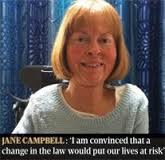
British disability leader speaks out against assisted suicide - "I am convinced that a change in the law would put our lives at risk."

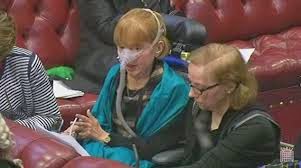
These are the two speeches by Baroness Jane Campbell in the British House of Lords on January 16, 2015 opposing the assisted suicide bill.

Baroness Campbell was Commissioner of the Equality and Human Rights Commission (EHRC) from 2006–2008, Chair of the Disability Committee which lead on the EHRC Disability Programme, former Chair of the Social Care Institute for Excellence (SCIE) and Commissioner of the Disability Rights Commission until October 2006.

Cambell has been featured in several articles on assisted suicide such as: ● Assisted Suicide could lure me to the grave, ● Why I oppose assisted suicide and ● Assisted suicide bill in Britain is fatally flawed.

Baroness Campbell's first speech in the House of Lords - January 16, 2015. 
My Lords, I thank the Minister. I am sorry I have not got a loud voice. I may be a little slow. This is not because I want to hold up the Bill, I just have things to say.


Baroness Jane Campbell
We have been told time and again that disabled people with life-limiting conditions—and I use that term advisedly because we do not recognize the terms “terminal illness” and “months” or “weeks to live”; ... have nothing to fear from the Bill. We are told that it is necessary only to help a few desperate individuals to end their lives when they have weeks or months to live, and that, if enacted, it will not touch anyone who does not want it. 

I do not believe that and, it seems, neither do the authors of the Bill. Why else would they elect to name it the Assisted Dying Bill instead of the assisted suicide Bill? If it is truly concerned only with personal autonomy and choice, surely that should be celebrated and clear.

By avoiding the term “assisted suicide”, the Bill circumvents the framework of measures in place to review, monitor and prevent other forms of suicide. It seeks to exclude deaths under the Bill from the general requirement for a coroner’s inquest to be conducted where suicide is considered a possible cause of death. It contains a provision for publication of annual statistics of “assisted deaths” separate from the established arrangements for collecting and publishing statistics on deaths by suicide. It provides for a death under the Bill to be recorded by the registrar as an “assisted death”.

I have a question for the Minister. This Government, like their predecessors, have a major cross-departmental suicide prevention strategy. It seeks,
“a reduction in the suicide rate in the general population in England”,
and defines suicide as,
“a deliberate act that intentionally ends one’s life”.
In the light of this definition, will the Minister inform us whether, if the Bill were to become law, he anticipates a rise in the suicide rate, and would he expect the suicide prevention strategy to contain measures to reduce the numbers in this group intentionally ending their own lives?

We all, in this House and outside, understand the word “suicide”. It centres on the individual. The act of suicide is the responsibility of the person who commits it, and no other. It is impossible to commit suicide without first consenting to do so. The same does not apply to the word “dying”.

Assisted dying is practised in Belgium, the Netherlands and elsewhere. Whatever the initial intentions were, decisions to end life in those places are now not taken only by the individual. It is not an autonomous act. The slippery slope is oiled by the vague euphemism of “assisted dying”. Disabled people are rightly frightened that the Bill, as currently named, puts them at risk. ... “Assisted suicide” makes it clear that only the individual may instigate and control the process leading to an early, state-sanctioned death. I urge noble Lords to support this argument.

Baroness Campbell's second speech in the House of Lords - January 16, 2015. 

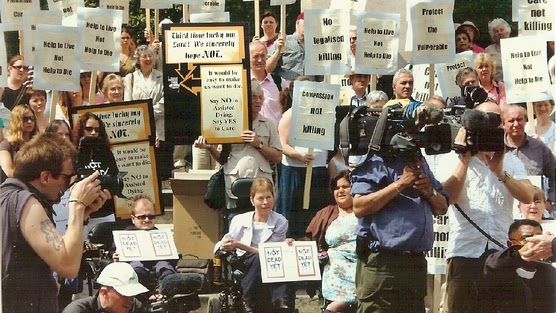
Baroness Campbell speaking to the
Not Dead Yet UK rally in July 2014.
I thank the Minister. My Lords, there are many reasons why I strongly oppose the Bill and why I have spoken against it in the past. But one of the most important reasons why I oppose the Bill is the definition of terminal illness and how many months, weeks or years we have to live. The definition in the Bill gives rise to uncertainty and is therefore terribly open to misinterpretation and abuse. Proponents of the Bill claim that “disabled” and “terminally ill” are distinct from one another. We are told that disabled people can be assured that the Bill is not intended to apply to them.

Double assisted suicide of elderly cousins, based on fear of living alone.

By Alex Schadenberg
International Chair - Euthanasia Prevention Coalition

The Telegraph UK news reported on the assisted suicide deaths of Scottish cousins, Stuart Henderson (86) and Phyllis McConachie (89), who had lived together for 40 years and feared living alone. They died at a suicide clinic in Basel Switzerland.

They were not sick or terminally ill, they were older and feared living alone.

Last year the Swiss suicide groups agreed to extend assisted suicide to people who are elderly but not terminally ill.

Peter Saunders
Peter Saunders, Campaign Director for the Care Not Killing Alliance stated that these deaths were a great tragedy. Saunders stated:

“Assisted suicide in these circumstances is the ultimate abandonment,” 
“This tragic case strongly underlines the need for comprehensive and affordable patient-centred care in which people's social and spiritual needs and not just physical needs are provided for."
Assisted suicide bills are being debated in Scotland and the UK.

Once society decides that it is acceptable to cause the death of people, the only question remaining is who can be assisted in their suicide.Henderson and McConachie feared living alone. It is concerning that the Swiss suicide group visited them and agreed that their lives were not worth living. 

They needed adequate home care and support not assisted suicide.