Showing posts with label Fabian Stahle. Show all posts

Thursday, August 17, 2023

Assisted Suicide: Whose is the decision?

This story was written by Fabian Stahle, a Swedish researcher, and published on August 15 as part of the Euthanasia Prevention Coalition story contest (Contest link).

Link to the full story by Fabian Stahle (Story Link).

Fabian Stahle
A patient is depressed after receiving the diagnose of a serious illness and therefore wants to end it all. The doctor, who has known the patient for quite a long time, perceives the patient’s death wish as an indication of psychological stress, caused by the sense of hopelessness and fear of the future, and concludes that the patient, given the present depressive condition, is not capable to decide about such a final action. The doctor explains that the outcome is not absolutely certain, even though it looks serious, and seeks in this way to encourage the patient to take up the fight against the illness.

But the patient is not satisfied with this. He is afraid of the side-effects of an uncertain treatment and feels that his life is meaningless. And, once again he remembers his daughter’s silence when he talked about his thoughts about ending it all – no arguments, only silence.

Yes, he thinks to himself, this is the only decent thing I can do, and contacts another physician.

Link to the full story by Fabian Stahle (Story Link).

Monday, February 27, 2023

Stephen Mendelsohn: Strong opposition to Connecticut Assisted Suicide Bill SB 1076

By Stephen Mendolsohn

Stephen is a leader of the disability rights group, Second Thoughts Connecticut and a member of the EPC-USA board.

Senator Anwar, Rep. McCarthy Vahey, and members of the Public Health Committee:

“If assisted suicide is legal, some people’s lives will be ended without their consent, through mistakes and abuse. No safeguards have ever been enacted or proposed that can prevent this outcome, which can never be undone.” —Marilyn Golden (1954-2021), Senior Policy Analyst at the Disability Rights Education and Defense Fund

I am an autistic adult and one of the leaders of Second Thoughts Connecticut, a coalition of disabled people opposed to the legalization of assisted suicide. I also serve on the board of directors of Euthanasia Prevention Coalition-USA and previously served on the Connecticut MOLST Task Force.

Notwithstanding the attempt to add additional and mostly unworkable “safeguards” from previous iterations of this legislation, SB 1076 is fatally flawed and should be rejected. 

These added safeguards are part of a deliberate bait and switch tactic by proponents to get a bill passed and then come back to amend it to gut these and other safeguards. This was openly acknowledged by J.M. Sorrell, Executive Director of Massachusetts Death with Dignity, who was quoted on a similar bill in his state, saying, “Once you get something passed, you can always work on amendments later.” This incrementalist strategy is also confirmed in Kim Callinan’s testimony for Compassion & Choices, who describes these changes from previous assisted suicide bills as “unnecessary” and claims they “will result in more patients being unable to access the law.”

Some of the new provisions are likely to be immediately challenged in court. The enhanced residency requirement in SB 1076 is at odds with lawsuits filed by Compassion & Choices in Oregon and Vermont claiming that all such residency requirements are unconstitutional. The provision in Section 21 requiring an attending physician to meet every thirty days with a patient who has been prescribed lethal drugs to either certify the patient still qualifies or to dispose of the drugs is either unworkable, unconstitutional, or both. Once a patient receives a lawfully obtained lethal concoction of DDMAPh costing nearly $1000 from a mail-order compound pharmacy, there is no way to control what happens to it. You cannot compel a patient to meet with their doctor, and it would require a search warrant to enter the patient’s private home. Moreover, seizing a lawful prescription without compensating the patient who just forked over a significant amount of money for it would violate the Due Process and Takings Clauses of the Fifth Amendment, which respectively require due process and just compensation before the government seizes someone’s property.

We are in the midst of a serious opioid epidemic, yet we do not authorize searching the private homes of people lawfully prescribed opioids for unused pills and seizing them. Simply put, no safeguard can prevent lethal drugs from being ingested by people who may have originally qualified but no longer do, nor is there any way to prevent misuse by others once lethal drugs are prescribed. In one recent case from Colorado, after the intended patient took a swallow and exclaimed “Man it burns!” (as amitriptyline in the lethal compound burns the throat), a bystander also swallowed the lethal concoction and nearly died before being rescued by EMS personnel.

The mandatory counseling provision can be met my a brief consult with a social worker affiliated with Compassion & Choices for this purpose. If the attending physician is a psychiatrist prescribing for someone whom he/she/they have diagnosed as having “terminal anorexia,” there appears to be nothing in SB 1076 to prevent this psychiatrist from self- referring the patient, as a psychiatrist can qualify for both roles.

As you are probably aware, people with a sole diagnosis of anorexia nervosa have been prescribed and have died from lethal prescriptions in both Colorado and Oregon. This has even led to Compassion & Choices finally admitting to an abuse of the law. Kevin Díaz, C&C’s Chief Legal Advocacy Officer, states on the organization’s website that “This law does not and was never intended to apply to a person whose only diagnosis is anorexia nervosa.” Yet in her testimony for this bill, Kim Callinan appears to state otherwise: “There have been no documented or substantiated incidents of abuse or coercion across the authorized jurisdictions...” Does Ms. Callinan thus approve of assisted suicide for people with a sole diagnosis of anorexia? And can we really believe a single word she says when she makes this astonishing and demonstratively false claim?

The definition of “terminal illness” in Section 1 (21) was tweaked once again, this time to read “physical medical condition.” Nothing here would exclude anorexia nervosa from qualifying, as the main symptom is physical—the patient is emaciated. Indeed, biological psychiatrists have long claimed that “mental illnesses” are “physical medical conditions,” and NAMI asserts that “mental illnesses are physical illnesses.”

Nor would the mandatory counseling requirement exclude people with anorexia from receiving lethal prescriptions, as most would meet the definition of “competent” in Section 1 (4). As psychiatrist Dr. Angela Guarda, director of the Johns Hopkins Eating Disorders Program, has testified elsewhere:

Patients with anorexia appear rational in all ways but one: they lack the capacity to accept the care they most need. Yet they meet the definition of capacity in this [assisted suicide] bill. Instilling hope is crucial for a positive therapeutic stance. How as a physician do I hold this view when I do not know which, if any of my patients are incurable? I oppose this bill because there’s too much room for error. It risks endangering the most vulnerable and the one in five Americans who suffer from a treatable mental condition.
Last year, the definition of “terminal illness” in Section 1 (21) added the words “... if the progression of such condition follows its typical course.” As Cathy Ludlum demonstrated in her powerful l testimony, she qualifies for lethal drugs under this definition. As Fabian Stahle notes, so do people with chronic conditions like insulin-dependent diabetes who reject treatment. So do people who have treatment denied by their insurance company or are otherwise unable to afford it. So do people with anorexia nervosa. Without nutrition, the “typical course” for anorexia is death in under six months. The American Clinicians’ Academy on Medical Aid in Dying (ACAMAID) has a case report in which their “Ethics Consultation Service” stated,
If the patient’s eating disorder treating physician and evaluating psychiatrist agreed that she had a “terminal disease” and retained decision-making capacity, she would meet those requirements of the aid in dying statute in her jurisdiction.
Less than two months ago, ACAMAID’s “Ethics Consultation Service” published another case report, this time on Voluntary Stopping of Eating and Drinking and Medical Aid in Dying, pushing the boundaries of “terminal illness” to its logical extreme. Their members found that “Legally, there is nothing in the letter of the law of any of the U.S. states’ aid in dying bills that explicitly prohibits accepting voluntary stopping of eating and drinking as a terminal diagnosis to qualify for aid in dying.” They further note that allowing VSED to qualify for lethal prescriptions would “essentially eliminate the criteria of terminal illness to qualify.”

Thus virtually anyone at least 21 years old who is depressed, unhappy, traumatized, or lacks the will to live can qualify as “terminally ill” for a lethal prescription simply by electing to use VSED. It should be noted that some ACAMAID team members were not willing to support this position, arguing that “[e]mbarking on this could imperil the currently existing laws that allow access for terminally ill patients.” It is clear that what matters to ACAMAID, C&C, and the rest of the assisted suicide lobby is how far they can expand the law, whether by amendment or reinterpretation, without encountering pushback.

All of the ostensible safeguards in SB 1076 are rendered unenforceable and meaningless by the mere “good faith” standard in Sections 14(f) and 19. This “good faith” standard creates an unacceptable carve-out from the prevailing professional standard of care required for all other patients under Section 52-184(c) of the Connecticut General Statutes. As it is virtually impossible to prove that a medical provider did not act in “good faith,” providers granted legal immunity under this statute can use creative interpretations of the law, as ACAMAID has already done, to reinterpret and expand the law without resorting to amending it.

Regarding falsification of the death certificate, Section 9 (6) (b) from the 2013-2021 bills, stating “The person signing the qualified patient's death certificate shall list the underlying terminal illness as the cause of death,” has been removed from SB 1076. In no way does this mean that death certificates will not continue to be falsified. Previous bills demonstrate clear intent to do so, as does last year’s oral testimony from death certificate certifier Shannon E. Stanford, MD, who said that “people are free to write what they want on the death certificate” (on YouTube starting at clip position 5:25:55).

In Oregon, language mandating death certificate falsification is not in statute but is in regulations, and that is certain to be the case in Connecticut. The only way to correct this is to specifically include language similar to Oklahoma’s Death Certificate Accuracy Act, §63-1- 316b. It states in part:

A certifier completing cause of death on a certificate of death who knows that a lethal drug, overdose or other means of assisting suicide within the meaning of Sections 3141.2 through 3141.4 of this title caused or contributed to the death, shall list that means among the chain of events under cause of death or list it in the box that describes how the injury occurred. If such means is in the chain of events under or in the box that describes how the injury occurred, the certifier shall indicate "suicide" as the manner of death. 
A certifier who knowingly omits to list a lethal agent or improperly states manner of death in violation of subsection E of Section 1-317 of this title shall be deemed to have engaged in unprofessional conduct as described in paragraph 8 of Section 509 of Title 59 of the Oklahoma Statutes.

It is deeply disheartening that a bill to require honest death certificates, HB 5486, was not granted a public hearing by this committee. That proposed bill would have enacted similar language here in Connecticut to the aforementioned Oklahoma statute:

That the general statutes be amended to require, upon legalization of any provision allowing the prescribing of medication to a terminally ill patient that the patient may self-administer to bring about death, a medical certifier completing cause of death on a death certificate, who knows that a lethal drug, overdose or other means of assisting suicide caused or contributed to the death, shall list such means among the chain of events under cause of death, and, if such means is in the chain of events, the certifier shall indicate "suicide" as the manner of death.
The actual purpose here is to avoid covering up foul play in a potential murder prosecution, which is the real problem with death certificate falsification as noted by previous testimony from the Division of Criminal Justice.

The “accordance” language in Section 14 (c) and (d) of SB 1076 also mandates falsification of the manner of death. According to the Office of the Chief Medical Examiner, the choices in Connecticut are “homicide,” “suicide,” “accidental,” “natural,” “therapeutic complication,” or “undetermined.” The “accordance” language rules out homicide and suicide as a matter of law. “Accidental,” “therapeutic complication,” and “undetermined” are clearly ruled out, as the manner of death is both intentional and of known cause. Thus as in other states, the death will be deemed “natural,” even if it was unnaturally caused by an intentional overdose of lethal drugs. This would also interfere with a potential murder prosecution.

This “accordance” language would also interfere with our state’s suicide prevention plan, which calls this act suicide and notes the intersection between assisted suicide and suicide prevention, particularly in regard to suicide prevention for disabled people (pp. 57-59).

No amount of change in bill language can change the fact that some people will suffer prolonged and agonizing deaths from the experimental lethal drug cocktails, with some even regaining consciousness only to die of their terminal illness. Medical science cannot guarantee the peaceful death proponents claim. If lethal injections administered for capital punishment have resulted in inhumane deaths, oral ingestion of lethal drug compounds is far more likely to do so. We may put our pets down without their consent and for bad reasons—because they are unwanted or have behavior problems—but at least we do not make them ingest these experimental lethal compounds and make them suffer even more in the process.

No change in language can change the deadly mix between assisted suicide and a broken health care and home care system. As the cheapest “treatment,” assisted suicide diminishes choice, and especially so for people of color, disabled people, and others who have been historically marginalized in our health care system.

No change in language can change the problem of misdiagnosis or the unreliability of terminal prognosis. Jeanette Hall, John Norton, and Rahamim Melamed-Cohen have outlived ostensibly terminal prognoses by decades. All three became staunch opponents of assisted suicide.

No change in language alters the fact that offering suicide prevention to most people while offering suicide assistance (redefined as “aid in dying”) to an ever-widening subset of disabled people is lethal disability discrimination.

The definition of “attending physician” in Section 1 (3) was modified last year, and of “consulting physician” in the current bill, to exclude someone whose practice is “primarily comprised of evaluating, qualifying and prescribing or dispensing” the lethal drugs. This is apparently an attempt at discouraging doctor shopping. It will not work because anyone can just set up a 50-50 practice with half devoted to curative or palliative care and half to assisted suicide. Moreover, the limitation does not appear to be enforceable and there are no sanctions for setting up a practice primarily devoted to assisted suicide. It also does not pertain to the person providing counseling under Section 8 of SB 1076.

The definition of “competent” allows social workers to perform capacity evaluations, and still allows someone else to speak for a patient with a communication disability. Section 3 follows the 2015-2020 and 2022 bills in requiring two written requests and disallowing heirs and other interested parties from being witnesses to the dispensing of the lethal prescription. Nonetheless, an heir can still bring two close friends to be witnesses to a pair of faxed-in requests and allows the examination to occur via telehealth. The attending and consulting physicians may have no idea that the patient is being pressured into dying faster by an abusive heir. Moreover, there is no required independent witness at the time the lethal drugs are ingested. Many people change their minds, yet all “safeguards” end once the prescription is dispensed.

Beyond the failure of any changes to the bill language to protect against mistakes, coercion, and abuse, there is the issue of expansion. We only need to look at what Compassion & Choices and other proponents are saying, and the bills and lawsuits they have been pushing in other states. We can all remember when Compassion & Choices’ president emerita Barbara Coombs Lee came to Hartford in October 2014 declaring support for assisted suicide for people with dementia and cognitive disabilities unable to consent; in her words, “It is an issue for another day but is no less compelling.”

We can also look at recent expansion legislation and court cases being pushed by Compassion & Choices in other states, particularly those in states that already have legalized assisted suicide, including Oregon, Washington, California, Vermont, Hawai‘i, and New Mexico. Bills have provisions that would dramatically shorten and/or waive the mandatory waiting period, allow APRNs and PAs to prescribe lethal drugs, waive the requirement for a second doctor to confirm the ostensibly terminal diagnosis, allow almost anyone who does counseling for a fee to qualify in the rare case that the patient is referred for a mental health evaluation, eliminate residency requirements, allow mail-order delivery of lethal overdoses, and compel objecting providers to refer patients to other providers who will dispense lethal prescriptions.

This last provision, enacted two years ago as California SB 380, is a threat to patient safety, as noted by the example of Jeanette Hall, who sought to die under Oregon’s law but was persuaded by her doctor to accept cancer treatment and is still alive more than 20 years later. Under a “do or refer” regime supported by Compassion & Choices, people like Jeanette Hall would have their lives cut short by years or even decades as ethical doctors will be forbidden to use their professional judgment to encourage their suicide-minded patients to seek lifesaving treatment.

So when Compassion & Choices’ president Kim Callinan testifies about all of the “safeguards” in SB 1076, please remember she and her organization are working diligently to gut these same provisions in the aforementioned states that have already enacted this legislation.

Moreover, once the concept of certain people having a right to assistance with their suicides to end their suffering is codified into law, there is no limiting principle to prevent it from being extended to other disabled people who also may claim to be suffering. If SB 1076 were enacted, further expansion will move into the hands of judges. While we in the disability-rights community view legalizing assisted suicide as a violation of the Americans with Disabilities Act and the disability equal protection clause (Article XXI, amending Article V) of the Connecticut Constitution—people with certain disabilities are thus denied the benefit of suicide prevention services—judges could easily use both of these provisions to require extending the “benefit” of this “end of life option” to other disabled people. The limitations of “six months,” “terminally ill,” “mentally competent,” and “self-administer” in SB 88 all discriminate on the basis of disability. Indeed, back in 1999, former Deputy Attorney General of Oregon David Schuman wrote this response to state senator Neil Bryant regarding the issue of self-administration:

“The Death with Dignity Act does not, on its face and in so many words, discriminate against persons who are unable to self-administer medication. Nonetheless, it would have that effect....It therefore seems logical to conclude that persons who are unable to self-medicate will be denied access to a ‘death with dignity’ in disproportionate numbers. Thus, the Act would be treated by courts as though it explicitly denied the ‘benefit’ of a ‘death with dignity’ to disabled people....”

Indeed, the Connecticut Supreme Court’s ruling in State v. Santiago, striking down a prospective repeal of the death penalty in favor of full repeal, shows how our courts can expand laws beyond the intent of this legislature using equal protection grounds. The same principle is at work with SB 1076, which gives suicide assistance to some while others get suicide prevention, and the arbitrary difference is what disability they have.

So what about the person with ALS who has a six month prognosis, but has lost the ability to self-administer? What about the person with Parkinson’s disease, who will have tremors for years before dying? What about people with communication disabilities who may not be able to make the request on their own? What about Grandma with dementia, or the person with a severe psychiatric disability? Once the door to assisted suicide is pried open, Compassion & Choices will seek to open it further through the courts, going from six months terminal to one year, to perhaps five years; from assisted suicide to euthanasia; and from euthanasia for terminal illness, to chronic illness, to mental suffering. This is how we go down the same road as Canada, which has enacted Bill C-7 to allow euthanasia even for non-physical conditions, which is contemplating extending euthanasia to minors without parental involvement, and where hospitals routinely deny treatment to disabled people while offering euthanasia instead. For Compassion & Choices, these are merely issues for another day, and for them, no less compelling.

Legislators and the public should not be fooled by a privileged lobby that seeks to sell suicide as a solution to their own disability-phobia. We should follow the recommendations of the National Council on Disability’s report, “The Danger of Assisted Suicide Laws,” and reject codifying lethal and systemic disability discrimination into law. 

Tuesday, March 15, 2022

Oregon 2021 assisted suicide report. Ingestion status unknown with 106 lethal prescriptions.

Alex Schadenberg
Executive Director, Euthanasia Prevention Coalition

The Oregon 2021 assisted suicide report indicates that there were 238 reported assisted suicide deaths and 383 lethal prescriptions written in 2021.

The number of reported assisted suicide deaths was lower in 2021 but that may be misleading. The 2020 report stated that 245 people reportedly died by assisted suicide and the ingestion status was unknown for 80 people who received lethal drugs. The 2021 report stated that 259 people died by assisted suicide in 2020. Therefore 14 reports from 2020 were received late by the Oregon Health Authority.

Since the 2021 report states that there were 238 reported assisted suicide deaths and the ingestion status is unknown for 106 people who received lethal drugs. Similar to last year people who received lethal drugs died by assisted suicide but the report has not yet been submitted.

As with previous years, the report implies that the deaths were voluntary (self-administered), but the information in the report does not address that subject.

According to the 2021 Oregon assisted suicide report.

  • There were 238 reported assisted suicide deaths.
  • There were 383 lethal prescriptions written which is up from 373 in 2020.
  • 20 of the deaths, the lethal drugs were prescribed in previous years.
  • 2 people were referred for a psychiatric evaluation.
  • 1 person ingested the assisted suicide drugs but did not die.
  • 106 people received lethal prescriptions, but their "ingestion" status is unknown. When the ingestion status is unknown, the person may have died by assisted suicide but no report was received as of the time of publishing the report.
  • The time of death ranged from two minutes to 24 hours, but the data is only available when a health care provider was present.
  • 1 physicians was referred to the Oregon Medical Board for failure to comply with the law in 2021.
  • Anorexia is now listed as a condition for which assisted suicide is provided.
  • As in previous years, the three most frequently reported end-of-life concerns were loss of autonomy (93%), decreasing ability to participate in activities that made life enjoyable (92%), and loss of dignity (68%)

Oregon Governor Kate Brown, in July 2019, signing Bill SB 0579 into law. This bill, essentially, eliminates the 15 day assisted suicide waiting period. This expansion of assisted suicide allows the physician to waive the waiting period, and if the patient is depressed, the patient loses the opportunity to change their mind.
 
In 81 cases the physician waived the 15 day waiting period - in some cases the lethal poison was ingested the day after being first requested.

Assisted suicide activists have been experimenting for several years with lethal drug cocktails on people approved for assisted suicide. An article by Lisa Krieger published by the Medical Xpress on September 8, 2020 uncovers information about the lethal drug experiments:

A little-known secret, not publicized by advocates of aid-in-dying, was that while most deaths were speedy, others were very slow. Some patients lingered for six or nine hours; a few, more than three days. No one knew why, or what needed to change.

"The public thinks that you take a pill and you're done," said Dr. Gary Pasternak, chief medical officer of Mission Hospice in San Mateo. "But it's more complicated than that."

An article published in USA Today in February 2017 examined the experiments  being done on people to find a cheaper lethal drug cocktail for assisted suicide. The article states that assisted suicide researchers are promoting new generations of lethal drug cocktails. The results of the first two lethal drug cocktails were:

The (first) turned out to be too harsh, burning patients’ mouths and throats, causing some to scream in pain. The second drug mix, used 67 times, has led to deaths that stretched out hours in some patients — and up to 31 hours in one case.
The 2021 Oregon report emphasizes the use of the fourth generation of lethal drug cocktails show that the length of time to die has reduced but the problems with the use of these lethal drug cocktails continues.
 
 
In December 2017, Fabian Stahle, a Swedish researcher who is concerned about assisted suicide, communicated by email with a representative of the Oregon Health Authority.
Stahle confirmed that the definition of terminal illness, used by the Oregon Health Authority includes people who may become terminally ill if they refuse effective medical treatment.
The responses to Stahle from the Oregon Health Authority also confirmed that there is no effective oversight of the Oregon assisted suicide law.
 
The yearly Oregon DWD reports are based on data from the physicians who prescribe and carry-out the assisted suicide deaths and the data is not independently verified. 
 
Data concerning complications and length of time of death, etc., can only be verified when a healthcare provider is present at the death. In other words, we don't know if more complications were not reported or if abuse of the law has occurred or if all of the information from these reports is accurate.

Wednesday, February 23, 2022

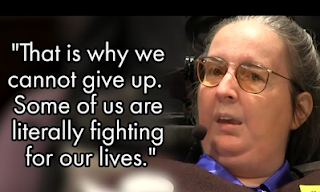
Cathy Ludlum opposes Connecticut assisted suicide bill. She is literally fighting for her life.

Co-chairs and members of the Public Health Committee:

My name is Cathy Ludlum, and I am one of the leaders of Second Thoughts Connecticut, a group of disabled people and allies who are working to prevent the legalization of medical assisted suicide. I am opposed to SB 88.

The question at hand is not whether people can take their own lives. Suicide is not illegal. The question is how many other struggling people will follow their lead, pressured by society and assisted by the healthcare system to die?

Every year when this bill comes up, I testify against it. I stand before you as a competent, creative, and successful professional who has a good life while experiencing a high level of disability.

Not this year.

The shortage of direct care workers (whether you call them personal assistants, PCAs, or home health aides) has reached a point where lives hang in the balance, including mine.

Yes, I am talking about the fact that people are not consistently getting out of bed in the morning, or must go to bed at 5 in the afternoon. Sometimes meals are skipped or other bodily needs go unmet because there is no one to assist with these critical activities.

These workers are significantly undercompensated and are leaving the field by the hundreds because they cannot make ends meet. They do not feel respected or appreciated, and the value of the support they provide has been largely unrecognized.

But in the context of today’s legislation, I am talking about the psychological impact of being severely disabled and not having enough support …for years.

Every so often, someone asks what medical assisted suicide has to do with disability. For two decades, the disability community has been pointing to the End-of-Life Concerns listed in the Oregon and Washington State data summaries. The top four concerns never change:

From the Oregon Death with Dignity Act 2020 Data Summary 1
  • Less able to engage in activities making life enjoyable (94.3%)
  • Losing autonomy (93.1%)
  • Loss of dignity (71.8%)
  • Burden on family, friends/caregivers (53.1%)
From the Washington State 2020 Death with Dignity Act Report 2
  • Less able to engage in activities making life enjoyable (90.6%)
  • Losing autonomy (89.6%)
  • Loss of dignity (74.8%)
  • Burden on family, friends/caregivers (58.6%)
Let me show how this is relevant to me and my colleagues.

Less able to engage in activities making life enjoyable — With the dedicated support of my personal assistants, I have lived in my own home for 30 years, worked, traveled, done things with friends, and basically had a great life. That seems to be over as I struggle to get enough supports. Advertising no longer produces new hires. Without enough workers, my focus every day has to be on shifting people around so I can get my most basic needs met.

Losing autonomy – My independence depends on interdependence. Technology allows me to do a few things for myself, mainly on the computer. But without human assistance, I cannot clean my house, take a shower, or get to a doctor’s appointment; much less work toward my personal and business goals.

Loss of dignity – I believe that dignity is inherent in everyone, but not everyone is treated that way. I have had to hire a number of people who were literally repulsed by normal bodily functions. Some hurt me with their words. I have adjusted so many things in my life, my home, my relationships, and my personal care that I don’t even know where I can trim anymore.

Burden on family, friends/caregivers – Everyone is going to burn out eventually. Not having enough workers, I overrely on the ones I have left. In times past, I had backup assistants, but you can’t find those now. When I cannot find anyone else, I have to rely on friends, some in their 70s, to provide care. I know like I’ve never known before what it means to feel like a burden.

I am telling my story because I want you to understand that death has begun to look preferable to living like this.

You can keep saying that medical assisted suicide is not intended for the likes of me, but it takes a lot of effort every single day to keep my body working and my lungs breathing… and increasingly I think about giving up.

Don’t believe I would qualify under SB 88? Look at the bill. It clearly points to people like me as appropriate users of medical assisted suicide.
Sec. 1 (21) “Terminal illness” means the final stage of an incurable and irreversible medical condition that an attending physician anticipates, within reasonable medical judgment, will produce a patient’s death within six months if the progression of such condition follows its typical course.
The progression of spinal muscular atrophy is death if it follows its typical course. I am almost 60 years old because I have been vigorously interfering with the typical course of SMA. When I was 35 I became unable to eat enough to sustain my life and started using a feeding tube. At 38 I was choking in my sleep so I started using respiratory support.

SB 88 says nothing about the impact of treatment on life expectancy. The public likely assumes that the lethal prescription is only available to people who have exhausted all treatment options. But this is not so. An individual may stop life-sustaining medications or technologies at any point, rendering them terminal within six months. In my case, we are talking days, not months.

In their discussion on whether people with anorexia qualify for assisted suicide, the American Clinician’s Academy on Medical Aid in Dying’s (ACAMAID) Ethics Consultation Service notes:
Mandating that the patient exhaust all possible treatments before requesting aid in dying is not in keeping with other “terminal” illnesses. For example, we allow patients with end stage cancer to forgo chemotherapy or other potentially life – extending treatments and request medical aid in dying. 3
As an Oregon official has clarified in writing, any person who becomes terminal because they do not receive treatment, for any reason (including not only refusal of treatment, but inability to pay for treatment), would qualify for assisted suicide under an Oregon-type law. 4 5
The law is best seen as a permissive law, and states only that patients must have a terminal illness with six months or less to live. It does not compel patients to have exhausted all treatment options first, or to continue current treatment. It is up to the patient and doctor to discuss disease and treatment options. But if the patient decides they don’t want treatment, that is their choice.
I am not suggesting that people be forced to accept treatment they do not want. But we must understand that populations other than those traditionally considered to be terminal (end stages of cancer, COPD, kidney failure, for example) will be affected by this legislation.

Refusal of treatments that have previously allowed people not only to live, but to thrive, should point in the direction of suicide prevention. Instead, there is too often an assumption that death is imminent and even preferable. Connecticut’s State Suicide Prevention Plan 2025 describes the challenges faced by disabled people in getting equal access to suicide prevention services. It also acknowledges that physician assisted suicide puts people with disabilities at particular risk. Please see pp. 56-58. 6

Suicide is contagious, and this is suicide, no matter how often and fervently you deny it.

I am not alone. Many people are hanging on by a thread. Maybe because of unmet disability needs. Maybe because of economic distress. Maybe from isolation and sadness.

Do we as a society want to strengthen that thread so it does not break? Do we want to make sure people who need supports (whether home care or other supports) get them?

Or do we want to create a policy that says, in effect, “ending your life is reasonable if your problems are big enough”? Given that wink of approval, some (I suggest many) will cut that thread. Perhaps not right away, but more and more as the years go by.

I am aware that there is intense pressure to get this bill passed in this legislative session. If it does, there will be plenty of time to go back later and gut the hollow safeguards it contains. This is already happening in other states.

Again, I say, the question at hand is not whether people can take their own lives. The question is how many other struggling people, pressured by society and assisted by the healthcare system, will follow their lead?

SB 88 is bad medicine, bad for people, and bad public policy. Please vote NO. Thank you.

Sources:
1 Oregon Death with Dignity Act 2020 Data Summary
https://www.oregon.gov/oha/ph/providerpartnerresources/evaluationresearch/deathwith dignityact/Pages/index.aspx
 
2 Washington State 2020 Death with Dignity Act Report
https://www.oregon.gov/oha/ph/providerpartnerresources/evaluationresearch/deathwith dignityact/Pages/index.aspx
 
3 Summary of Consultation concerning a Patient with Anorexia Nervosa, American Clinicians Academy on Medical Aid in Dying (ACAMAID), Aid in Dying Ethics Consultation Service
https://www.acamaid.org/wp-content/uploads/2021/09/Ethics-Consultation-Anorexia- Nervosa-9-3-21.pdf

4 Fabian Stahle, “Oregon Health Authority Reveals Hidden Problems with the Oregon Assisted Suicide Model”
https://drive.google.com/file/d/1xOZfLFrvuQcazZfFudEncpzp2b18NrUo/view

5 “Diabetics Eligible for Physician Assisted Suicide Oregon,” The Washington Times
https://www.washingtontimes.com/news/2018/jan/11/diabetics-eligible-physician-assisted- suicide-oreg/;

6 Connecticut’s State Suicide Prevention Plan 2025, pp. 56-58
https://www.preventsuicidect.org/wp-content/uploads/2021/05/Suicide-P
revention-Plan- 2020-2025.pdf

Saturday, March 6, 2021

Oregon 2020 assisted suicide report - 28% increase in assisted deaths.

Alex Schadenberg
Executive Director, Euthanasia Prevention Coalition

The 2020 Oregon assisted suicide report indicates that there was a 28% increase in the number of reported assisted suicide deaths since the 2019 Oregon assisted suicide report. As with previous years, the report implies that the deaths were voluntary (self-administered), but the information in the report does not address that subject.

According to the 2020 Oregon assisted suicide report.
  • There were 245 reported assisted suicide deaths up from 191 in 2019.
  • There were 370 lethal prescriptions written, up from 290 in 2019.
  • 22 of the deaths, the lethal drugs were prescribed in previous years.
  • 3 people were referred for a psychological or psychiatric evaluation.
  • 1 physicians was referred to the Oregon Medical Board for failure to comply with the law in 2019.
  • In 2019, the time of death ranged from 1 minute to 47 hours, in 2020 the time of death ranged from 6 minutes to 8 hours.
  • 80 people received lethal prescriptions, but their "ingestion" status is unknown.
*Order the pamphlet - Shedding light on assisted suicide in America.
The increase in the number of assisted suicide deaths is likely related to the normalization of assisted suicide in Oregon and the change in the law to allow doctors to waive the waiting period.
 
There may be more assisted suicide deaths.

According to the 2020 Oregon report, the ingestion status was unknown in 80 deaths. When the ingestion status is unknown, the Oregon Health Authority knows that the person received lethal drugs but they have no idea how the person died. It is possible that all or some of the unknown deaths are unreported assisted suicide deaths. 

The 2019 report stated that 188 people died by assisted suicide, but the 2020 report amends teh 2019 data by stating that there were 191 reported assisted suicide deaths.


Oregon Governor Kate Brown, in July 2019, signing Bill SB 0579 into law. This bill, essentially, eliminates the 15 day assisted suicide waiting period. This expansion of assisted suicide allows the physician to waive the waiting period, and if the patient is depressed, the patient loses the opportunity to change their mind.

Assisted suicide activists have been experimenting for several years with lethal drug cocktails on people approved for assisted suicide. An article by Lisa Krieger published by the Medical Xpress on September 8, 2020 uncovers information about the lethal drug experiments:

A little-known secret, not publicized by advocates of aid-in-dying, was that while most deaths were speedy, others were very slow. Some patients lingered for six or nine hours; a few, more than three days. No one knew why, or what needed to change.

"The public thinks that you take a pill and you're done," said Dr. Gary Pasternak, chief medical officer of Mission Hospice in San Mateo. "But it's more complicated than that."

An article published in USA Today in February 2017 examined the experiments  being done on people to find a cheaper lethal drug cocktail for assisted suicide. The article states that assisted suicide researchers are promoting new generations of lethal drug cocktails. The results of the first two lethal drug cocktails were:

The (first) turned out to be too harsh, burning patients’ mouths and throats, causing some to scream in pain. The second drug mix, used 67 times, has led to deaths that stretched out hours in some patients — and up to 31 hours in one case.
The 2020 Oregon report emphasizes the use of the fourth generation of lethal drug cocktails show that the length of time to die has reduced but the problems with the use of these lethal drug cocktails continue.
 

In December 2017, Fabian Stahle, a Swedish researcher who is concerned about assisted suicide, communicated by email with a representative of the Oregon Health Authority.
Stahle confirmed that the definition of terminal illness, used by the Oregon Health Authority includes people who may become terminally ill if they refuse effective medical treatment.
The responses to Stahle from the Oregon Health Authority also confirmed that there is no effective oversight of the Oregon assisted suicide law.
 
The yearly Oregon DWD reports are based on data from the physicians who prescribe and carry-out the assisted suicide death and the data is not independently verified. Therefore, we don't know if the information from these reports is accurate or if abuse of the law occurs.

Thursday, July 25, 2019

Oregon removes 15 day waiting period for assisted suicide.

Alex Schadenberg
Executive Director, Euthanasia Prevention Coalition

Oregon Governor Kate Brown agreed to expand the assisted suicide law by signing Bill SB 0579 into law. This bill, essentially, eliminates the 15 day waiting period to die by assisted suicide, a safeguard that was designed to assure that the person has an opportunity to change their mind.

Proponents of the bill argued that the bill only applies to people with less than 15 days to live, and yet, it is difficult to know whether someone has less than 15 days to live.

The assisted suicide lobby argued that assisted suicide laws have not expanded in Oregon, therefore there is no fear of expansion in other jurisdictions. But previous to this bill, Oregon Health Authority had expanded assisted suicide by changing the meaning of terminal illness. 

As Fabian Stahle wrote: 
"So under Oregon's assisted death law one can achieve the status of being 'incurably' sick even if the disease can be treated!".
The Netherlands euthanasia law has also expanded by changing the interpretation of the law. The latest Netherlands euthanasia statistics suggest that the euthanasia law has been re-interpreted to include euthanasia for "completed life."

This bill waves the 15 day waiting period, meaning, a person who is approved for assisted suicide can die within days, and if depressed, loses the opportunity to change their mind.


Thursday, June 20, 2019

Oregon approves bill to expand assisted suicide law.

Alex Schadenberg
Executive Director - Euthanasia Prevention Coalition


The Oregon House passed a bill on Tuesday that expands the Oregon's assisted suicide law by essentially waving the requirement of a 15 day waiting period.

Oregon Bill SB 0579 which enables a physician to wave the 15 waiting period states:
Notwithstanding subsection (1) of this section, if the qualified patient’s attending physician has medically confirmed that the qualified patient will, within reasonable medical judgment, die before the expiration of at least one of the waiting periods described in subsection (1) of this section, the prescription for medication under ORS 127.800 to 127.897 may be written at any time following the later of the qualified patient’s written request or second oral request under ORS 127.840.
By waving the 15 day waiting period, a person who is approved for assisted suicide could die by assisted suicide without an opportunity, if depressed, to change their mind. 

The assisted suicide lobby argues that assisted suicide laws have not expanded in Oregon, therefore there is no fear of expansion in other jurisdictions. Previous to this bill, Oregon had expanded assisted suicide by re-interpreting the meaning of terminal illness. In January 2018, Fabian Stahle proved that the Oregon Health Authority re-interpreted the meaning of terminal illness. Now Oregon has expanded the language of the legislation.

The Netherlands euthanasia law has expanding, not by changing the language of the law, but by changing the interpretation of the law. The latest Netherlands euthanasia statistics suggest that the euthanasia law was re-interpreted to include euthanasia for "completed life."

Monday, April 22, 2019

Oregon assisted suicide. The myth of "oversight" and "control."

Alex Schadenberg
Executive Director - Euthanasia Prevention Coalition

As the Executive Director of the Euthanasia Prevention Coalition (EPC) my position opposing assisted suicide is clear. For the sake of this article, I will simply share some information about assisted suicide in Oregon.


In 2018 two Oregon doctors were investigated for abuse of the assisted suicide act. Since the Oregon assisted suicide act uses a self-reporting system (the physician who assists the suicide is also the physician who reports) it is difficult to uncover abuse of the law.

A search of the Oregon Medical Board disciplinary actions on September 15, 2018, found that Dr Rose Kenny was disciplined by the Medical Board. The order from the meeting states:
3.1 Licensee must not prescribe or manage the prescriptions for any medication for any patient enrolled in hospice care,
3.2 Licensee must not prescribe or manage the prescriptions for any medication for any patient requesting Death with Dignity.
Recent assisted suicide research has uncovered excessive suffering related to death by assisted suicide. An article by JoNel Aleccia published by Kaiser Health News on March 5, 2017 reported that the following occurred while doing research on assisted suicide drug cocktails: 
The first Seconal alternative turned out to be too harsh, burning patients’ mouths and throats, causing some to scream in pain. The second drug mix, used 67 times, has led to deaths that stretched out hours in some patients — and up to 31 hours in one case.
The myth that the Oregon assisted suicide law has effective oversight has enabled the assisted suicide lobby to push for an expansion of the Oregon assisted suicide law.

Oregon is proposing to expand the assisted suicide law.

The Oregon legislature is debating several bill including Bill HB 2217 to expand the assisted suicide law to permit euthanasia (homicide) by redefining the term "self administer" to allow  patients to take the lethal drugs into their body using any method, including an IV tube or injection. The bill states:
“Self-administer” means a qualified patient’s physical act of ingesting or delivering by another method medication to end his or her life in a humane and dignified manner.
Bill HB 2232  proposes to change the definition of terminal from a six month prognosis to:
a disease that will, within reasonable medical judgment, produce or substantially contribute to a patient’s death.
This new definition eliminates the requirement that a person, who dies by assisted suicide, be terminally ill. 

Many people have a disease that will within reasonable medical judgement, produce or substantially contribute to death, are not "terminally" ill. This new definition will give doctors the right to prescribe suicide drugs to many more people.

Oregon Bill SB 0579 enables a physician to wave the 15 waiting period in the assisted suicide law. SB 0579 states:
Notwithstanding subsection (1) of this section, if the qualified patient’s attending physician has medically confirmed that the qualified patient will, within reasonable medical judgment, die before the expiration of at least one of the waiting periods described in subsection (1) of this section, the prescription for medication under ORS 127.800 to 127.897 may be written at any time following the later of the qualified patient’s written request or second oral request under ORS 127.840.
By waving the 15 day waiting period, a person who is approved for assisted suicide could receive the lethal drugs immediately with no opportunity for a depressed person to change their mind.

When analyzing the recent Oregon assisted suicide report we notice significant problems with the law beyond the fact that assisted suicide causes death.

The Oregon assisted suicide report states that there were 168 reported assisted suicide deaths in 2018 up from 158 reported assisted suicide deaths in 2017. The longest duration before death being 21 hours in 2018 while one person died 807 days (more than 2 years and 2 months) after being approved for assisted death.

In December 2017, Fabian Stahle, a Swedish researcher, communicated by email with a representative of the Oregon Health Authority.

Stahle confirmed that the definition of terminal illness, used by the Oregon Health Authority includes people who may become terminally ill if they refuse effective medical treatment.

The responses to Stahle from the Oregon Health Authority also confirmed that there is no effective oversight of the Oregon assisted suicide law.
Assisted suicide and "other" suicide deaths.

The Oregon suicide rate is increasing faster than the national average. In 2007 Oregon's conventional suicide rate was 35% higher than the national average while in 2014, Oregon's conventional suicide rate was 43% higher than the national average.


It has been argued that there is not a direct co-relation between the Oregon suicide rate and assisted suicide, nonetheless, it must be noted that there appears to be a suicide contagion effect.

Oregon assisted suicide law is designed to cover-up abuse of the law.

The Oregon law enables the physician who assesses a person requesting assisted suicide to be the same physician who prescribes the lethal assisted suicide drugs and then be the same physician who is required to report the assisted suicide death.

By law, the same doctor is the judge, the jury and the executioner.

The yearly Oregon DWD reports are based on data from the physicians who prescribe and carry-out the assisted suicide death and the data is not independently verified. Therefore, we don't know if the information from these reports is accurate or if abuse of the law occurs. There is no third party oversight or intervention it is all a mirage.

Since doctors rarely self-report abuse of the law or even self-report controversial decisions, therefore the law enabled a cover-up of any and all concerns.
Every state that has legalized assisted suicide has also employed the same system to cover-up potential problems with the law.

If the facts concerning assisted suicide were known and openly debated, people would reject assisted suicide and demand excellent care.

To share this information, order the pamphlet: Shedding Light on Assisted Suicide in America.

We believe in Caring Not Killing.