Showing posts with label New Zealand euthanasia. Show all posts

Wednesday, July 8, 2026

New Zealand 2025 euthanasia report. Assisted deaths increase again.

Alex Schadenberg
Executive Director, Euthanasia Prevention Coalition

The New Zealand 2026 assisted dying report (April 1, 2025 - March 31, 2026) was recently released indicating that the number of reported assisted deaths increased to 486 reported assisted deaths up from 472 in the 
2025 report (April 1, 2024 to March 31, 2025) and 344 reported in the 2024 report.

Euthanasia and assisted suicide were legalized in New Zealand in November 2021. The law allows doctor administered death (euthanasia) and self-ingestion (assisted suicide).
 
The 2026 report indicated that 460 of the 486 assisted deaths were carried-out by the doctor (euthanasia) which was up from 450 of the 472 assisted deaths being carried-out by the doctor (euthanasia) in 2025.

On November 11, 2025 I reported that New Zealand MP Todd Stephension introduced - The End of Life Choice Amendment Bill, a private members bill to expand the New Zealand assisted dying law.

What would the New Zealand euthanasia expansion bill (among other things) do?

  • Amends the definition of who can do euthanasia by changing the terminology from attending medical practitioner to attending practitioner.
  • Changes the terminal illness requirement to a person who has been diagnosed with a condition that is advanced, progressive, and, either on its own or in combination with 1 or more other diagnosed conditions, is expected to cause death. (Expected to cause death is not the same as a terminal illness with a 6 month prognosis).
  • Eliminates conscience rights by forcing a medical practitioner to refer a person to the assisted dying service when they have received a request for assisted dying.
The New Zealand government may follow Canada's lead with plans to expand euthanasia to people who are not terminally ill. In fact the bills definition of who qualifies to be killed can be interpreted wide enough to include most people with disabilities.

In October 2020, New Zealand voters supported euthanasia based on specific legalization legislation. The law has only been in place since November 2021 and now there is a push to expand the legislation.

Tuesday, November 11, 2025

New Zealand euthanasia expansion bill follows Canada's lead

Alex Schadenberg
Executive Director, Euthanasia Prevention Coalition

The New Zealand euthanasia expansion bill appears to have followed Canada's lead.

The New Zealand parliament passed a euthanasia bill in December 2019. New Zealand then had a referendum in October 2020 that supported that particular euthanasia bill with the law coming into force on November 7, 2021.

New Zealand MP Todd Stephension has introduced - The End of Life Choice Amendment Bill, a private members bill to expand the New Zealand euthanasia law in several ways.

Since New Zealand citizens voted on a referendum in October 2020 that was based on specific legislation that was passed in parliament, therefore any expansions to that legislation undermine the will of the people or minimally assume that the people want the law to be expanded.

What does the New Zealand euthanasia expansion bill do? Among other things the bill:

  • Amends the definition of who can do euthanasia by changing the terminology from attending medical practitioner to attending practitioner.
  • Changes the terminal illness requirement to a person who has been diagnosed with a condition that is advanced, progressive, and, either on its own or in combination with 1 or more other diagnosed conditions, is expected to cause death. (Expected to cause death is not the same as a terminal illness with a 6 month prognosis).
  • Eliminates conscience rights by forcing a medical practitioner to refer a person to the assisted dying service when they have received a request for assisted dying.
Sadly, it appears that the New Zealand government is following Canada's lead by expanding euthanasia to people who are not terminally ill. In fact the new definition of who qualifies to be killed can be interpreted wide enough to include most people with disabilities.

In October 2020, New Zealand voters supported euthanasia based on specific legalization legislation. The law has only been in place since November 2021 and now there is a push to expand the legislation.

This approach undermines the vote of the people. Any significant amendments, such as The End of Life Choices Amendment Bill should also go to the people for approval.

Friday, August 8, 2025

Assisted deaths increase by 37% in New Zealand

Alex Schadenberg
Executive Director, Euthanasia Prevention Coalition

Euthanasia and assisted suicide became legal in New Zealand on November 7, 2021 under the End of Life Choices Act which was passed in Parliament by a vote of 69 to 51 in December 2019 and endorsed in a referendum in 2020 by 65% of voters.

The most recent report that was released by the New Zealand Assisted Dying Service (April 1, 2024 to March 31, 2025) indicated that there were 472 assisted deaths (up from 344 in the previous year), and there 1137 active cases (up from 945 in the previous year).

New Zealand legalized both euthanasia and assisted suicide. The report stated:
For the 472 assisted deaths that took place between 1 April 2024 and 31 March 2025:
• 17 people chose ingestion, triggered by the person,
• 5 people chose intravenous delivery, triggered by the person,
• 9 people chose ingestion through a tube, triggered by the AMP or ANP
• 441 people chose injection, administered by the AMP/ANP.

Therefore 441 out of 472 were euthanasia and 31 were assisted suicide deaths. Similar to Canada, euthanasia has become the primary way to die by assisted death. 

It is important to note that:

  • 21% of the applicants were not receiving palliative care and,
  • 12% of the applicants were living with a disability. 
  • only 126 medical professionals were willing to participate in an assisted death in 2024 which indicates that most medical professionals are unwilling to kill their patients, and
  • only 10 applicants (1137 active cases) had a psychiatric assessment to check for both competence and for any presence of coercion.

Some those who suggest that there is no slippery slope after legalizing euthanasia and assisted suicide, they are ignoring that New Zealand has a political debate concerning expanding the euthanasia law. 

Anne Whyte reported for The Press on August 29, 2024 that:

The ACT Party is in the process of making moves to widen the scope on euthanasia, launching back into the contentious issue that could have sunk the law when it originally went through Parliament.

The End Of Life Choice law currently has a range of requirements needed to be eligible for assisted dying, including being in an “advanced state of irreversible decline in physical capability” and experiencing “unbearable suffering that cannot be relieved in a manner that the person considers tolerable”.

They also need to have a terminal illness “that is likely to end the person’s life within six months”.
The ACT leader, David Seymour, who sponsored the original euthanasia law called the terminal illness requirement "a political compromise." Seymour wants to expand the law.

Previous articles concerning euthanasia in New Zealand.

  • New Zealand will debate expanding it's assisted dying law (Link). 
  • New Zealand doctor offers euthanasia to a suicidal patient (Link).

Thursday, April 3, 2025

Defining assisted suicide as medical treatment

Alex Schadenberg
Executive Director, Euthanasia Prevention Coalition

I have been writing about euthanasia and assisted suicide for almost 30 years. During that time I have taken the clear position that killing is not caring and euthanasia and assisted suicide are not medical treatment.

The outcome related to defining medical treatment as including killing is substantial.

Dan Hitchens was published in compactmag.com on March 31, 2025 explaining: How assisted suicide will undo the NHS. The NHS refers to the National Health Service in the UK. Hitchens writes:
Last week, the MPs examining Britain’s assisted suicide bill voted through a very remarkable subclause. A single sentence, tabled by the bill’s chief architect Kim Leadbeater, quietly altered the definition of the National Health Service. The NHS’s original legislation in 1946 laid down that it must “secure improvement in the physical and mental health of the people of England…and the prevention, diagnosis and treatment of illness.” None of which really includes assisted suicide. If Leadbeater’s bill manages to pass its future votes in the Commons and Lords, this might have opened the government to a legal challenge.
I personally consider this change to the assisted suicide bill as revolutionary. Hitchens explains the significance of the amendment to the assisted suicide bill:
Hence the subclause, which allows the Health Secretary to declare that “commissioned VAD [voluntary assisted dying] services” are in fact part of the NHS’s legislative charter. The subclause doesn’t explain why: It just ensures that the government can say so. Which, as the Tory MP Danny Kruger observed, effectively admits that the National Health Service would turn into a different kind of institution. It would, through this tweak to its founding legislation, become the National Health and Assisted Suicide Service. But the alarm was loudest on the other side of the Commons. Labour MPs tend to regard the NHS as their party’s definitive achievement, the greatest edifice of the postwar welfare state built by Clement Attlee’s government. After the subclause went through, six Labour MPs signed a letter calling the bill “irredeemably flawed and not fit to become law,” noting—among a dozen other issues—that it makes “a change to the founding language and purpose of our NHS.”
Professor Sir Louis Appleby, who leads the National Suicide Prevention Strategy for England responded that they work on the principle that:
“Of protecting people at their lowest point, helping them find something worth living for, however bleak life looks.”

“Once the principle behind suicide prevention has been set aside, once any part of the ground has been ceded—not only to allow suicide but to assist it—we have lost something we may not get back.”
Hitchens explains that Kit Malthouse, a Tory MP argues that assisted suicide is not suicide. Hitchens makes reference to Australian MP Alex Greenwich who referred to assisted suicide as:
"an important form of suicide prevention.”
Hitchens explains that defining assisted suicide as part of medical treatment, with relation to the NHS will take the heart out of the NHS especially since Kim Leadbeater, the sponsor of the assisted suicide bill stated that trying to persuade a loved one from assisted suicide may qualify as “coercion.” Hitchens writes:
To recap: Taking your own life isn’t suicide, the provision of lethal drugs is suicide prevention, begging a loved one to stay alive is coercion, and the rejection of a safeguard “creates safeguards.” It is sometimes worth asking, in the words of WS Graham, what is the language using us for? This kind of language, this style of thought, uses us to obliterate what we thought we knew about our duties to each other.
Hitchens comments on how legalizing assisted suicide changes palliative care.
Palliative care, and more specifically hospice care for those nearing the end of life, is one of the signal achievements of modern medicine. Both in removing physical pain, and in addressing the complex emotional needs of the terminally ill, it can be transformative. But in jurisdictions with assisted suicide, it begins to hold a more brutal meaning. One Oregon nurse has lamented that “There is an attitude among many of our clients that ‘If I go into hospice, they’re going to kill me because that’s what a hospice does.’”
Hitchens continues by presenting data from a New Zealand study of healthcare professionals who work within a Hospice setting. The study by Dr Sinéad Donnelly indicates that the legalization of assisted death in New Zealand has changed the nature of hospice care. Hitchens comments on the change in attitude in New Zealand by writing:
Again, knock out the universal principle—we will care for you until the very end—and the atmosphere shifts decisively. There are two kinds of existences: those worth living, and those not worth living. A colder, more impatient, more utilitarian logic begins to work its way into our relationships.
Hitchens concludes his article by stating:
Stepping back a little, it is hard not to see a connection between the assisted suicide bill and the national condition in 2025: our crumbling public services, bewildered government, and extractive rentier economy. Hospices are struggling to stay open. The care sector survives on superhuman self-sacrifice and poverty wages (“a miracle sitting on top of a disgrace,” as one care manager has said.) Working-age parents are squeezed for every last penny and every last minute. There isn’t enough to go around—not enough cash, not enough time, not enough attention. And every one of those problems makes itself felt in the NHS, where waiting lists have hit record highs, 30 per cent of staff feel burnt out, and hospitals are so swamped that one hospital recently advertised for a “corridor care” doctor. Health and social care is perhaps the defining challenge for the current generation of politicians, and officially they all want to solve it. But wouldn’t it be easier, a voice seems to whisper, to just give up?
I believe that the problem goes further than described by Hitchens. When assisted suicide is considered to be medical treatment, the outcome is a requirement to inform everyone who may qualify for it based on the fact that people have a right to know about all medical options.

The reality is that assisted suicide is not medical treatment and in fact, it does not have a medical purpose. It does cause death, but death is not an intentional medical outcome, rather it is a reality of life.

Once assisted suicide is defined as a medical treatment, the legislation will be forced to expand. It becomes discriminatory to limit medical treatment to persons over the age of 18 and you cannot limit medical treatment to someone who is not dying, based on equality, when it can be offered to someone who is dying.

If euthanasia and assisted suicide are defined as medical treatment, then death becomes a treatment for conditions that require excellent care.

Thursday, August 29, 2024

New Zealand will debate expanding it's euthanasia law.

Alex Schadenberg
Executive Director, Euthanasia Prevention Coalition

The New Zealand government is discussing expansions to their euthanasia law. The primary expansion that is being discussed is the removal of the 6 month terminal illness prognosis in the law to permit euthanasia of people with chronic conditions, similar to what Canada did in March 2021.

New Zealand passed a euthanasia referendum on October 17, 2020 with the euthanasia law coming into force on November 7, 2021. After less than three years of killing, a debate on expanding the law by removing the terminal illness requirement has begun.

Anne Whyte reported for The Press on August 29 that:
The ACT Party is in the process of making moves to widen the scope on euthanasia, launching back into the contentious issue that could have sunk the law when it originally went through Parliament.

The End Of Life Choice law currently has a range of requirements needed to be eligible for assisted dying, including being in an “advanced state of irreversible decline in physical capability” and experiencing “unbearable suffering that cannot be relieved in a manner that the person considers tolerable”.

They also need to have a terminal illness “that is likely to end the person’s life within six months”.
The ACT leader, David Seymour, who sponsored the original euthanasia law called the terminal illness requirement "a political compromise." Whyte reported:

“The six month limit was a political compromise,” ACT leader David Seymour said on Wednesday, at a petition handover in front of Parliament.

Seymour, speaking to CEO of advocacy group Social Justice Aotearoa Jackie Foster who delivered the petition asking Parliament for the euthanasia legislation to also allow those who have degenerative diseases, said he was “sorry that we made that compromise”.

“I never supported it. I never wanted it. I didn't introduce it that way. I had to compromise, because if I didn't get the votes, there'd be no law at all.”
Canada legalized euthanasia in June 2016. In March 2021 Canada passed Bill C-7 that removed the "terminal illness" requirement in the law, created a two-tier law by removing the waiting period for people who were terminally ill and adding a 90-day waiting period for people who were not terminally ill and allowing euthanasia for mental illness alone.

Euthanasia for mental illness alone remains contentious and has currently been delayed until March 2027.

In the United States, nearly every state that has legalized assisted suicide has later expanded their law.

The euthanasia lobby considers legal safeguards as a compromise that can later be removed from the law.

Tuesday, July 11, 2023

New Zealand doctor offers euthanasia to a suicidal patient

Alex Schadenberg
Executive Director, Euthanasia Prevention Coalition

The New Zealand Herald reported on July 11 that New Zealand's Ministry of Health stated that there were 328 euthanasia deaths and 807 euthanasia applications from April 1, 2022 and March 31, 2023 representing approximately 1% of all deaths in New Zealand.

Isaac Davison, reporting for the New Zealand Herald indicated that an investigation was launched into a New Zealand health practitioner who allegedly raised assisted dying with a suicidal patient. 

Davison reported:
The report said a complainant had raised concerns about “a health practitioner initiating a conversation about assisted dying with a suicidal young person”.  
Under New Zealand’s assisted dying law, a doctor or other health professional cannot initiate discussion about assisted dying. It must be initiated by the patient.
There were 8 complaints made to the Disability Commission about assisted dying in the time-frame of the report.

On July 20, 2022, Davison reported in the New Zealand Herald that there were 143 New Zealanders who died by euthanasia in the first five months of their law. According to Davison there were 4 complaints made at that time.

According to the data, there were 471 euthanasia deaths and 12 complaints filed between legalization and March 31, 2023 (17 months).

Friday, May 5, 2023

New Zealand report: First year of euthanasia and assisted suicide.

This article was recently published by the Australian Care Alliance.

Euthanasia and assistance to suicide became legal in New Zealand on 7 November 2021 under the End of Life Choices Act which passed the Parliament by 69 votes to 51 in December 2019 and was endorsed at a referendum in 2020 by 65.1% of voters.

Numbers
  • 257 people were euthanased or assisted to suicide between 7 November 2021 and 6 November 2022.
  • Deaths by euthanasia and assisted suicide accounted for approximately 0.67% of all deaths in New Zealand.
  • 23% more women than men applied for euthanasia or assistance to suicide - 365 women and 296 men.
Eligibility criteria

The key eligibility criteria are that the person is an adult New Zealand citizen or permanent resident who, according to two assessing medical practitioners, “suffers from a terminal illness that is likely to end the person’s life within 6 months”.

Neither medical practitioner needs to have any specialist qualification in a field relevant to the particular terminal illness.

If either or both assessing practitioners are uncertain of the person’s competence to make an informed decision then the person must be examined by a psychiatrist to determine this matter.
Only 6 of the 636 people assessed by a first medical practitioner or the 475 people assessed by a second medical practitioner for eligibility between 7 Nov 2021 and 6 November 2022 were referred to a psychiatrist, and each of these were confirmed as eligible other than one person who died before the assessment was completed.
Health practitioner

Health practitioners are not permitted to initiate a discussion with or make a suggestion to a patient about accessing euthanasia or assistance to suicide under the Act.

A medical practitioner with a conscientious objection can refuse to participate but must advise a person who requests access of the person’s right to ask the SCENZ Group for the name and contact details of a replacement medical practitioner. The SCENZ (Support and Consultation for End of Life in New Zealand) Group maintains a register of health practitioners willing to provide access to people seeking euthanasia or assistance to suicide.

Administration

If the person chooses to self-administer the prescribed lethal poison it is only supplied to them shortly before a time specified by the person for self-administration (suicide).

Regardless of whether the lethal poison is self-administered or administered by an attending medical or nurse practitioner, the attending medical or nurse practitioner (or a substitute practitioner) must be in “close proximity to the person”, but not necessarily in the same room or area, until the person’s death.

Annual report

The only elements required by the Act to be in the annual report from the Registrar (Assisted Dying) are the total number of deaths and the number of deaths occurring through each of the four methods described in the Act and the number of complaints received about breaches of this Act and how those complaints were dealt with.

The first annual report covered the period 7 November 2021 to 31 March 2022 and reported on 66 assisted deaths.

The four methods of administration of the lethal poison set out in s19(2)(a) of the Act are, and the number of deaths by each method between 7 November 2021 and 31 March 2022 were:
  • ingestion, triggered by the person - 6
  • intravenous delivery, triggered by the person - 4
  • ingestion through a tube, triggered by the attending medical practitioner or an attending nurse practitioner – 0, and
  • injection administered by the attending medical practitioner or an attending nurse practitioner - 56
No complaints about breaches of the Act were received.

Monday, November 28, 2022

New Zealand doctors group wants "brakes" put on expanding euthanasia.

Alex Schadenberg
Executive Director, Euthanasia Prevention Coalition

Dr Bryan Betty
On November 7 I reported that David Seymour, the leader of the ACT party and the MP who sponsored New Zealand's euthanasia law was calling for the law to be broadened.

Isaac Davison reported for the New Zealand Herald on November 6 that Seymour wants the 6 month terminal illness prognosis in the law removed. Seymour indicated that he only included the terminal illness requirement in the law to gain support for euthanasia from the other political parties.

New Zealand Royal College of GP's medical director, Dr Bryan Betty, on November 28, 2022, called for "brakes" to be put on the expansion of euthanasia. As published by Scoop Politics:

The practice of assisted suicide and euthanasia has been happening for little over a year in New Zealand, and already some proponents are calling for changes to the criteria saying many are “missing out”. The main criteria under fire is the 6 month terminal prognosis requirement, which prevents those with only chronic conditions or disabilities from being eligible.

But Dr Betty says broadening the eligibility criteria would not improve equitable choice to those facing end of life decisions. He is adamant that expansion of the End of Life Choice Act should not progress in light of the current palliative care climate in New Zealand, and not without careful analysis.
Dr Betty argues that since there is no strategic plan for palliative care in New Zealand that an inbalance has developed with the legalization and promotion of euthanasia and assisted suicide.

According to Dr Betty palliative care is not properly funded in New Zealand:

The Royal College of GPs includes more than 5,500 GPs, specialist GPs, trainee GPS, and rural hospital doctors who practise a range of different modalities from 1000 practices across the country.

Dr Betty says these doctors are often providing palliative care to their patients pro bono because there is no funding available for end of life care, and it’s a serious failing of the system.

“Palliative care is so dependent on local funding which is traditionally done by DHBs, but there’s a total lack of funding, resourcing and a national approach,”
As I previously stated, since New Zealand legalized euthanasia through a referendum and since the referendum stated that euthanasia would only be for terminally ill people with a six month prognosis, therefore any changes to the law should require another referendum.

Monday, November 7, 2022

New Zealand wants to follow Canada by removing terminal illness requirement from euthanasia law.

Alex Schadenberg
Executive Director, Euthanasia Prevention Coalition

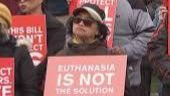
New Zealand protest
David Seymour, the leader of the ACT party and the MP who sponsored New Zealand's euthanasia law is calling for the law to be broadened.

Isaac Davison reported for the New Zealand Herald on November 6 that Seymour wants the 6 month terminal illness prognosis in the law removed. He indicated that he only included the terminal illness requirement to get support for euthanasia from the other political parties. Davison reported.

Assisted dying law in New Zealand should be relaxed to remove a requirement that a patient has only six months to live, the law’s architect says....

Seymour said he agreed to the six-month requirement to gain the support of the Green Party to pass the bill.
Davison points out that Seymour's original bill did not include a terminal illness requirement.
Seymour’s original bill would have allowed non-terminal patients with “grievous and irremediable conditions” to get access to voluntary euthanasia.

Some groups felt that definition was too broad, and raised concerns it could make assisted dying available to disabled people or mental health patients.

The amended law, which was voted on in a public referendum, made it explicit that applicants could not get access to assisted dying on the basis of disability or mental illness alone.
Not enough killing. 

Seymour seems concerned that too many euthanasia applications were turned down. Davison reported:

Voluntary euthanasia was legalised exactly a year ago, and so far 214 patients had an assisted death. In all, 596 people have applied and 294 people have been deemed eligible.

A total of 120 people were turned down because they were not eligible.

Seymour noted that a third of the ineligible patients were declined because they didn’t meet the criteria of having a terminal illness likely to end their lives within six months.

Seymour argued that the criteria of the New Zealand euthanasia law should be broadened after the government reviews the law in 2024.

Since New Zealand legalized euthanasia through a public referendum and since the referendum specifically stated that euthanasia would only be for terminally ill people with a six month prognosis, therefore any changes to the law should only be passed by another referendum
.

Thursday, July 21, 2022

New Zealand: 143 people die by euthanasia, one death is being investigated.

Alex Schadenberg
Executive Director, Euthanasia Prevention Coalition

An article by Isaac Davison that was published in the New Zealand Herald on July 20 reports that 143 New Zealanders died by euthanasia in the first five months of their law.

Davison reported that 400 people requested euthanasia and 143 reportedly died by euthanasia. It is likely that many of the people who were approved for euthanasia have not yet died by lethal drugs.

Davison reported that:
A total of 68 people (17 per cent) were deemed ineligible, more than half of them because they did not have a terminal illness which was likely to end their life within six months.
According to the report, there have been 4 complaints and one of the deaths is being investigated. The article stated:
An investigation has been launched after a complaint was laid about an assisted death in a public hospital.

A family member of the person who died laid a complaint about their experience at the hospital to the Ministry of Health.

The ministry's assisted dying secretariat has upheld the complaint and referred it to the Health and Disability Commissioner, who has begun an investigation.

Further details, including the location of the hospital, were not known...
A report by Kate Hawkesby for NewstalkZB  interviews Wayne Naylor, the acting CEO of Hospice New Zealand, who is concerned that the government may expand the New Zealand euthanasia law in 2024. Hawkesby reported:
But he told Roman Travers experience from other countries suggests there could be issues if rules around the practice were altered.
He claims some countries have loosened laws over time, resulting in babies with health issues or people with dementia being euthanised.
For instance, Canada legalized euthanasia in June 2016, the law was expanded in March 2021 when the Canadian government expanded the regulations to permit people who are disabled or chronically ill to die by euthanasia, they eliminated the 10 waiting period, they allowed people who had requested euthanasia but then later became incompetent to die by euthanasia, and they expanded the law to include people with mental illness alone.

Wednesday, April 20, 2022

66 New Zealanders die by euthanasia in 5 months after legalization.

The following New Zealand update was published by the Australian Care Alliance.

Euthanasia and assistance to suicide became legal in New Zealand from 7 November 2021 under the End of Life Choices Act which passed the Parliament by 69 votes to 51 in December 2019 and was endorsed at a referendum in 2020 by 65.1% of voters.

Numbers

66 people were euthanased or assisted to suicide between 7 November 2021 and 31 March 2022 – approximately 0.48% of all deaths in New Zealand in that period.

More women than men applied for euthanasia or assistance to suicide - 114 women and 92 men. No breakdown by sex is given for the 66 applicants who had their lives actively ended. However, if the proportion was the same then this would give a rate of 0.53% of all deaths of women in the period, compared to 0.42% for men – more than a quarter (26%) higher rate for women than men.Eligibility criteria
The key eligibility criteria are that the person is an adult New Zealand citizen or permanent resident who, according to two assessing medical practitioners, “suffers from a terminal illness that is likely to end the person’s life within 6 months”.

Neither medical practitioner needs to have any specialist qualification in a field relevant to the particular terminal illness.

If either or both assessing practitioners are uncertain of the person’s competence to make an informed decision then the person must be examined by a psychiatrist to determine this matter.
Not even one of the 168 people assessed by a first medical practitioner or the 128 people assessed by a second medical practitioner for eligibility between 7 Nov 2021 and 31 March 2022 was referred to a psychiatrist.
Health practitioner

Health practitioners are not permitted to initiate a discussion with or make a suggestion to a patient about accessing euthanasia or assistance to suicide under the Act.

A medical practitioner with a conscientious objection can refuse to participate but must advise a person who requests access of the person’s right to ask the SCENZ Group for the name and contact details of a replacement medical practitioner. The SCENZ (Support and Consultation for End of Life in New Zealand) Group maintains a register of health practitioners willing to provide access to people seeking euthanasia or assistance to suicide.

Administration

If the person chooses to self-administer the prescribed lethal poison it is only supplied to them shortly before a time specified by the person for self-administration (suicide).

Regardless of whether the lethal poison is self-administered or administered by an attending medical or nurse practitioner, the attending medical or nurse practitioner (or a substitute practitioner) must be in “close proximity to the person”, but not necessarily in the same room or area, until the person’s death.
Annual report

The only elements required by the Act to be in the annual report are the total number of deaths and the number of deaths occurring through each of the four methods described in the Act and the number of complaints received about breaches of this Act and how those complaints were dealt with.

The first annual report is not due to be tabled in Parliament until after 30 June 2022.

Download as a (PDF Link)

Monday, December 20, 2021

COVID-19 patients may be eligible for euthanasia in New Zealand

The following article was published by DefendNZ on December 19, 2021.

An Official Information Act reply to The Defender, from the Ministry of Health, which says that patients with COVID-19 could be eligible for euthanasia, has left National MP Simon O’Connor disappointed but not surprised.
In November The Defender wrote to the New Zealand Ministry of Health (MOH) to ask some important questions about the practice of euthanasia and assisted suicide in New Zealand.


In light of the serious deficiencies in the End of Life Choice Act (EOLCA), and concerns that have been raised by healthcare professionals, we felt it was crucial to put some urgent questions to the MOH.

In our Official Information Act (OIA) request we asked the following question:

“Could a patient who is severely hospitalised with Covid-19 potentially be eligible for assisted suicide or euthanasia under the Act if a health practitioner viewed their prognosis as less than 6 months?”

There were several reasons why The Defender wanted to seek clarity from the MOH about this issue.

Firstly, New Zealand is currently described as being in a precarious position when it comes to COVID-19 and hospital resources. In light of this, it would not be hard to envisage a situation in which a speedy and sizeable rise in COVID-19 hospitalisations could result in pressure to utilise euthanasia and assisted suicide as tools to resolve such a serious crisis.

Overseas commentators have raised the prospect of these kind of unethical motivations since early in this pandemic.

Last year’s tragic case of the elderly Canadian woman who had an assisted suicide to avoid another COVID-19 lockdown highlights exactly why caution is warranted in relation to COVID-19 and euthanasia.

“The lack of stringent safeguards in the EOLCA raised red flags with us. Could a patient with COVID-19 find their way into the eligibility criteria? And, if so, what serious risks would this pose to the already often-vulnerable elderly members of our communities?” says The Defender editor Henoch Kloosterboer.

The MOH responded to our OIA request on Tuesday (7th of December, 2021).

Their reply to The Defender started on a more promising note:

“There are clear eligibility criteria for assisted dying. These include that a person must have a terminal illness that is likely to end their life within six months.”
But then their response becomes more disturbing (emphasis added):
“A terminal illness is most often a prolonged disease where treatment is not effective. The EOLC Act states eligibility is determined by the attending medical practitioner (AMP), and the independent medical practitioner.”
This raises serious concerns.

Firstly, there is nothing concrete about the phrase “most often”, in fact, its inclusion in this specific context clearly seems to suggest that the MOH considers the definition of terminal illness to be subjective and open to interpretation.

The very next sentence seems to back this up. It clarifies that the MOH considers the attending medical practitioner (AMP) and the independent medical practitioner to be empowered by the EOLCA to make the determination about what does and doesn’t qualify as a terminal illness.

“In light of this vague interpretation, it is reasonable to suggest that COVID-19 could be classified as a ‘terminal illness’ depending on the prognosis of the patient and the subjective judgments of the AMP and independent medical practitioner. This feels like we’ve been sold one thing, and been delivered another.” says Kloosterboer.

In the final paragraph the MOH put this issue beyond doubt when they state (emphasis added):
“Eligibility is determined on a case-by-case basis; therefore, the Ministry cannot make definitive statements about who is eligible. In some circumstances a person with COVID-19 may be eligible for assisted dying.”
If you examine the eligibility criteria for assisted suicide and euthanasia, as stated on the MOH website, it becomes easier to see how, given the right circumstances, a COVID-19 diagnosis could qualify:

  • aged 18 years or over 
  • a citizen or permanent resident of New Zealand 
  • suffering from a terminal illness that is likely to end their life within six months 
  • in an advanced state of irreversible decline in physical capability 
  • experiencing unbearable suffering that cannot be relieved in a manner that the person considers tolerable 
  • competent to make an informed decision about assisted dying

It seems to us that the only possible protective factor here, and it’s an extremely flimsy one, is that all of this hinges on the tenuous grounds of how the phrase ‘terminal illness’ is interpreted.

In particular, whether or not the AMP and independent medical practitioner are willing to hold firm to the MOH’s suggestion to us that a terminal illness is a “prolonged disease”.

Even then, the term ‘prolonged disease’ is still extremely fraught due to its highly subjective nature. Who is to say that a medical practitioner who considers an illness which lasts longer than a fortnight to be a ‘prolonged disease’ isn’t actually correct in making such a determination?

The End of Life Choice Act doesn’t offer any clarity or robust safeguards that would put this matter beyond doubt. Instead it does just the opposite, leaving the door wide open for abuse.

When we put this matter to National MP Simon O’Connor, he expressed concerns about what clearly seems to be an expansion of the new law less than a month after it came into force.

“When New Zealanders voted in the referendum in 2020, did they anticipate the law could be used for COVID-19 patients? The wording of the law was always deliberately broad and interpretable, placing far too much into the judgement of the doctor.”

He also said that this development raises serious questions about the problems in the EOLCA.

“In my mind, it is just a timely demonstration of how badly drafted the law is. When you consider the lack of key safeguards, and the risky shroud of secrecy that the EOLCA has thrown over the practice of euthanasia and assisted suicide, you can see that those of us warning about this Act shouldn’t have been dismissed so flippantly,” says O’Connor.

The implications of this are extremely serious.


Not simply because of the potential threat COVID-19 poses to our ill-equipped NZ healthcare system, or the fact that vulnerable elderly people are the most affected by the ravages of this illness.

There is also the fact that an unacceptable lack of transparency has been built into the EOLCA which will cloak all of this in a dangerous veil of secrecy that prevents robust public scrutiny.

In a nutshell, the poorly considered structure of the EOLCA has now made the COVID-19 pandemic potentially even more dangerous for the people of Aotearoa New Zealand.

#DefendNZ, who publish The Defender, are calling on the Ministry of Health to take urgent action to ensure that the End of Life Choice Act cannot be used to provide assisted suicide or euthanasia to COVID-19 patients in New Zealand.

#DefendNZ have created a petition to send a message to Parliament, calling for urgent amendments to the law including required detailed reporting and required independent witnesses – among other things – and are asking concerned citizens to sign and share it.

Wednesday, October 7, 2020

7 ways Belgium doesn’t follow its own euthanasia law

This article was published by Mercatornet on October 7, 2020

So-called “safeguards” are much more window dressing than providing any real protection.

Robert Clarke
By Robert Clarke

As the New Zealand euthanasia referendum approaches, voters could be helped by looking at the experience in other countries before making up their minds on this complex topic. At the end of July, Czechia became the latest country to reject the legalisation of euthanasia following similar rejections in Portugal and Finland. The opposition to the bill was largely based on concerns about the impact on the elderly and vulnerable. The final nail in the coffin was the Ministry of Social Affairs’ assessment that the bill did not contain enough safeguards against human error or violations of the law.

Wherever euthanasia is proposed, its advocates normally try to alleviate concerns by explaining that the system would be carefully controlled and tightly monitored — after all, we are talking about the deliberate ending of someone’s life. In evaluating what they say, we do not have to rely on speculation. Instead, we can look to the way these so-called “safeguards” function in countries that have already legalised these practices.

Tom Mortier's mother
I represent Tom Mortier, a Belgian university lecturer in his landmark case at the European Court of Human Rights. In 2012, his physically healthy 64-year-old mother was euthanised for what the doctor called ‘incurable depression’. After more than six years of research, and close analysis of responses provided by the Belgium government, it is clear that the reality falls a long way short of the promises made when the Belgian legislation was passed in 2002.

1. Myth: Euthanasia is possible only where there is suffering that cannot be alleviated

This was the standard built into the Belgian euthanasia law, but its interpretation has been watered down to the point that it provides no protection. In the case of Tom’s mother, doctors knew that she was struggling with depression, in part because of distance from her family. And yet when she refused to reach out to them, they quickly concluded her suffering was incurable. By this logic, almost anything could be considered incurable.

2. Myth: Euthanasia must be approved by two independent doctors

One of the supposed safeguards is that a doctor’s decision must be confirmed by one, or in some cases two other doctors. And yet in the case of Tom’s mother, the doctors involved were members of the same pro-euthanasia organisation. Hardly an “independent” verification, but it was considered acceptable by the Belgian authorities. Moreover, in the weeks before her euthanasia, Tom’s mother made a 2,500 EUR payment to this organisation, which presents yet another possible conflict.

3. Myth: The paperwork must be completed in a timely way

According to the Belgian law, the official euthanasia form must be filed with the government within four working days. In the case of Tom’s mother, the government admits it was received at least two months late. And yet, when the Commission reviewed this form, it found no cause for concern.

4. Myth: Cases must be reviewed by an independent euthanasia review commission

Not only did the Belgian Commission fail to see the obvious issues with the form in this case, it has reviewed over 12,000 cases and only referred one for investigation to the prosecutor. That statistic is less surprising in light of the fact that the Commission has been co-chaired since its creation by a leading euthanasia activist, who happens to be the doctor who euthanised Tom’s mother.

5. Myth: There is a robust system for dealing with conflicts of interest within the euthanasia commission

Given the Commission is packed with doctors who advocate for and practice euthanasia, you might imagine it has a robust system for dealing with potential conflicts of interest. Instead, the Belgian government has told the European Court of Human Rights that its procedure simply requires a doctor to sit silently in the room while the rest of the Commission discusses whether or not their case should be referred for criminal investigation. It is hard to imagine a more useless system of oversight.

6. Myth: The system is open to external scrutiny

To maintain public confidence, it is important that the decisions of the Commission be subject to scrutiny. In the case of Tom’s mother, the Commission — led by the doctor who carried out the euthanasia — simply refused to release the form to her next of kin. When Tom filed a complaint, the prosecutor initially “misplaced” it. After locating it, he took the next three years investigating it to then conclude with a single-sentence letter stating there was insufficient evidence to proceed. And yet we now know that even a quick glance at the euthanasia form should have raised cause for significant concern.

7. Myth: The patient must have made a settled and voluntary decision

Tom’s mother was suffering from a diagnosed psychiatric condition at the point at which her life was ended by lethal injection. To satisfy this apparent requirement, the doctor simply scribbled on the form that she had been “asking for it for years.” And yet this doctor had only met her months earlier; he specialises in cancer, not psychiatry; and appears only to have been approached because of his unquestioning approach to euthanasia.

To those who would say, “this is just one case.” It is. But that is one life, one mother, and one grandmother too many. She leaves behind children and grandchildren who are still — years on — dealing with the fallout. And the issues identified in this case go much deeper. Who knows how many other tragedies have been nodded through by this defective system? Moreover, once these laws are passed, there is no logical stopping point. Their advocates push for more and more. That has happened in Belgium — where child euthanasia was legalised in 2012 — and in the Netherlands — which is debating making euthanasia available for elderly people who are “tired of life”, after already expanding the law to include those suffering with dementia.

As we grapple with the implications of euthanasia and assisted suicide, we owe it to ourselves, and to the sick and the vulnerable, to weigh up not just the “best case scenario” that some paint, but to wrestle with the dark reality that is revealed when we really pull back the curtain on these practices. The sad conclusion is that these so-called “safeguards” are much more window dressing than providing any real protection. And the reality is that these laws are more likely to harm than to help the vulnerable.

Confused Kiwis line up to vote on a euthanasia law

This article was published by Mercatornet on October 7, 2020

Many think it’s all about saving people from being ‘kept alive’ against their will

By Carolyn Moynihan

Among the roadside billboards canvassing votes for political parties and their candidates in New Zealand’s triennial election on October 17 is one announcing starkly: “LETHAL DOSE with NO assessment for coercion required.” Below that it asks: “Is the End of Life Choice Act safe?”

It’s the kind of silly question you have to ask when parliament has already passed a law allowing euthanasia and all the rest of us can do is vote yes or no to it in a referendum. Deliberately killing yourself, let alone empowering doctors and nurses to kill you, can never be safe; but when the majority of legislators insist that it can, you have to fight them on their own ground.

VoteSafe, the campaigners behind the Lethal Dose billboard, have highlighted an issue that should give everyone with a sense of their own mortality pause.

In a society where elder abuse appears to be common, including by family members, the EoLC Act only requires that a doctor acting on a request for euthanasia “do their best to ensure the person exercises their wish free from pressure”.

Do their best? Isn’t that setting the bar rather low? There is no formal requirement for assessing coercion. How good will that “best” be when the doctor hardly knows you, let alone your family? How much time can he or she invest in the whole process?

Despite open-ended provisions like this, advocates of the law maintain that it’s watertight. According to one recent poll almost two-thirds of New Zealanders would vote yes in the referendum. Leading political contenders from left – Labour Prime Minister Jacinda (Be Kind) Ardern – and right – National leader Judith (Crusher) Collins – both voted for the EoLC Act.

They and other MPs had the advantage of debating it in parliament and having to listen to the opposition’s arguments. It’s a safe bet, though, that 90 percent of Kiwis have never read the legislation that sails under the flags of “choice” and “compassion”, and many will be voting on the basis of superficial – or occasionally more serious but subtly biased – media coverage.

In fact, research shows that the majority of people know next to nothing about the Act apart from the fact that it legalises euthanasia.

VoteSafe ran an online quiz about it that found almost half the 130,000 respondents thought it’s about turning off life support. Campaign manager Henoch Kloosterboer told Radio NZ:
“There’s a lot of confusion out there from people thinking that it’s around legal options which already exist such as turning off life support, do not resuscitate orders, the ability to refuse treatment, and palliative medication that may hasten death. But we’re not actually voting on that, we’re voting on the End of Life Choice Act.”
With voting only two weeks away, a poll by Curia Market Research found similar ignorance on this point, and on other aspects of the EOLC Act. Euthanasia Free NZ, the group that commissioned the poll reports:
Only 21% knew that this Act would not make it legal to have life support machines turned off, while 45% were unsure.

Only 18% were aware that terminally ill people who meet all the eligibility criteria, but also have depression or another mental illness, would indeed be allowed euthanasia under this Act.

Less than a third (28%) knew that this Act would make euthanasia available to terminally ill people even if they don’t have any physical pain. A third (33%) mistakenly thought that a person would need to have physical pain to qualify and 39% were unsure.
The End of Life Choice Act requires that a person experiences “unbearable suffering that cannot be relieved in a manner the person considers tolerable” but doesn’t require that this suffering be physical. A large Australian study found that 53% of people near death did not experience any pain.

About 41% of respondents assumed that the Act would require two witnesses when a person signs their euthanasia request in front of the doctor and about 40% were unsure. Only 18% knew that the Act does not actually include this safeguard. It only requires one “independent medical practitioner” in addition to the doctor assisting the suicide. In the assisted dying laws of Canada; Victoria and Western Australia; and nine US states, two people need to witness a person signing their written request in front of the first doctor.

How many voters know – what an article in the NZ Medical Journal points out – that the person requesting euthanasia doesn’t need to have had access to appropriate medical or palliative care? Or that there is no mandatory cooling off period after a request? Or that the individual, who might be a young adult, does not need to tell anyone about their decision?

In a year of plague and electioneering, Kiwis are being asked to vote on a piece of legislation that deals with the imponderables of “terminal Illness”, suffering and freedom at the end of life, as well as professional ethics.

Sadly, too many will tick a box that they think will save a loved one from dying in unrelieved pain, or suffering the indignity of lying helpless in a hospital bed connected to a respirator.

Wednesday, September 30, 2020

Doctors are Saying No to Assisted Suicide in New Zealand.

Alex Schadenberg
Executive Director, Euthanasia Prevention Coalition

Dr Sinead Donnelly
New Zealand is having a referendum on euthanasia as part of its October 17 federal election.

Doctors say no is an Open Letter to New Zealanders by doctors supporting the World Medical Association and New Zealand Medical Association position statements that euthanasia and assisted suicide are unethical, even if they become legal.

Doctors say no have more than 1750 signatures from New Zealand doctors for a letter to New Zealand citizens opposing euthanasia and assisted suicide. The letter states:
We are committed to the concept of death with dignity and comfort, including the provision of effective pain relief and excellence in palliative care.

We endorse the views of the World Medical Association and the New Zealand Medical Association that physician assisted suicide and euthanasia are unethical, even if they were made legal.

We uphold the right of patients to decline treatment, as set out in the NZ Code of Health and Disability Services Consumers’ Rights.

We know that the proper provision of pain relief, even if it may unintentionally hasten the death of the patient, is ethical and legal. Equally the withdrawal or withholding of futile treatment in favour of palliative care is ethical and legal.

We believe that crossing the line to intentionally assist a person to die would fundamentally weaken the doctor-patient relationship which is based on trust and respect.

We are especially concerned with protecting vulnerable people who can feel they have become a burden to others, and we are committed to supporting those who find their own life situations a heavy burden.

Doctors are not necessary in the regulation or practice of assisted suicide. They are included only to provide a cloak of medical legitimacy. Leave doctors to focus on saving lives and providing real care to the dying.
Doctors say no’ is an Open Letter to all New Zealanders by doctors supporting the World Medical Association and New Zealand Medical Association position statements that euthanasia and assisted suicide are unethical, even if they were to become legal.

More articles on the New Zealand euthanasia referendum.

Friday, September 25, 2020

Why is New Zealand considering assisted dying during a pandemic?

Alex Schadenberg
Executive Director, Euthanasia Prevention Coalition

New Zealand is having a referendum on euthanasia as part of its October 17 federal election.

New Zealand's parliament passed a euthanasia bill in November 2019 by a vote of 69 to 51. To obtain the votes to pass the Act the government agreed to a referendum.

Robyn Hunt, a joint coordinator of the disability rights group Not Dead Yet Aotearoa, wrote an article that was published yesterday in The Spinoff in New Zealand asking: Why are we considering assisted dying during a pandemic?

Robyn Hunt
Hunt writes:
Considering assisted dying in the middle of a deadly world pandemic seems counterintuitive. We are fortunate to live in a country that has worked hard to preserve life, has recognised that certain groups are greatly at risk and tried, largely successfully, to protect them. But we are to vote in a referendum for the End of Life Choice Act in just a few weeks, so it is important to carefully consider its implications in this context.
Hunt explains her concerns:
There is no way to get around the fact that this is bad law, badly written. The worst of it, from the point of view of the disability community, is that of the eligibility criteria. They are very loose. Supporters of the act believe that discounting age, mental illness and disability provides protection for the groups who expressed concern during the inquiry and the progress of the legislation.

But there is no bright line in real life between disability and terminal illness. The supposed exclusion of disability is meaningless, as the disability community understands only too well. Baroness Jane Campbell put it very clearly when she said, “The distinction between disability and terminal illness is a false one: for many disabled people a chest infection is a terminal illness unless treated. The disabled person dependent on a ventilator is terminally ill if the ventilator is switched off. I am many years over my prognosis end date, along with countless others who have a progressive condition.”
Hunt continues with the lived experience of people with disabilities.
Disability and illness easily become conflated. MS and motor neuron disease are impairments that result in illness. Severe illness brings impairment. The two are conflated in the bill and not understood by its supporters or the general public. “Incurable disease” has been described as code for “disability”.

There’s a sort of existential dread surrounding disability, a fear of perceived pain and suffering that causes perfect strangers to approach people I know, particularly those who use wheelchairs, and say, “If I were like you I would kill myself,” with absolutely no thought of the effect those remarks would have on the disabled person.

There’s the “someone else having to wipe your bum” test that makes many non-disabled people think death is preferable. Yet I know people who live such lives already with grace and dignity, and manage full lives on their own terms, when access to quality support allows them. But the negative societal attitudes subtly devalue lives and can grind people down.
She then comments on the subtle pressures.
Societal and personal pressure can be extremely subtle. Can we be absolutely sure that nobody would ever choose assisted dying because of pressure from another person or group of people? Or from constant negative social pressure and the feeling that they are a worthless burden? They are constantly reminded of their precariousness as people who may need considerable support of various kinds, and often have to struggle simply to get what they need.

Disabled people can be made to feel worthless by a deeply ableist society. New Zealand has a very high youth suicide rate yet we have no record of how many of them are disabled.
Hunt comments on native people with disabilities.
The act is highly individualistic. It holds the right of the individual above the rights of the group, a concept that I know makes many Māori and disabled people feel uneasy. As one disabled Māori leader says, “Why should Māori trust the state on the topic of euthanasia, when we can’t even trust the state to provide adequate and equitable health care, education and housing?” Māori and Pacific disabled people have less access to disability services and supports than other disabled people so that level of cynicism is hardly surprising.
She explains how trust has been eroded for people with disabilities.
Disabled people do not trust a system that already allows violence, abuse and deaths to go unreported and often unacknowledged. Families who kill disabled members are treated more leniently by the courts than others who kill family members. There is talk of “mercy” killings. Of course situations like this are complicated, and can’t be “fixed” by a simple solution. But disabled people don’t trust a system that so often fails them.
She explains that mental health and palliative care services are lacking.
Our mental health services are failing people who need them, and months of lockdown and Covid uncertainty have not helped. The health system is also struggling to meet the needs of the poorest New Zealanders, and in particular children and Māori and Pacific peoples.

In some parts of New Zealand, those approaching the end of their lives have access to world-class palliative care. Unfortunately that isn’t the case everywhere. The option of quality palliative care ought to be readily available before we consider euthanasia or assisted suicide.
She then comments on the fear of wrongful death.
I’ve always found it comforting and appropriate that one of the reasons for abolishing capital punishment was the possibility, and proven occurrence, of wrongful death. Ironically, there is no protection against it in this act. The worst criminals have better protection than some of our most at-risk citizens.
Hunt concludes by stating the concerns of the disability community.
Despite what supporters still claim, opposition to assisted suicide in New Zealand is not always based on religious grounds. While some disabled opposition will be based on sincerely held faith-based views, the majority of disabled people here and internationally are opposed on the grounds of hard-fought and hard-won human rights protections that they are desperate to protect from the erosion this act allows.

Disabled people live on the front lines of the health system in a society that increasingly devalues old, ill and disabled people. Most of the reasons people give for wanting assisted suicide are really disability issues like dependence and independence, without understanding that we are all interdependent. Supporters of the act call for choice. Disabled people want social justice.
More articles on the New Zealand euthanasia referendum.