Tuesday, December 9, 2014

Andrew Coyne: Assisted Suicide, What begins in compassion seems to end in eugenics.

This article was written by Andrew Coyne and published in the National Post on December 9, 2014.

Andrew Coyne
By Andrew Coyne - National Post Columnist

The case for assisted suicide and euthanasia, at least as it has been presented, is that we may freely dispense with certain moral distinctions, once considered of some importance — between killing yourself and having someone else kill you; between refraining from prolonging life and deliberately ending it — while continuing to insist on any number of others.

The issue is thus invariably cast as if the practice would be reserved for adults of sound mind, in the final stages of a terminal illness, suffering unbearable physical pain, freely consenting to have done to them what they would surely choose to do themselves were they not so disabled. In its most complete form, the patient must not only consent, but actually initiate the process in some way (hence “assisted” suicide, versus euthanasia, where someone else does the deed). At all events we are assured the task would be performed by a licensed physician, no doubt with a sterilized needle.

So it is that a cause advanced in the name of a limitless individual freedom (self-annihilation, it is said, being the ultimate assertion of personal autonomy) defends itself with reference to how acutely limited that freedom would actually be. Advocates, impatient with such arbitrary distinctions as that between suicide and assisted suicide — of what use is the right to kill oneself, they ask, if you are physically incapable of carrying it out? — are nevertheless at pains to preserve the distinction between terminal illness and mere depression, between adults and children, between the mentally competent and incompetent, between personally consenting and having someone else consent on your behalf.

But it cannot be. By erasing the one distinction, they eviscerate the rest. For the right asserted in this case is not merely a negative right, in the old-fashioned sense of the right to be left alone, but a positive right, a claim on others, entitling one to their assistance. It is not a civil liberty, such as the right to vote, implying a degree of competency or at least free will such that it might justifiably be restricted to adults, but a more fundamental sort of right, like the right not to be tortured, that does not hinge upon agency in the rights-holders, but inheres in them simply as human beings (or even animals).

Monday, December 8, 2014

A critique of Canadian Senate Bill S - 225 - An Act to Amend the Criminal Code (physician-assisted death)

By Alex Schadenberg, 
Executive Director - Euthanasia Prevention Coalition

Alex Schadenberg
Senate Bill S - 225 is designed to legalize euthanasia and assisted suicide by amending Section 14 and Section 251 of the Criminal Code of Canada.

The Euthanasia Prevention Coalition (EPC) opposes the legalization of euthanasia and assisted suicide for several reasons including the fact that legalizing physician-assisted death gives physicians, in law, the ultimate power to cause or assist the death of their patients. When abused, the result is the death of a vulnerable Canadian.

EPC supports measures to improve: disability rights, pain and symptom management and suicide prevention.

The bill was originally written by Stephen Fletcher MP for his own potential death, and thus it is written for a person who is not terminally ill, who requires a wide application for euthanasia and assisted suicide.
  • The bill specifically allows euthanasia and assisted suicide for people with disabilities. 
  • The bill is not limited to terminal illness. 
  • The bill allows euthanasia or assisted suicide for "psychological suffering," which is not defined.
  • The bill requires physicians to self report the death after it has occurred. This assumes that physicians will self-report abuse of the law and it does not provide protection for the patient. 
Bill S-225 is particularly concerning because it specifically focuses on intentionally causing the death of people with disabilities who already lack equality and acceptance within Canadian culture.

Our concerns related to the conditions in Bill S-225 are:


Section 3(a) be eighteen years of age or more;

  • This is only a temporary “safeguard.” It will be considered a form of discrimination to deny assisted death to someone because of their age if the person claims to be physically or psychologically suffering. 
Section 3(c) have been diagnosed by a physician as having an illness, a disease or a disability, including a disability arising from traumatic injury,
Section 3(c)(i) that causes the person physical or psychological suffering that is intolerable to that person and that cannot be alleviated by any medical treatment acceptable to that person,
  • This section provides uncontrollable access to euthanasia and assisted suicide. Physical or psychological suffering that is intolerable to that person and cannot be alleviated by any medical treatment acceptable to that person is completely subjective. This section offers no objective reasons for a physician to say no to a lethal injection.
  • The term psychological suffering was interpreted in the Netherlands to enable a 63-year-old healthy man who had worked all of his life, who never married, to die by euthanasia because he was retiring, depressed and lonely.
  • The term psychological suffering was interpreted in Belgium to enable a healthy 70-year-old woman to die by euthanasia because she became very depressed after a long-term relationship ended.
  • Psychological suffering is not defined and no “safeguard” can protect people from the abuse that may occur and from the expansion of the law that will occur, as is the case in the Netherlands and Belgium.
Section 3(c)(ii) that results in the person being in a state of weakened capacities with no chance of improvement;
  • This section is so wide that you can drive a hearse through it. What does it mean to be in a state of weakened capacities with no chance of improvement? Many people with disabilities and other frail people fulfill this criteria.
Section 3(d) be of sound mind and capable of fully understanding the information provided to him or her under subsection (6)
  • a study from the Journal Clinical Oncology (September 20, 2005) found that people in the Netherlands experiencing feelings of depression were 4.1 times more likely to request euthanasia. The study found that depression is a primary risk factor for requests for euthanasia.
Section 3(e) be acting voluntarily, free from coercion or undue influence.
  • Elder abuse and the abuse of other vulnerable persons are growing problems that are under-reported. You cannot assume that all assisted deaths will be voluntary and free from coercion or undue influence.
  • A study published in the CMAJ (June 2010) found that people who died by an assisted death without request tended to be over the age of 80, in a hospital and incompetent to make decisions for themselves. The study stated:

“Our finding that the use of life-ending drugs without explicit patient request occurred predominantly in hospital and among patients 80 years or older who were mostly in a coma or had dementia fits the description of “vulnerable” patient groups at risk of life-ending without request.”
Section 13 An assisting physician must, not later than 30 days after the death of a person to whom the physician has provided assistance with dying, submit to the Minister of Health, for the purpose of data collection and analysis, a report in the form prescribed by the regulations that includes the following information:
  • The reporting system requires the doctor who does the act to report the death after the person has died. This does not represent a “safeguard” for vulnerable persons. Since the person has already died when the report is submitted, if an abuse of the law occurred, it is too late to protect the person.
Doctors will not self report abuse. The information gathered by the reporting system will only have statistical value.
  • You cannot assume that every assisted death will be reported. The Lancet (September 8, 2012) reported that 23% of all assisted deaths in the Netherlands (2010) were not reported. The BMJ (October 5, 2010) reported that 47% of the assisted deaths in the Flanders region of Belgium (June - November 2007) were not reported.
This bill gives physicians the power, in law, to directly and intentionally cause the death of their patients. People need support and protection, not lethal injections. People with disabilities seek equality in living not more ways to die.

This bill is written with language that can be interpreted widely. We do not live in a utopian society, a place where elder abuse does not exist, coercion is unheard of, and people with disabilities do not experience discrimination. 

Whether or not you support euthanasia or assisted suicide, this bill is deadly. 
Please vote no and reject Bill S - 225.

Links to more articles on this topic:

Wales to debate assisted suicide, Kevin Fitzpatrick responds.

Written by Dr Kevin Fitzpatrick, OBE, to two members of the Welch assembly. 
Dr Fitzpatrick is the Director of EPC - International and the spokesperson for the disability rights group, Not Dead Yet - UK.
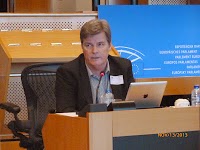
Kevin Fitzpatrick speaking at
the European Parliament

I understand that in just two days time, the Welsh Assembly will debate whether there is support for wider legislation permitting assisted suicide/euthanasia (AS/E). I am writing to you most urgently to ask you to consider how such legislation affects all citizens, but especially disabled people.

There are deep and serious questions when someone says ‘I wish to die’. For example, amongst many factors, the thought can seduce someone in a vulnerable moment. Disabled people know this seduction as well as any.

So our difficulty here is not focused on individual vulnerability - but on the consequences of introducing a law, ‘permitting’ the intervention of any third party into end-of-life decisions. Such laws have the most awful, fatal outcomes for disabled and other vulnerable people. Overwhelming evidence from other jurisdictions, including and particularly Oregon in the context of the proposed legislation, makes that clear

Disabled people are most at risk from this legislation - largely due to discrimination solely on the grounds of disability
Anyone faced with such an end-of-life decision can be ‘vulnerable’. AS/E laws, implemented by practitioners or not, have terminal consequences for vulnerable disabled people.

Friday, December 5, 2014

Nancy Elliott writes to New Jersey Senators concerning assisted suicide.

Dear Senator __________

Nancy Elliott
My name is Nancy Elliott and I am a Team Leader with Euthanasia Prevention Coalition, International. I am a former three term New Hampshire State Representative. I served on the Judiciary Committee, which is where I was first exposed to Assisted Suicide Legislation.

Early this spring our Democrat led House soundly rejected HB1325, a similar bill to yours by a vote of 219 to 66. Many expected this bill to pass, but Legislators, some who thought they were for this bill, became uncomfortable as they were educated in the kinds of harm this legislation could cause.

Many of you have been led to believe that it is imperative that you pass this legislation to help people like the young woman from Oregon who recently took her own life. Her situation was sad, but as legislators, you know that to make laws for a small select few is bad law. While this might help someone face a bleak future, it will hurt many more. We must look at the big picture.

In New Hampshire legislators were particularly concerned with the aspect of Elder Abuse. I am sure you have heard much on this, but the fact is that our bill and A2270 doesn't require a witness at the death. Once the person requests Assisted Suicide, they have put everyone on notice, if anything happens to me, don't ask any questions. If the person is given the lethal dose against their will, who would know. There is no witness at the death. This is a prescription for Elder Abuse especially if the person has money. This troubled our Legislators.

Euthanasia of newborns with disabilities and infanticide.

By Alex Schadenberg
Executive Director - Euthanasia Prevention Coalition

Udo Schuklenk, who was the chair of the one-sided Royal Society of Canada: End of Life Decision Making panel, is now proselytizing his philosophy (or Peter Singer's philosophy) promoting euthanasia of newborns and infanticide. Schuklenk uses quality-of-life arguments to support his eugenic philosophy to encourage the killing of newborns with disabilities.

In an article published in The Journal of Thoracie and Cardiovascular Surgery, titled: Physicians can justifiably euthanize certain severely impaired neonates, Schuklenk argues that some lives are not worth living and that parents should have the right to decide to end the lives of newborns with disabilities. Schuklenk states:
A quality-of-life ethic requires us to focus on a neonate's current and future quality of life as relevant decision-making criteria. We would ask questions such as: Does this baby have capacity for development to an extent that will allow him or her to have a life and not merely be alive? If we reach the conclusion that it would not, we would have reason to conclude that his life is not worth living.
Schuklenk argues that based on a Quality-of-Life Ethic euthanasia of newborns or infanticide is a moral option and in some cases it should be demanded. Schuklenk states:
A quality-of-life proponent could just as well argue that respect for human dignity demands that the infant's life be terminated on compassionate grounds.

Thursday, December 4, 2014

Canadian Senate to debate dangerous euthanasia bill

By Alex Schadenberg
Executive Director, Euthanasia Prevention Coalition


A critique of Canadian Senate Bill S - 225.


Senator Nancy Ruth and Senator Larry Campbell introduced Senate Private Bill S 225, a bill that legalizes euthanasia by lethal injection and assisted suicide by lethal prescription. This bill is based on the private members bills that were introduced by Stephen Fletcher MP earlier this year.

The Euthanasia Prevention Coalition (EPC) welcomes an open debate based on the facts.

Canada has debated euthanasia and assisted suicide on many occasions with the most recent vote in parliament (April 2010) where bill C-384 was defeated by a vote of 228 to 59.


The language of Senate Bill S 225 is intentionally permissive. The bill is designed to protect physicians who act by lethally injecting or assisting the suicide of their patients. It is not designed to protect the patients. 
  • The bill specifically allows euthanasia and assisted suicide for people with disabilities. 
  • The bill allows euthanasia or assisted suicide for "psychological suffering." Psychological suffering is not defined. 
  • The bill is not limited to terminal illness.
  • The bill requires the physician to self report the death after it has already occurred. This assumes that physicians will self-report abuse of the law. Since the patient is dead, when the act is reported, therefore no actual protection exists for the patient.
People with disabilities generally oppose euthanasia and assisted suicide. The Council of Canadians with Disabilities (CCD) intervened at the Supreme Court of Canada case concerning euthanasia and assisted suicide. In its media release CCD spokesperson, Catherine Frazee stated:
In jurisdictions where assisted suicide/euthanasia is legal the leading reasons given for dying are not pain related, but rather “losing dignity and autonomy” and “becoming burdensome for family and friends”. 
To endorse these as valid reasons to die can only reinforce and entrench fear of disability and prejudice about the value of disabled people’s lives
Since bill S 225 does not define "psychological suffering" we must consider how this term has been applied in the Netherlands where euthanasia for psychological suffering already occurs. For instance:
Professor Theo Boer, a 9 year member of a Regional Euthanasia Review Committee in the Netherlands, changed his mind and now opposes euthanasia. In a recent article, Boer stated:
I used to be a supporter of legislation. But now, with twelve years of experience, I take a different view.  
At the very least, wait for an honest and intellectually satisfying analysis of the reasons behind the explosive increase in the numbers. Is it because the law should have had better safeguards? Or is it because the mere existence of such a law is an invitation to see assisted suicide and euthanasia as a normality instead of a last resort? Before those questions are answered, don’t go there. Once the genie is out of the bottle, it is not likely to ever go back in again.
EPC welcomes an open debate on euthanasia and assisted suicide, so long as it is an open debate. Ignoring the facts will be at Canada's peril. 

Links to further information.

Liz Carr: Silent Witness, the Right to Die and the perceived value of people with disabilities

This article is part of the interview by Hannah Dunleavy with disability leader, actress and comedian, Liz Carr, that was published in Standard Issue Magazine on December 3, 2014. 
Liz Carr currently stars in the BBC TV show Silent Witness.

Liz Carr: Not So Silent Witness comments on assisted suicide:

... With Lord Falconer's Assisted Dying Bill at the committee stage, we can’t not talk about this vision of the Right to Die.

“It puts too much power in hands of the medical profession. I’m not religious, I’m not anti-choice. And it’s not that I’m not compassionate, I hope.

“What concerns me are doctors are already a very closed shop. You will find doctors that will help you and doctors who won’t, and that’s happening now. But it will be much harder to challenge.

“Currently, where people have had assistance to end their life, it often will go through the court, so it’s there for people to see what’s going on. And I feel better with those safeguards.

“I fear we’ve so devalued certain groups of people – ill people, disabled people, older people – that I don’t think it’s in their best interests to enshrine in law the right of doctors to kill certain people.

“I think it will begin with terminally ill people and then that definition will widen. It’s not like I think people will be taking granny to the chambers. It’s much more subtle. It’s almost like constructive dismissal where so many things are happening to you – your benefits have been cut, you’re in pain, you’re ill but the home help can’t come anymore. Or your family are tired from looking after you and you don’t want to see them suffer. There are so many reasons that all come together. For some people, if we put in the right supports, would they still want to die?

Liz Carr as Clarissa Mullery in Silent Witness
"The phrase dying with dignity has been synonymous with the people who support this legislation. I don’t want people to die in pain or without dignity, I think people can have that with decent healthcare and medical care, where we plough money into palliative care.

“Hospices aren’t government funded they’re privately funded and we need to look at that and giving people the choice to die how they want. And if there’s still a group of people who aren’t happy, then we ask ‘are we in a position to provide for that?’”

Monday, December 1, 2014

Euthanasia & Assisted Suicide: 20 most read blog articles.


2. Euthanasia is out-of-control in the Netherlands – September 25, 2012.


3. Declaration of Hope – January 17, 2013.

4. Belgian twins euthanized out of fear of blindness – January 14, 2013.

5. Petition: Stop euthanasia Bill 52 in Quebec – May 24, 2014

6. Nitschke continues to promote Nembutal sales over the internet – June 22, 2010.

7. 5 reasons why people devalue the elderly – May 25, 2010.

8. Depressed Belgian woman dies by Euthanasia – February 6, 2013.

9. Dutch ethicist changed his mind - Assisted Suicide: Dont Go There - July 16, 2014.

10. Trisomy 18 is not a Death Sentence. The story of Lilliana Dennis – May 29, 2012.


11. Québec's euthanasia Bill 52 is lethal - December 12, 2013.

12. Dr Phil show: Woman wants to euthanize her adult children with disabilities – April 16, 2012.


13. Botched sex-change operation victim euthanized in Belgium – October 1, 2013.

14. Hassan Rasouli to be transferred from Sunnybrook hospital - January 6, 2014.

15. Belgium study finds that nearly half of all euthanasia deaths are not reported – December 4, 2010.

16. Mild stroke led to mother’s forced death by dehydration – September 27, 2011.

17. Elder abuse caught on video, incident is not isolated - May 22, 2013.

18. Oregon 2012 Assisted Suicide report - January 24, 2013.

19. Oregon suicide rate soars after legalizing assisted suicide - September 12, 2010.


20. Belgian woman with Anorexia Nervosa dies by euthanasia – February 10, 2013.


Other important articles:

Assisted suicide 'a stepping stone'

This article was published on December 1 in New Zealand by Stuff media.

By Renee Joubert

I know first-hand how painful it is to watch a loved one deteriorate and die.

However, I feel frustrated by the emphasis the current assisted suicide debate puts on the terminally ill.

Rhetoric about how the terminally ill need assisted dying is only a way to manipulate our emotions and soften up society for the real agenda: legal assisted suicide for everyone. The pro-euthanasia lobby wants suicide to be regarded as normal, acceptable and rational. Their only objection is that "suicide is violent" - not that it's to be prevented and discouraged in principle. In fact, it should be facilitated for anyone who "wants to die".

Recently euthanasia advocate Philip Nitschke appealed his medical deregistration in response to his involvement in the suicide of a 45-year old depressed but healthy man. Nitschke's lawyer said in his opening address, the case was about "the dangerous idea [of] whether a person who is contemplating rational suicide ought to be required by a medical doctor not to do so".

He implied that if a person had a good reason to want to die, a doctor should not intervene.

Dutch doctors to approve organ donation euthanasia

This article was published on December 1 by Mercatornet on their Careful blog.

By Michael Cook

Doctors in the Netherlands are working on a scheme to increase the number of life-saving organs available for transplant – by harvesting them from people who want to be euthanased.

Erasmus Medical Centre in Rotterdam and the University Hospital of Maastricht have already written national guidelines which are being studied by the Dutch Transplant Foundation.

If the procedures are approved, they would be binding on hospitals and doctors throughout the country.

Spurring on this study is the feeling among transplant surgeons that healthy organs are sometimes wasted when patients are euthanased. In the words of a medical ethics expert with the Royal Dutch Medical Association (KNMG), Gert van Dijk, “An estimated 5 to 10% of people who are euthanased could be considered for organ donation. Five percent does not seem like much, but this still means 250 to 500 potential organ donors every year.” He believes that Dutch doctors could even double the number of organs available for life-saving procedures.

Commercial Assisted Suicide Industry

This article was published on National Review Online on November 30, 2014.


By Wesley Smith

Wesley Smith
Human logic goes where our first principles and fundamental premises take it.

Assisted suicide’s core premise is that being killed to stop suffering is a fundamental human right. In other words, terminal illness may sometimes be potically expedient entry point to euthanasialand, but it isn’t the point of legalization.

And now, in the journal Bioethics, bioethicist Roland Kipke argues that if assisted suicide is a right of autonomy, we should permit entrepreneurs to go into the business of making people painlessly dead, what he calls “commercially-assisted suicide” (CAS). From, “Why Not Commercial Assistance for Suicide?”:

‘CAS’ means that persons who wish to commit suicide are supported in a businesslike fashion, for remuneration. In the majority of cases, the core of this support might consist in providing a lethal dose of a drug to enable the person to kill herself. Furthermore, the assistance can consist of counselling, accompanying the suicidal person during the dying process, and further services connected with the suicide. 
‘Businesslike’ means that the suicide assistants intend to provide their service on a continuing basis and to earn (a part of) their livelihood from it. CAS, as it is understood here, is, therefore, not a one-off act and it is not (only) done as a favour…However, as it is understood here, CAS is only provided by non-physicians.
This isn’t a new idea.

Sunday, November 30, 2014

Assisted suicide is about disability-phobia, not "choice" or "dignity."

This letter was published in the Norwich Bulletin (Connecticut) on November 16, 2014
Regarding your Nov. 6 editorial, "Terminally ill deserve a choice," safeguards in legislation are hollow and cannot be fixed. The Public Health Committee rejected two bills similar to Oregon's "Death With Dignity Act" allowing an heir and the heir's close friend to testify about the dispensing of the prescription and no witnesses at the death — a prescription for elder abuse. 
Other problems include misdiagnosis and incorrect prognosis, the deadly mix with a broken cost-cutting health care system where suicide becomes the cheapest "treatment," falsification of death certificates, suicide contagion and disability discrimination in suicide prevention. Every progressive national disability-rights organization that has taken a position strongly opposes the legalization of assisted suicide. 
Voters are also rejecting assisted suicide legislation and candidates who support it. State Rep. Betsy Ritter, the lead supporter of assisted suicide in the Legislature, lost her state Senate bid by a significant margin. Lead proponents were defeated in Vermont and New Hampshire. Two years ago, Massachusetts voters had second thoughts, rejecting a ballot measure to legalize assisted suicide. 
Assisted suicide is about disability-phobia, not "choice" or "dignity." Real choice means improved palliative care, hospice and home care so no one is driven toward suicide. 
Stephen Mendelsohn
New Britain
Stephen Mendelsohn is a member of the disability rights group - Second Thoughts Connecticut.

Friday, November 28, 2014

New Scientific discovery: Pain can be "turned-off"

By Alex Schadenberg
Executive Director - Euthanasia Prevention Coalition

Alex Schadenberg
Most people recognize that legalizing euthanasia or assisted suicide will lead to abuse with some people dying without request or being coerced into euthanasia, with support for euthanasia based on the fear of living with uncontrolled pain. The control of pain has significantly improved since the late 1960's when Cicely Saunders began to develop modern hospice techniques in the UK.

On November 26, Science Daily reported on a great new scientific discovery concerning the control of pain. Researchers at the St Louis University Medical Center published results of research in the medical journal Brain showing that the researchers may have found a way to block pain pathways which could lead to the effective control of neuropathic pain. Neuropathic pain is usually what has developed when people have uncontrolled pain.

Science daily reported that there may be an "off switch" for pain:

Saint Louis University researcher Daniela Salvemini, Ph.D. and colleagues within SLU, the National Institutes of Health (NIH) and other academic institutions have discovered a way to block a pain pathway in animal models of chronic neuropathic pain including pain caused by chemotherapeutic agents and bone cancer pain suggesting a promising new approach to pain relief. 
The scientific efforts ... demonstrated that turning on a receptor in the brain and spinal cord counteracts chronic nerve pain in male and female rodents. Activating the A3 receptor -- either by its native chemical stimulator, the small molecule adenosine, or by powerful synthetic small molecule drugs invented at the NIH -- prevents or reverses pain that develops slowly from nerve damage without causing analgesic tolerance or intrinsic reward (unlike opioids).
This research offers hope for people who are living with chronic pain or pain that has developed while receiving treatment for cancer.

Assisted Suicide lobby used Brittany Maynard to dupe people into signing online assisted suicide petition

By Alex Schadenberg
Executive Director - Euthanasia Prevention Coalition

Katie Buck from Iowa signed an online sympathy card connected to the Brittany Maynard website without knowing that her name would be used by Compassion and Choices, an assisted suicide lobby group, to lobby for the legalization of assisted suicide in her state.

Katie produced a video to explain what happened to her and to urge Americans to be aware of how the assisted suicide lobby launched a petition without choice. Katie's video: A Petition Without Choices.


Katie wrote:
The organization called Compassion and Choices used an online sympathy card to steal the names of people all over America to use for their petition to legalize assisted suicide. This video contains undercover proof linking the sympathy card and the petition
***UPDATE*** Now that Brittany has passed away, the "sympathy card" has been replaced with a "condolences card" for her family. I have confirmed this "condolences card" will also get you on their petition. I have undercover proof of this as well. Stay tuned for more information!
Compassion and Choices is obviously not about choices.

Euthanasia / Organ Harvesting spreads to the Netherlands

This article was originally published on Wesley Smith's blog on November 26, 2014.

Wesley Smith
By Wesley Smith

So, this is where euthanasia leads, and how its values spread like a virus.

Belgium permits euthanasia to be combined with organ harvesting.

That odious couplng has now apparently spread to the Netherlands, where Dickey Ringeling, age 61, came down with a serious case of MS. Rather than live with her disabling difficulties, she wanted be killed and harvested for her organs. And so it came to pass.

A newspaper there reports the story and calls her “a heroine.” From “MS Patient Saves Lives of Five People,” published Dageli Ikse Standard (Google translation):

Ringeling’s course [made her] a real heroine. Patients who received her organs should for her life be grateful.

Wednesday, November 26, 2014

Euthanasia and Organ Donation in the Netherlands.

By Alex Schadenberg
International Chair - Euthanasia Prevention Coalition

Alex Schadenberg
For the past few years doctors in Belgium have linked organ donation to euthanasia. Now the Dutch media has reported that Edith Schippers, the Dutch Minister of Public Health supports the practice of euthanasia/organ donation.

The media report stated:

Minister Edith Schippers of Public Health is working on a protocol to guide people who want to donate organs after their euthanasia. 
This means, for example, that they will not be able to die at home, but will have to die in the hospital. The doctor should also perform the euthanasia in the hospital. The guidelines established for this is a practical implementation of laws, said Schippers. The first version of the guidelines was written by the Rotterdam Erasmus MC and the University Hospital of Maastricht (MUMC).
Euthanasia/organ donation can become a form of coercion to die by euthanasia.

It is one thing to kill someone as a false means to a "good death," it is another thing to kill someone to improve public health.

Euthanasia/Organ Donation can coerce people with disabilities who are not terminally ill to die by euthanasia. Studies in Belgium indicate that people who have neurological conditions, mental or psychological issues or dementia make excellent organ donors, especially when linked to euthanasia because the organs are healthier than those from people who were terminally ill or nearing death.

Combining euthanasia with Organ Donation will cause fear that physicians will become willing to kill a person for their healthy organs.

Tuesday, November 25, 2014

Media seem indifferent to euthanasia-victimized families

This article was published by Wesley Smith on his blog on November 23, 2014.

Wesley Smith
By Wesley Smith

Imagine you are at work, going about your day. The phone rings. You pick up and it is a mortuary informing you they have your mother's body.
"What do you mean you have my mother's body!" you exclaim in utter shock. 
"She was just euthanized today," the voice on the other end mildly answers. "What should we do with the body?"
That is exactly what happened in 2012 to Belgian chemist Tom Mortier, who spoke (via Skype) at the very well attended East Coast Conference Against Assisted Suicide. 

A self-described secular humanist, he described his agony at the euthanasia killing of his depressed mother, Godelieva De Troyer, by an oncologist. His continuing pain was vivid in every word he spoke.

You might assume that since De Troyer was killed by an oncologist, she had terminal cancer. Wrong. She was a cancer patient but knew she was cancer free at the time of her death.

But she did have chronic depression. She was killed without any notice to her son.

And here's the kicker: What I didn't know -- and it made my jaw drop -- was that Mortier's mother willed her body to science, as a result of which, he was forced to deliver his mother for dissection and experimentation to the very hospital at which she had been killed.

Maggie Karner urges fearless debate on assisted suicide.

By Ellen Kolb

I doubt that Maggie Karner rang in the new year thinking she was going to be asked to speak at a conference against assisted suicide. She probably didn’t foresee the suicide of Brittany Maynard or the very well-publicized media campaign that went along with it. She certainly didn’t expect to be diagnosed with a brain tumor. Yet there she was in front of me at the recent East Coast Conference Against Assisted Suicide, speaking quietly but without hesitation.

She’s as compelling a speaker in person as she is in her now-famous video message to Maynard, made in an unsuccessful attempt to dissuade Maynard from suicide. As conference host Alex Schadenberg from the Euthanasia Prevention Coalition said after her presentation, “Maggie is a gift for us.” That “us” goes far beyond the people who were in the room at the time.

“I’m no expert. Just me.”

Maggie Karner (East Coast Conference)
Self-effacing but not shy, Karner began by advising her listeners at the conference, “I’m no expert. Just me.” She was diagnosed in April with glioblastoma, the same type of brain tumor that beset Brittany Maynard. She recorded her video message to Maynard with that common experience in mind. She found after her video went viral that her cancer was the one thing some news reporters found relevant in her message.

She described a recent interview she did via Skype with a news outlet in Bogota, Columbia. 
“It turned out to be an informal debate, and they didn’t tell me that. On the air with me was the communications director for Compassion and Choices [the pro-assisted-suicide group], who spoke Spanish, of course. I don’t. And a pro-euthanasia doctor from Miami, who also spoke Spanish. So I’m the only white gringo there who didn’t speak Spanish. One thing the producers and editors all mentioned was that they wanted to interview me because I had the same terminal brain cancer diagnosis [as Maynard], and apparently that made me qualified to speak on this topic of physician-assisted suicide. I guess they were looking for that emotional right hook as the media is wont to do. 
“But that left me wondering, does that mean that anyone without a terminal diagnosis can’t express their opinion on assisted suicide? Even after all the TV interviews and YouTube hits on the video to Brittany, I still got lots and lots of tweets and comments that basically said ‘who are you to judge her?’ Even with my brain tumor qualifications. So I guess that’s what our post-modern society has left us now: if you have an opinion on something, apparently you are judging the people who have a different opinion, and [I should] just shut up.’ What happened to the great free American marketplace of ideas? What happens to vigorous scholarly debate with issues that affect our whole society? I guess you can only have an opinion on something now if you’ve lived through it, felt its wrath, or walked in its shoes. Because it’s all about feelings. If you have evidence on the positives or negatives of something, that apparently doesn’t matter. The only thing that matters is how you feel about the issue and whether people like how you said it.”
“It’s a public policy issue”

Monday, November 24, 2014

Wesley Smith: Assisted Suicide causes PTSD

This article was written by Wesley Smith and published on his blog on November 24, 2014.

By Wesley Smith

Wesley Smith
A study in European Psychiatry shows that 20% of close friends or family who witness assisted suicide develop post traumatic stress disorder (PTSD). From the study:
Of the 85 participants, 13% met the criteria for full PTSD (cut-off≥35), 6.5% met the criteria for subthreshold PTSD (cut-off≥25), and 4.9% met the criteria for complicated grief. The prevalence of depression was 16%; the prevalence of anxiety was 6%. 
CONCLUSION: A higher prevalence of PTSD and depression was found in the present sample than has been reported for the Swiss population in general. However, the prevalence of complicated grief in the sample was comparable to that reported for the general Swiss population. Therefore, although there seemed to be no complications in the grief process, about 20% of respondents experienced full or subthreshold PTSD related to the loss of a close person through assisted suicide.
By way of comparison: 11 percent of American soldiers serving in Afghanistan have PTSD, and 20% of Iraq veterans. So, witnessing assisted suicide would appear to be equivalent in upset to serving in war zones. Perhaps that will give the suicidal pause before they order the pills.

Of course, the suicide pushers at Compassion and Choices aren’t bothered in the least, sending “counselors” to give advice in many cases. Indeed, C & C acts as death matchmaker or otherwise helps facilitate more than 80% of all assisted suicides in Oregon.

But, you know, normal people react to the awful nature of what is done. That’s healthy, and as I said, in an ironic way, perhaps a cause for hope that the death tide will ebb.

Facts on the ground prove a slippery slope is here.

Published by True Dignity Vermont on November 24, 2014

“You don’t see people marching in the street demanding the right to be killed by a doctor,” Attorney and Award winning Author Wesley J. Smith told a packed conference room at Saturday’s East Coast Conference Against Assisted Suicide in Hartford, Conn., coordinated by the Family Institute of Connecticut and the Euthanasia Prevention Coalition.

“Suicide pushers are a small group. We look like America, they don’t,” Smith emphasized.

T
Wesley Smith
he “we” to whom Smith referred, are essentially anyone for whom legally sanctioned, assisted suicide poses a very real risk. The elderly, the frail, the mentally ill, those who face serious illness or disability of any kind– all eventually may be judged as “better off dead” in a culture where the solution to suffering is to kill the sufferer, Smith told the audience.

“We’re not talking about a theoretical slippery slope, we’re talking facts on the ground,” he said.
Yet, despite their small numbers, the persistent efforts of the “suicide pushers” to pass legislation to allow doctors to help patients kill themselves have begun to change the national consciousness about suffering and perhaps more significantly, about those who suffer. The exploitation in recent weeks of Brittany Maynard by Compassion and Choices, formerly the Hemlock Society, has catapulted the topic into the headlines and onto social media, putting a sympathetic, but deceptive face on the realities of legalized assisted suicide.

Saturday, November 22, 2014

Assisted suicide opponents meet in Connecticut

By Alex Schadenberg 
International Chair - Euthanasia Prevention Coalition

(right side of the room)
The Associated Press reported on the East Coast Conference Against Assisted Suicide today.

The Associated Press reported that:

Organizers say about 140 people have turned today for conference on assisted suicide. 
The two-day event, dubbed East Coast Against Assisted Suicide, was wrapping up on Saturday in Windsor Locks. It was sponsored by several groups that oppose legalizing the practice, including the Connecticut-based Family Institute of Connecticut and Second Thoughts Connecticut. 
Other sponsors included the Euthanasia Prevention Coalition and Second Thoughts Massachusetts. 
Speakers include experts from the region and around the world who oppose assisted suicide legislation in the U.S., particularly the East Coast. 
Last year marked the second straight year that a Connecticut legislative committee held a public hearing on legislation allowing physicians to prescribe medication to help terminally ill patients end their lives. The bill was not brought up for a vote.
The East Coast Conference Against Assisted Suicide was an incredible success. It was organized to train people from all political and social points of view to understand the issues related to assisted suicide and to effectively oppose it in their state.
to
Read more here: http://www.mercedsunstar.com/living/health-fitness/article4064655.html#storylink=cpy

Thursday, November 20, 2014

New Jersey Governor Chris Christie may need to Veto assisted suicide bill

By Alex Schadenberg
International Chair - Euthanasia Prevention Coalition

Sign the petition urging New Jersey Governor Chris Christie to veto the assisted suicide bill.

Governor Chris Christie
It seems likely that New Jersey Governor Chris Christie may need to veto the State assisted suicide bill. 


The media has reported that Stephen Sweeney (D), the President of the New Jersey State Senate, has agreed to be the primary sponsor for New Jersey Senate Assisted Suicide Bill 382, after Joseph Vitale (D) withdrew his sponsorship of the assisted suicide bill.

Vitale, the Chairman of the State Senate Health Committee, told the New Jersey media:
“I initially supported the idea of the bill and signed on. After a time, I had more questions and concerns than answers. So I thought it was honest to remove my name and continue to think about it.”
On November 13, the New Jersey State Assembly passed the assisted suicide bill A 2270 by a vote of 41 to 31 after pushing for a quick vote on the bill while the Brittany Maynard story was fresh in the minds of the state legislators.

New Jersey citizens are urged to contact their State Senators to defeat the assisted suicide bill.

Everyone can sign the petition urging New Jersey Governor Chris Christie to veto the assisted suicide bill.


Links to more information: